Wednesday, March 15, 2023

ChatGPT 4: Watch, As It Offers Advice to Genomic Lab CEO's

This blog discusses ways that ChatGPT 4 can provide initial overviews of customer problems in technology industries (example: genomic tests), and lay out a starting-point road map to solutions.

##

Brief History

I enjoy consulting with cutting-edge technologies, close to the "bleeding edge" - their "XYZ" has not been done before.  

The deal is, for better and for worse, my mindset often works like it did for Zoom and video:  Back when we were thrown into COVID world, I got intrigued with how video conference worked.  And pulling on that thread, I gradually got involved in lighting and cameras and mic's and green screens, and then video editing.   

Continuing my exploration phase with Chat GPT, which began a few weeks ago, I just saw an example of using ChatGPT to think about business design problems.  This led me to try a genomic testing example. Find both below.

The Input:  Peter Sena's Use-Case Article about Chat and Design

I ran across a new article by Peter Sena, a design expert.   He showed how he used ChatGPT queries, correctly constructed, to lay out roadmaps of customer insights - in his words, "85% correct."   Peter Sena's article is here:

https://uxdesign.cc/how-chatgpt-made-me-realize-where-bad-design-comes-from-8006e24f4697

Sena figured out how to use ChatGPT input like this:

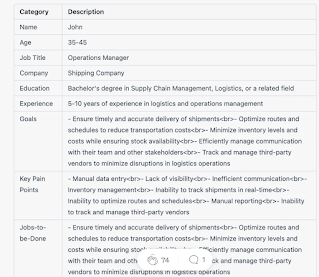
Act like a marketing manager and create a customer avatar of an operations manager. Describe the customer avatar of an operations manager and what are their key pain points pertaining to shipping manifests, logistics, and jobs to be done. Format in a table.

The result looks like this.  (See full article above for more details and examples).

I could end this blog here, and say, "A person could probaby figure out some way to map this onto biotech or genomic testing."   But with a few minutes thought, I came up with an approach.

The Output: Playing with AI

Biotech CEO Example:

I am a strategic advisor to CEO's of biotechnology companies that develop genomic tests.  I have been asked to provide strategic advice to the CEO of a genomic test company that has just raised Series A funding of $10M.   The CEO is a new hire and is new to the genomic test industry, although he has worked in the life sciences medtech area for 15 years.  Provide me a table of the pain points the CEO is most likely to be worried about, and a brief description of how I may help him with each pain point.  I expect the table to have about 7 to 10 pain points and briefly describe ways to help that pain point using my years of experience working with many startup genomic test laboratories. 

Answer:

Pain PointDescriptionHow I Can Help
1. Regulatory ComplianceNavigating complex regulations and certification requirements for genomic testsShare my experience in managing regulatory processes and suggest best practices
2. Market PenetrationEstablishing a foothold in the competitive genomic testing marketLeverage my network and knowledge of the industry to identify potential partnerships
3. Technology DevelopmentEnsuring the development of cutting-edge genomic tests that are both accurate and cost-effectiveOffer guidance on R&D investments and keeping up with emerging technologies
4. Reimbursement StrategiesSecuring favorable reimbursement rates from payers, such as insurance companiesAdvise on strategies to demonstrate the value of genomic tests to payers and providers
5. Sales & MarketingCreating and executing effective sales and marketing strategies for the company's productsProvide insights on targeting the right customer segments and crafting compelling messages
6. Intellectual Property ProtectionSafeguarding the company's proprietary technologies and know-howHelp develop a robust IP strategy to protect and maximize the value of the company's assets
7. Talent Acquisition & RetentionAttracting and retaining top talent in the competitive biotech spaceShare best practices for creating a positive company culture and competitive compensation
8. Supply Chain ManagementEnsuring a reliable and cost-effective supply chain for the company's products and servicesOffer advice on selecting and managing suppliers and optimizing inventory management
9. Quality ManagementMaintaining high quality standards in genomic testing processesSuggest quality management systems and processes based on my experience with other startups
10. Financial PlanningManaging the company's financial resources to ensure long-term successProvide guidance on budget allocation, fundraising strategies, and risk management

 Let's try one more example, push it a little further.

Please expand on Topic 4, Reimbursement Strategies.  

Please provide 5 to 10 aspects of this problem area, and examples of ways I can help with each.  Assume that both you and I are highly experienced consultants in the field of genomic test reimbursement strategies.


AspectDescriptionHow I Can Help
1. Payer NegotiationBuilding relationships with payers and negotiating favorable reimbursement ratesShare my experience in successful payer negotiations, helping the CEO understand their priorities and decision-making process
2. Clinical UtilityDemonstrating the clinical utility of the genomic test to justify reimbursementAdvise on the design and execution of clinical studies to generate strong evidence supporting the test's utility
3. Cost-EffectivenessShowcasing the cost-effectiveness of the genomic test in comparison to alternative diagnostic methodsHelp the CEO develop and present a solid cost-effectiveness analysis to payers and other stakeholders
4. Coding and BillingEnsuring accurate coding and billing practices for the genomic test to avoid reimbursement denialsOffer guidance on best practices for coding, billing, and documentation, leveraging my knowledge of payer requirements
5. Health Economics and Outcomes Research (HEOR)Conducting HEOR studies to support the value of the genomic test in real-world settingsProvide insights on the design of HEOR studies, including appropriate endpoints and methodologies for data collection
6. Market Access StrategyDeveloping a comprehensive market access strategy to optimize reimbursement and adoptionCollaborate with the CEO to create a tailored market access plan, accounting for the unique challenges and opportunities
7. Value PropositionCrafting a compelling value proposition for payers, healthcare providers, and patientsAssist in refining the company's messaging to clearly communicate the benefits and value of the genomic test
8. Reimbursement Landscape MonitoringKeeping abreast of the ever-changing reimbursement landscape and adapting strategies accordinglyLeverage my industry knowledge and connections to keep the CEO informed of relevant policy changes and market trends
9. Patient Access ProgramsImplementing patient access programs to provide the genomic test to patients with limited or no insurance coverageAdvise on the design and implementation of patient access programs that align with the company's goals and resources
10. Stakeholder EngagementEngaging key stakeholders, including healthcare providers, patient advocacy groups, and policymakers, to support reimbursement effortsShare my experience in building strong stakeholder relationships and coalitions to advocate for the genomic test's value
Tag:  "As highly experienced consultants in the field of genomic test reimbursement strategies, we can provide valuable insights and guidance to the CEO in addressing these aspects of the problem area. Our industry knowledge, network, and understanding of best practices can be leveraged to ensure successful reimbursement and market access for the company's genomic test."


I agree this is a very good listing of ten relevant considerations for reimbursement from insurance.   In addition, however, you have listed 10 factors that are pretty familiar to experts in the field. 

On the topic of reimbursement from insurance for genetic testing, can you offer any more creative or "out of the box" ideas for the CEO to consider?

I appreciate your feedback and understand the need for more creative and "out of the box" ideas. Here are five additional reimbursement considerations that may not be as familiar to experts in the field:

AspectDescriptionHow I Can Help
11. Data MonetizationExploring alternative revenue streams by monetizing the genomic data generated through testingAdvise on potential partnerships, data sharing agreements, or data marketplace opportunities to create additional revenue
12. Risk-Sharing AgreementsImplementing risk-sharing agreements with payers to align incentives and share the financial risk associated with genomic testingHelp the CEO develop and negotiate creative risk-sharing agreements that provide mutual benefits to both the company and payers
13. Personalized Reimbursement ApproachesDeveloping tailored reimbursement strategies that take into account patients' financial situations and insurance coverageExplore innovative pricing models, such as income-based pricing or tiered pricing, to ensure broader access to genomic tests
14. Direct-to-Consumer ModelsConsidering a direct-to-consumer (DTC) model that bypasses traditional healthcare providers and engages patients directlyAssess the feasibility of a DTC model and help the CEO navigate regulatory, marketing, and operational challenges
15. Collaborative Research InitiativesEngaging in collaborative research initiatives with academic institutions, healthcare providers, or other industry stakeholdersIdentify potential research collaborations that could yield additional evidence for reimbursement and foster strategic alliances

These creative approaches to reimbursement can help the CEO differentiate their genomic testing company and tap into novel opportunities within the industry. Combining these ideas with the initial ten reimbursement considerations will provide a comprehensive and innovative strategy for securing insurance coverage for the genomic tests.


Bonus:  Offer me some Tweets to advertise these services to this audience.
  • "Navigating the genomic testing landscape can be challenging. Let our expert guidance help you overcome regulatory hurdles and secure favorable reimbursement rates. Connect with us today!" #GenomicTesting #ReimbursementStrategy  

  • "Are you a genomic test CEO looking to accelerate market access for your cutting-edge products? Our specialized consulting services can help! Reach out to discuss how we can elevate your company." #GenomicTestCEO #MarketAccess  

  • "Unlock the potential of your genomic testing startup with expert advice from seasoned industry consultants. We're here to help with reimbursement strategies, market access, and more. Get in touch!" #GenomicStartup #Reimbursement  
Bonus 2:

The CEO reimbursement advice translated into "Pirate" and "German."  Here.

Bonus 3:

For a similar article in which ChatGPT 4 plays a Medicare lobbyist with a challenge, here.

Friday, March 10, 2023

Brief Blog: Where to Find It: HHS Budget for FY2024 (169pp)

Each spring, the White House releases budget recommendations and plans for the government agencies, and by fall, it's up to Congress to decide what the appropriations laws will actually be.   

(For example, the President can "announce" a tax on billionaires, but it's entirely up to the Hill to actually pass it.)

Here's the 2024 executive branch budget proposal for HHS:

https://www.hhs.gov/sites/default/files/fy-2024-budget-in-brief.pdf


The HHS summary press release is here.

Medicare starts at page 66 (PDF page 62). While CMS isn't directly involved in Cancer Moonshot, page 75 aims to amp-up quality measures in oncology.  On the CMMI side, a diabetes prevention program has been on extended status as a pilot program, but would be made permanent, just like any other benefit.  A judicial proposal would allow more appeals (ALJ system) to be "on the record" rather than court.   Medicare would be part of a national program to "eliminate hepatitis C" in as much as these drugs would be copay-free.
click to enlarge


Very Brief Blog: Silicon Valley Bank's Last Health Industry Innovation Reports

With the implosion of Silicon Valley Bank, I tracked down the link to their most recent health and life sciences innovation reports - for CY2022.  

In the past, fond memories of presentations of these reports year by year by SVB experts speaking at conferences.  John Norris - SVB Healthcare Lead - had a January 2023, 3 minute. intro/teaser video on YouTube for the 42-page CY2022 report, here.

See the home page for SVB reports:

https://www.svb.com/trends-insights/signature-research

(Click on the tab, Healthcare).

SVB/Healthcare Investments 2022 is a PDF of 42 pages, data-packed and well illustrated.

At the same page, HealthTech Innovation 2022 leads to a web-only view, slide by slide, with similar insights and data.

For more on SVB, see Foley Hoag here, Fierce Healthcare here.

SVP slide deck here.  January earnings call here.


March 22 Webinar: Use Genetics to Achieve Healthcare "Quadruple Goals"

Here's a catchy title, for sure;  "Use Genetics Services to Improve Each Aspect of your Quadruple Aim Goals."

The webinar has open registration and will be held March 22, 2023, from 1-2 eastern time.   The speakers are from Genome Medical,  Steve Bleyl (Chief Medical Officer), Colleen Caleshu (Sr Director, Clinical Research), and Erica Ramos (VP of Medical & Scientific Affairs).

Find the link and registration here:

https://www.fiercehealthcare.com/premium/webinar/using-genetic-services-improve-each-aspect-your-quadruple-aim-goals

Collateral text includes:

Genomic medicine and genetic testing have experienced tremendous growth in recent years driven in part by the impact they have on care delivery and patient health as well as the growth of telehealth service delivery.

  • Attendees will learn how genetic services can help their health system by:
  • Enhancing patient experience/satisfaction, leading to a >95% patient satisfaction rate 
  • Improving population health, with research that shows how clinically validated digital patient engagement solutions support population risk assessment
  • Managing costs, with insights into how early identification of health risks can help providers and health systems reduce costs and proactively support their patients in their healthcare journey.
  • Mitigating/reducing clinician burnout, with discussion of research and in-clinic experience that highlight how partnering for genetic services can help ease workload burdens for providers.


Journal Club: The Health Affairs "Value Report 2023" and the Forbes Summary Series (Bill Frist)

A good source for tracking current thinking in the much touted "value in health care" effort is a major white paper at Health Affairs. It's available in 16 page and in 54 page versions.

Meanwhile, it's been summarized in 4 articles at Forbes online.  These are bylined by Bill Frist - the Bill Frist, the former senator.  Frist also has an excellent weekly podcast where he interviews top leaders in healthcare.

Where to Find It

  • Find the home page for the Health Affairs project here.
    • Find the 16 page summary here.
    • Find the full 54-page report here.
  • Find the Forbes four-part series by Frist, summarizing the above and adding context.
Below, I've clipped a ChatGPT AI summary of the 4 Forbes/Frist articles.  I've also included the more detailed ChatGPT summary of each article, one at a time, further below.


##

 CHAT GPT AI Summary of the 4 Forbes/Frist Articles

The Health Affairs Council on Health Care Spending and Value has released its report, "A Road Map for Action," aimed at slowing down the growth of healthcare spending and maximizing value. The report focuses on four priority areas: 

  • Administrative streamlining, 
  • Price regulation and supports for competition, 
  • Spending growth targets, and 
  • Value-based payment. 
The report recommends streamlining processes in high-cost areas such as provider directories, credentialing, claims processing, and prior authorization. The report also calls for the harmonization of quality measures to reduce the excessive and duplicative array of metrics providers are required to capture. 

In terms of price regulation, the Council made four recommendations, including increased state and federal monitoring of market competitiveness and limited price regulation in markets that cannot be competitive. The Council also investigated the use of state-set spending growth targets and encouraged state action, with federal support, to control healthcare spending growth. On value-based healthcare models, the council recommends fewer models, stronger incentives for patients, increased levels of financial and clinical risk for payers, and exploring incentives for addressing non-medical determinants of health. Companies like Monogram Health and MDsave are leading the charge in value-based care and improving patient outcomes while reducing costs.

 (The above is a machine generated summary in 200 words of the 4 Frist articles, about 6000 words).

###

Chat GPT / Article 1.  Administrative Waste.

The Health Affairs Council on Health Care Spending and Value has released its report, "A Road Map for Action," which is the result of four years of research and collaboration between 21 healthcare experts. The report focuses on ways to slow down the growth of healthcare spending and maximize value. The four priority areas identified in the report include administrative streamlining, price regulation and supports for competition, spending growth targets, and value-based payment. The report recommends streamlining processes in high-cost areas such as provider directories, credentialing, claims processing, and prior authorization. Additionally, the report also calls for the harmonization of quality measures to reduce the excessive and duplicative array of metrics providers are required to capture. The report is intended to serve as a guide for policymakers, regulators, and healthcare executives to improve efficiencies and productivity within the healthcare sector.

 Chat GPT / Article 2. Price Regulation, Competition.

The US spends more per capita on health care than any other country due to high private-sector prices. This is a result of several factors, such as large scale industry consolidation, lack of price transparency, and misaligned payment incentives. To address this issue, the Health Affairs Council on Health Care Spending and Value focused on two priorities: improving competition and supplementing with regulation where necessary. The Council made four recommendations, including increased state and federal monitoring of market competitiveness, limited price regulation in markets that cannot be competitive, conditional price regulation in markets that could be competitive, and additional support for competition in markets that are already competitive. These recommendations aim to improve health and equity outcomes by making health care services more accessible and affordable. Companies like MDsave are leading the charge in prioritizing accessibility, affordability, and transparency.

 Chat GPT / Article 3.  Spending Targets.

The Health Affairs Council on Health Care Spending and Value investigated the use of state-set spending growth targets as a way to control health care spending. Two states, Maryland and Massachusetts, have been leaders in this area. Maryland established all-payer rate-setting for hospital payments in the 1970s and evolved to a global hospital budget in 2014, known as the Maryland All-Payer Model, which has demonstrated slower growth in Medicare expenditures and savings of nearly $1 billion to Medicare. Massachusetts established the Health Policy Commission in 2012 to keep its health care spending in line with its overall economic growth, and sets an annual health care cost growth benchmark. The Council encouraged this type of state action, with federal support, to control health care spending growth. However, a minority report expressed concerns about the approach and recommended waiting for more data before encouraging all 50 states to participate.

 Chat GPT / Article 4.  Value-based Payment [elastic payments].

Value-based healthcare models aim to improve healthcare outcomes while reducing costs. These models prioritize quality over quantity and come in various forms such as bundled payments, accountable care organizations, and capitation. However, the results from implementing these models have been modest, with limited data available to track progress or best practices. CMS believes that the current approach to value-based payment is overly complex and needs to be retooled. The Health Affairs Council on Health Care Spending and Value believes that the lack of savings could be due to design and implementation challenges that need further examination. The council recommends fewer models, stronger incentives for patients, increased levels of financial and clinical risk for payers, and exploring incentives for addressing non-medical determinants of health. Companies like Monogram Health are leading the way in value-based care and are making treatment more affordable while prioritizing patient experience. The potential for value-based payment models is immense and has the potential to drive down the overall costs of healthcare while improving patient outcomes.


In the podcast series, of particular interest is #199, Dr Marc Harrison, former CEO of Intermountain Healthcare, on his inspiring career and leadership style, as well as, his personal battle with multiple myeloma including stem cell transplant (failed) and CAR-T therapy.

##

Bonus.  Just for fun, I also asked ChatGPT for tweet ideas for this blog itself.

  1. "Healthcare reform starts with understanding the problem. Read my latest blog on the #HealthAffairsCouncil report on controlling healthcare spending and maximizing value. #HealthPolicy #ValueBasedCare"
  2. "Want to drive down healthcare costs while improving outcomes? Learn about the 4 priority areas outlined in the #HealthAffairsCouncil report and see how we can make change. #ValueBasedPayment #HealthPolicy"
  3. "Join the movement towards a more efficient and productive healthcare sector. Read my thoughts on the #HealthAffairsCouncil report and its recommendations for administrative streamlining, price regulation and more. #HealthPolicyMatters"
  4. "Leading the charge in value-based care. Check out my blog on the #HealthAffairsCouncil report and how companies like Monogram Health are making a difference. #ValueBasedHealthcare #PatientExperience"
  5. "Maximizing value in healthcare is crucial for a sustainable future. Read Senator Bill Frist's take on the #HealthAffairsCouncil report and the road map for action. #HealthPolicy #HealthcareReform"

Monday, March 6, 2023

Invitae: Coverage for All Solid Tumors for MRD Assay ("PCM(tm))"

In a press release on March 6, 2023, Invitae announces that it has won coverage for its minimal residual disease assay (MRD), in all solid cancers, from Blue Shield of California.   The assay, based on customized testing of the patient's circulating tumor DNA, is called Invitae PCM(tm) (Personalized Cancer Monitoring).

Find the press release here.  Find coverage at Genomeweb here.


Commercial payers are moving on MRD, which garnered MolDx coverage just over a year ago.  See recent news on Natera and Blue Shield of California here.

Sunday, March 5, 2023

Very Brief Blog / National Academies Genomic Oncology Workshop March 6-7, 2023

Just heard about an incredible-sounding two day workshop at National Academies in Washington, titled,  Incorporating Integrated Diagnostics into Precision Oncology Care: A Workshop.

It will livestream March 6-7, 2023, and I believe they normally post an archived video before too long.  National Academies workshops usually also produce a detailed summary as a 50-100 page book and ebook (in 6-12 months).

Check out the agenda and many other PDFs at the ink:

https://www.nationalacademies.org/event/03-06-2023/incorporating-integrated-diagnostics-into-precision-oncology-care-a-workshop

Scroll down the weblink above for a 4 page agenda, and a 46-page "briefing book" (mostly bios of panelists).  Slides are posted and they remark that videos will appear in about ten days (circa March 20).


Also via:

https://www.nationalacademies.org/our-work/incorporating-integrated-diagnostics-into-precision-oncology-care-a-workshop

Very Brief Blog / If of Interest / ChatGPT Summarizes One-Hour UCSF Lecture by Eric Topol

UCSF has an excellent grand rounds series - and available rapidly on YouTube.  On March 2, 2023, they posted grand rounds as a dialog between UCSF's Bob Wachter and Scripps' Eric Topol, two legendary thinkers on modern healthcare.

See the full one hour video here:

https://www.youtube.com/watch?v=gjoYq-plKsk

The YouTube is auto subtitled and I fed the script (2000 words at a time) through ChatGPT. Below, I clip the master summary of all 5 sections (150 words), as well as each summary generated by ChatGPT part by part (700 words).


### COMBINED AI SHORT SUMMARY (150 words) 

In this conversation between medical experts Bob Wachter and Eric Topol, they discuss various aspects of the COVID-19 pandemic, the efficacy of the bivalent COVID-19 vaccine, the controversy surrounding masks, long COVID, and the use of AI in healthcare. Eric Topol highlights the need for more research and funding for nasal vaccines, expresses confidence in their efficacy, and discusses the importance of hybrid immunity. He also discusses the issue of misinformation and the role of AI in healthcare, emphasizing the need for humans to review and validate information generated by AI models. Bob Wachter agrees with Eric on the importance of human oversight and the need for precision medicine. They also touch upon the topic of long COVID, discussing the lack of treatments and the increasing evidence of multi-system involvement and long-term health consequences. The conversation ends with Bob Wachter thanking Eric Topol for his contributions to the field of medicine and AI in healthcare.


### SECTION BY SECTION AI SUMMARIES (700 words)

Below, each 2000-word section of the talk was summarized separately due to Chat GPT word limits.  I've clipped below with minimal human edits.


1) In this conversation between Bob Wachter and Eric Topol, both medical experts, they discuss the current state of COVID-19 and the scientific enterprise related to it. Eric Topol, a renowned cardiologist and geneticist, notes that the situation with COVID-19 is as good as it's been for a long time but the real question is whether there will be another variant of the virus that is more transmissible, immune invasive and virulent. They also discuss the need for more research and funding for nasal vaccines and [panchkarma=pan corona virus]. Eric Topol is confident that nasal vaccines can work effectively, with a possible duration of three to four months, and believes that there is a need for a more durable, variant-proof vaccine. They both express concern over the lack of investment in COVID-related research and the need to prepare for the worst-case scenario.


2) They next discuss the efficacy of the bivalent COVID-19 vaccine. Eric Topol mentions that the vaccine performed better than expected, but acknowledges the issue of durability of protection, particularly for those who have not had prior COVID-19 infection. 

They also discuss the recent Lancet paper, which highlights the importance of hybrid immunity. Eric Topol expresses disappointment that the Centers for Disease Control and Prevention did not acknowledge prior COVID-19 as a way to achieve immunity, as it could have reduced polarization around vaccine mandates. They also touch upon the topic of whether people with prior COVID-19 infection are the moral equivalent of being vaccinated, and if they need another shot. Eric Topol feels that people with a recent prior COVID-19 infection and a booster shot have built up a strong immunity wall, which may protect against the Omicron family variants.


3)  They turn to additional topics related to the COVID-19 pandemic. They address the controversy surrounding masks and the Cochrane review, expressing their disbelief that masks are still being questioned as a preventative measure. 

They also delve into the topic of long COVID, discussing the lack of treatments and the increasing evidence of multi-system involvement and long-term health consequences. They also touch upon the issue of misinformation and the deterioration of the platform of Twitter, which has reduced the reach of information and led to toxicity in the information ecosystem. Eric Topol expresses his frustration with the situation and his motivation to continue to share information despite the challenges. Bob Wachter encourages him to continue and acknowledges the value of his contributions.


4) The topic of AI was next.  They discussed the use of AI in healthcare. Eric stated that AI is a very exciting and daunting field and that it's his main area of research interest. He mentioned that chat GPT and other AI models have the potential to revolutionize healthcare by automating many data clerk functions, such as generating medical notes, ordering tests, and prescribing medications. However, he emphasized the importance of having humans in the loop to review and validate the information generated by these AI models. Bob agreed with Eric and added that the human in the loop is necessary to ensure accuracy and to prevent laziness or atrophy in human oversight. Eric also mentioned that the human in the loop is important due to incentives or other motivations that may lead to lack of oversight.


5) In the last section of the hour, more about the role of Artificial Intelligence (AI) in healthcare and the future of medicine. They discuss the potential benefits of AI in freeing up time for doctors to focus on humanistic care and improving the accuracy of diagnoses. Eric Topol also talks about the need for the medical community to stand up for patients and protect their time, while administrators are driven by financial gain. He also touches upon the democratization of care and the potential of AI to improve the quality of care for patients. They also discuss the importance of precision medicine, with a focus on using genomic data to improve diagnoses and treatments. 


Eric Topol reflects on the slow progress of digital medicine and the need for validation studies to move forward. The conversation ends with Bob Wachter thanking Eric Topol for his contributions to the field.

##

The complete 10,000 word auto transcript should show up here or here.

##

Image, Pixabay, Alexandra Koch


Friday, March 3, 2023

MolDx Moves Markets: CareDx Down. Commercial Payers: Natera Up.

Update 5/2023.  CareDx full-year guidance; plans layoffs.  Here.  Share price is $8, vs $15 six months ago, but most of that was due to a half-price cut around March 1, stable since then. 

####

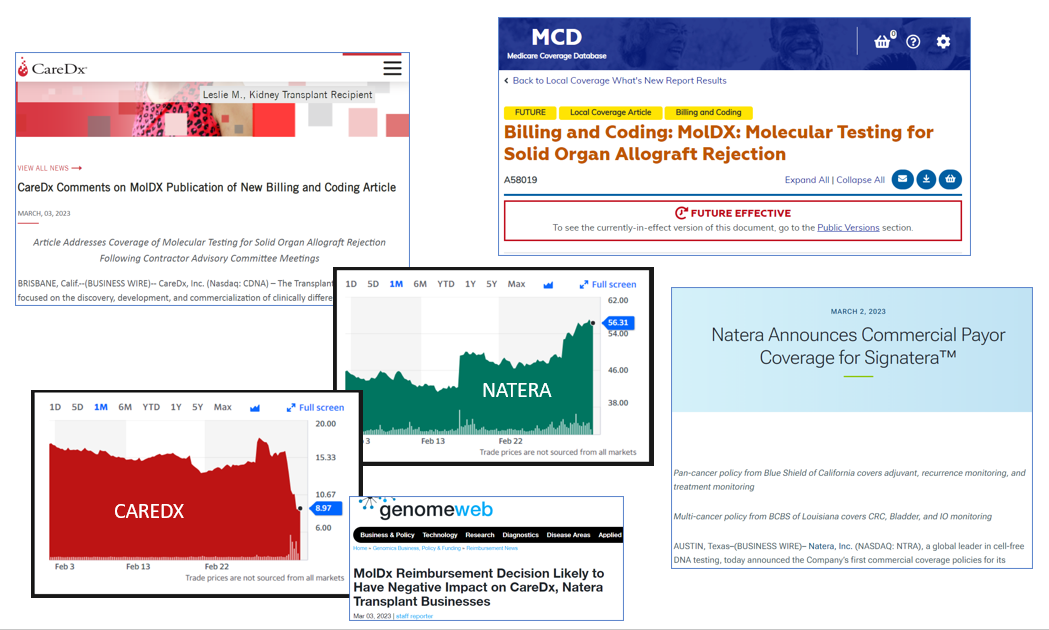
MolDx and other payers move markets.  Over a few weeks, Natera is up from $42 to $50 to $56, ending with a market cap of $6.2B.   During the same time, CareDx is down from around $16 to $9, ending with a market cap of $480M.  Details follow.

Natera Up Again

In a press release March 2, 2023, Natera announces a range of commercial payor coverage for Signatera, a tumor-exome-based minimal residual disease (MRD) test for cancer recurrence.  Named plans include Blue Shield of California and BCBS of Louisiana.  However, the announcements are also a benchmark for future coverage from other plans on a rolling basis.  Ten days earlier, the test had gotten MolDx coverage in breast cancer, here.

As share price has climbed from $42 to $50 to $56, market cap has risen about $1.5B, from around $4.7B to around $6.2B.

CareDx Transplant Documents Revised

There are complicated alterations to statements of policy for the suite of CareDx tests for transplant rejection, and I won't attempt to map all the details in this blog.  

(In addition, CareDx refers to its own conversations and Q&A with MolDx, and CareDx has probably made remarks in other investor calls, without aggregating all the details of which, it's impossible to interpret precisely from the new MolDx documents.)   

Key documents include:

  • CareDx press release on March 3 here.
  • The NEW transplant billing article A58019 here.  Eff. March 31.
  • The Current (now "Old") transplant billing article A58019 here.
  • Medicare held a medical-scientific workshop on this area of medicine last year, transcripts are here.  
    • At the time, I pointed out there was some daylight between the way Palmetto and Noridian described the same meeting - my blog here.  In the workshop, some of the statements in the transcript (including from CMS medical directors) seemed skeptical.  
  • Coverage at "Genomeweb" here, March 3.
Least Helpful "Explanation of Changes" Ever

When they change LCD's and Articles, near the bottom of the document, MACs are required to leave a public explanation of changes (the new one is R6 and has a row for explaining its changes.)  CMS doesn't define "explanation," but dictionaries do, such as "a reason or justification given for an action or belief."

In explaining R6, which moved the stock market so much, Medicare writes,
  • Article: Added four paragraphs.  
  • Deleted: Table.  
  • Group 1:  Deleted sentence.

It made be easier to see this in a table:

Explanation

Explanation of Changes (Rev 6)

"A reason or justification given for an action or belief."

Article: Added four paragraphs

Deleted: Table.

Deleted: Sentence (section Group 1)


The table "deleted" was a detailed 7-row table that provided specific details and conditions for use (for payment) for seven tests, being Prospera (Natera donor DNA), Allosure Kidney, TruGraf, AlloSure Heart, AlloMap, Viracor Trak, and QSant (urine based, w/ DNA).   This table is just gone.

  • The new four paragraphs provide four major rules for implementing the transplant LCD, which I clip as "Appendix - 4 Rules."
A key deleted sentence required AlloMap and AlloSure to be billed together if AlloSure was billed.\ This is replaced by a sentence stating, "For a given patient encounter, only one molecular test for assessing allograft status may be billed."

In a follow-up email, MolDx noted that the additions (I'm calling them "rules" for shorthand, there are 4) are all available from a close reading of one or another part of the text of the original LCD.  

MolDx closes by remarking, "Additional Articles may be added to provide more specific billing and coding instruction for specific services."  So, with regard to key points, all we can say is, "to be continued."


Pro's and Con's of "Foundational LCDs"

MolDx has shifted to "foundational LCDs" (also for hereditary cancer testing, and for minimal residual disease testing in all cancers and indications) - which allow specific coverage to be updated by articles or other decisions on a rolling basis, without the time-consuming rules for public notice and public comment.   So, for example, breast cancer can be added as a Natera MRD indication, quickly, if MolDx decides its data now justifies coverage under principles in the LCD.  However, the policy's implementation can also be changed quickly in other ways - as CareDx found out - for example, by deleting the sentence, "AlloSure Heart is to be billed in conjunction with AlloMap."


APPENDIX - Four Rules

The new four rules created for the upcoming version of A58019.

Article Text
The information in this article contains billing, coding or other guidelines that complement the Local Coverage Determination (LCD) for MolDX: Molecular Testing for Solid Organ Allograft Rejection L38568.

NOTES:

RULE ONE

-For a given patient encounter, only one molecular test for assessing allograft status may be billed. Any additional molecular tests billed after the first will be denied and subject to medical review.

RULE TWO

-Different Z-Code identifiers must be used for protocol vs for-cause testing.

NOTE that use of the molecular test for surveillance (protocol) testing is only compliant with the policy if the patient is enrolled at a center that utilizes this practice and would otherwise receive a surveillance (protocol) biopsy. 

Providers must demonstrate that such a practice (for protocol biopsies) is in place to meet coverage criteria of this policy.

RULE THREE

-Performing this test is not compliant with the language of the policy if used for cause [transplant signs and symptoms of problems - bq] when it will not be performed in lieu of a biopsy or to further inform on the need for or results of a biopsy. As such, the test and the biopsy cannot be performed simultaneously or within a short window of time such that the test cannot reasonably inform medical management. 

Tests performed within a week AFTER a biopsy are not compliant with policy.

RULE FOUR

-Per policy, one of the intended uses of the molecular test is "For further evaluation of allograft status for the probability of allograft rejection after a physician-assessed pretest."

A pre-test is defined here as "other physiologic/laboratory/clinical evidence consistent with rejection."

Therefore, performing the molecular test at the same time as the pre-test is NOT compliant with the policy. The results of the pre-test must be available to the treating clinician to inform the need for a molecular test or biopsy.

[For example, the patient has elevated creatinine on Monday (pre test) and gets molecular test on Wednesday. - BQ]

###
Frequency.

I was originally puzzled that the LCD didn't say much explicitly about "frequency."  However, on re-reading this week, it's probably not so vague.  If the test is used instead of a protocol biopsy, it would be the same frequency (let's say, quarterly in Year 1).  So that's clear enough.   If the test is used for cause - signs and symptoms of rejection - it would be used because of the clinical decline of the patient (elevated creatinine, decreased urine output, fever, etc).  So that's probably clear enough, too.

 ###

CareDx shares popped from $14.70 to $17.80 on the Tuesday the 28th, with its investor call, then slipped to $9 on March 3, ending with a market cap of $480M.   Peak to trough almost exactly 50%.

Thursday, March 2, 2023

Brief Blog; FDA Regulation of LDTs, Balls Still in Motion, Update for March 2023

 Right through last December, the end of the two-year legislative session when bills expire, the VALID act was in play on the hill and among dueling stakeholders.  See blog December 14, 2022.  Recall that in October 2022, FDA leaders said they would regulate LDTs by FDA regulation, even if not given such authority by a new statute.  Politico covered here.

The balls are still bouncing on the court.  Dark Daily has an updated open access review of the topic, dateline February 27, 2023, here.

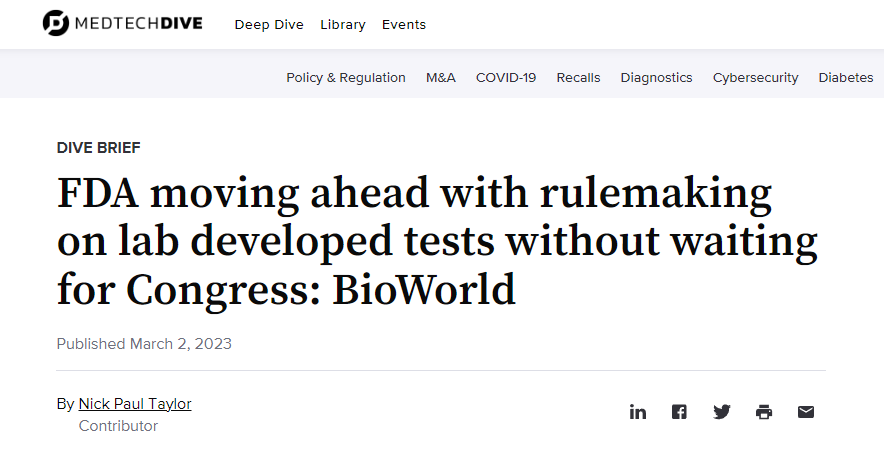
Just 48 hours later, FDA's Elizabeth Hillebrenner announced at the annual ACLA meeting that FDA was indeed planning to move straight ahead with regulation of LDTs by its own regulations, without needing any act of Congress.   Subscription discussion at BioWorld here.  See open access at Medtech Dive here.  Hillebrenner had made similar comments in a webinar in mid February (here).


Recall that Hillebrenner had been a spokesperson for FDA's concerns about LDT Pharmacogenetics in 2020.  She is chief of staff and associate director for scientific and regulatory programs at FDA's Center for Device and Radiological Health.


Wednesday, March 1, 2023

JAMA Introduces Policy on Use of AI in Writing; AI Chatbot Describes Editor's Position

In the February 28, 2022, issue, JAMA publishes a new policy regarding use of AI in writing publications for submission.


In a half-second, ChatGPT provides a automated 200-word summary of the 1500-page article.

The use of artificial intelligence (AI) technologies to help authors with writing, grammar, language, references, statistical analysis, and reporting standards is increasing. OpenAI has released an open-source natural language processing tool called ChatGPT that is designed to simulate human conversation. ChatGPT has potential uses in many fields, but there are concerns about potential misuse, such as using it to cheat on homework assignments, write student essays, and take examinations. Nature has defined a policy to guide the use of large-scale language models in scientific publication that prohibits naming such tools as a credited author on a research paper.

Other journals and organizations are also developing policies to ban the inclusion of AI-generated text in submitted work or require full transparency, responsibility, and accountability for how such tools are used and reported in scholarly publications. 

The JAMA Network has updated its Instructions for Authors to provide guidance and criteria for authorship credit and accountability, stating that nonhuman artificial intelligence, language models, machine learning, or similar technologies do not qualify for authorship, but authors must take responsibility for the integrity of the content generated by these tools if they are used to create content or assist with writing or manuscript preparation.