Tuesday, September 20, 2022

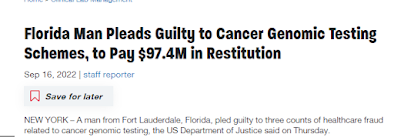
Genomeweb Highlights $94M Genetics Fraud Case; See My Very Recent Blog & Video

In an open access article, Genomeweb highlights a new guilty plea in a $94M genetic testing scheme case. A Ft. Lauderdale lab is highlighted.   How many Ft. Lauderdale genetics labs were there?  One.  Are its billing records public at CMS.gov?  Yes.  

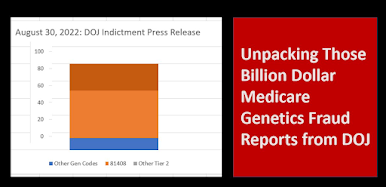
The Ft Lauderdale lab was billing FCSO MAC huge amounts of claims and 90%  for Tier 2 codes, mostly code 81408 (full sequencing of very rare genes and in multiples per each Medicare patient.)   

My video is a little caustic and I go through some CMS remarks where you really have to turn on your "B.S." detector and if you do, it will emit a piercing squeal.  

This was abuse you could train a ten year old to recognize in 3 minutes, yet it reached many hundreds of millions of dollars at this and other labs with near-identical patterns - and only in 1 or 2 MACs out of the whole US.  And year after year (2018, 2019, 2020...).


https://www.360dx.com/clinical-lab-management/florida-man-pleads-guilty-cancer-genomic-testing-schemes-pay-974m#.Yyo10XbMKM8


Earlier this month, I highlighted this DOJ indictment in a blog and a short 3 minute video.

Blog:

http://www.discoveriesinhealthpolicy.com/2022/09/brief-blog-genomeweb-fraud-article.html

Video:

https://www.youtube.com/watch?v=WH_Eb0_X9q8


__
The new Genomeweb article cites "a man from Ft Lauderdale" but the just-prior DOJ indictment and press release on the same man, refer to "labs in Houston and Ft. Lauderdale."  (See my blog linked just above).  While there were 10 labs in Houston with unrealistic of Tier 2 and 81408 billing, there was only 1 such lab, in Ft. Lauderdale.

AdvaMed Comments to CMS: New Thinking on TCET, on Software Reimbursement

In the past few weeks, AdvaMed has published several important examples of policy thought capital for CMS.

AdvaMed and TCET

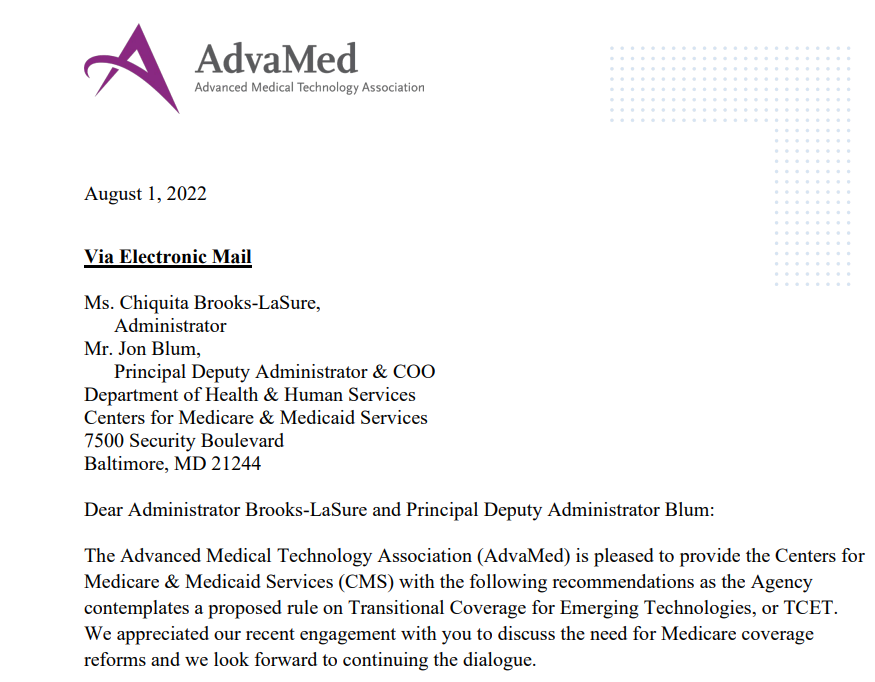
First, on August 1, they released an 8 page memo to CMS on how it could implement a new "TCET" or transitional coverage pathway.   

Among other things, they suggest a process that resembles the Medicare process for "Investigational Device Exemption" or IDE trials.   CMS pays for medical devices in IDE FDA trials if the basic health outcomes are understood.  For example, a new variant of a heart valve, or a prosthetic knee, or a pacemaker.  The original FDA-CMS rulemaking goes back to 1995 and was very well written.  Basically, the patient is getting one pacemaker, and CMS pays for it, whether it's approved model 101 or an updated model 101B in a clinical trial.   See back-references inside a 2017 FDA update here.

IDE trial coverage is now an accelerated and fairly straightforward process managed by CMS coverage staff.  See the CMS IDE web page here.   Basically, a TCET version would be similar except without the FDA IDE trial starting point.

AdvaMed and Software as a Service

Within its general comment to CMS on the OPPS rule for Summer 2022, CY2023, Advamed has some instructive comments on how CMS is handling, could handle, and should handle software reimbursement.   AdvaMed notes this needs to be extended to AI and Machine Learning and that CMS should hold an open call for comments on this topic.  See the SAAS section inside this document, page 19-22:

https://www.advamed.org/wp-content/uploads/2022/09/AdvaMed-CY-2023-OPPS-ASC-PR-Comment-Letter-091322.pdf


If of interest:  See my new 5 minute video "mini course" on CMS, MCIT, TCET, CED policy alphabet:


Sunday, September 18, 2022

JAMA: Cost of Developing Complex Medical Devices $500M

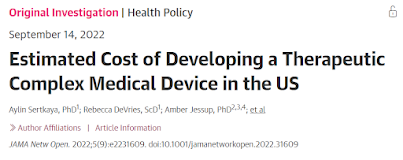
Sertkaya et al in JAMA Network Open - "Estimated Cost of Developing a Complex Medical Device in the US."  Find it here:

 https://jamanetwork.com/journals/jamanetworkopen/fullarticle/2796179

While confidence bars are wide, given the diversity of projects, direct costs averaged $54M and when weighted for failures and cost of capital, $522M.

In round numbers the failure rate was 50%, preclinical to feasibility, another 50% feasibility to clinical trial, and 75% in pivotal studies.  

Key summary:

In this economic analysis, the mean development cost for a novel therapeutic complex medical device was $54 million (95% CI, $25 million-$200 million) excluding any postapproval studies that might be required. After accounting for the cost of failed studies and cost of capital, the mean capitalized cost of bringing a novel therapeutic complex medical device to the US market was $522 million (95% CI, $205 million-$3382 million). 

The key factors associated with this cost were the phase transition probabilities: 46.9% for nonclinical to feasibility study, 48.0% for feasibility to pivotal study, 75.7% pivotal study to FDA premarket approval submission, and 80.5% for FDA premarket approval submission to approval. The nonclinical development stage constituted the largest portion of overall cost at 85.0% with the FDA review stage with the highest phase transition probability accounting for only a small fraction at 0.5%.


Friday, September 16, 2022

New Video: Keeping Up with the Busy "TCET" Scorecard: Innovative Technologies

 I've put together a 5-minute video that shows the viewer the full spectrum of 2020, 2021, 2022 activities around innovations in Medicare coverage processes.   Right now, these are captured under the CMS term, "Transitional Coverage for Innovative Technologies," or TCET.   

Find the video on YouTube at the link:

https://www.youtube.com/watch?v=G5HW3S9-Xro

It's a mini-course. Topics include:

  1. MCIT vs TCET.
  2. CMS Town Halls on TCET
  3. Stakeholders Weigh In (White papers, Webinars)
  4. 21st Century Cures and Breakthrough Coverage
  5. CMS Talks on TCET; Reading the Tea Leaves
  6. The Zeitler Paper on CED Data
  7. AHRQ Review of CED (for comment)
  8. December 2022 MEDCAC on CED
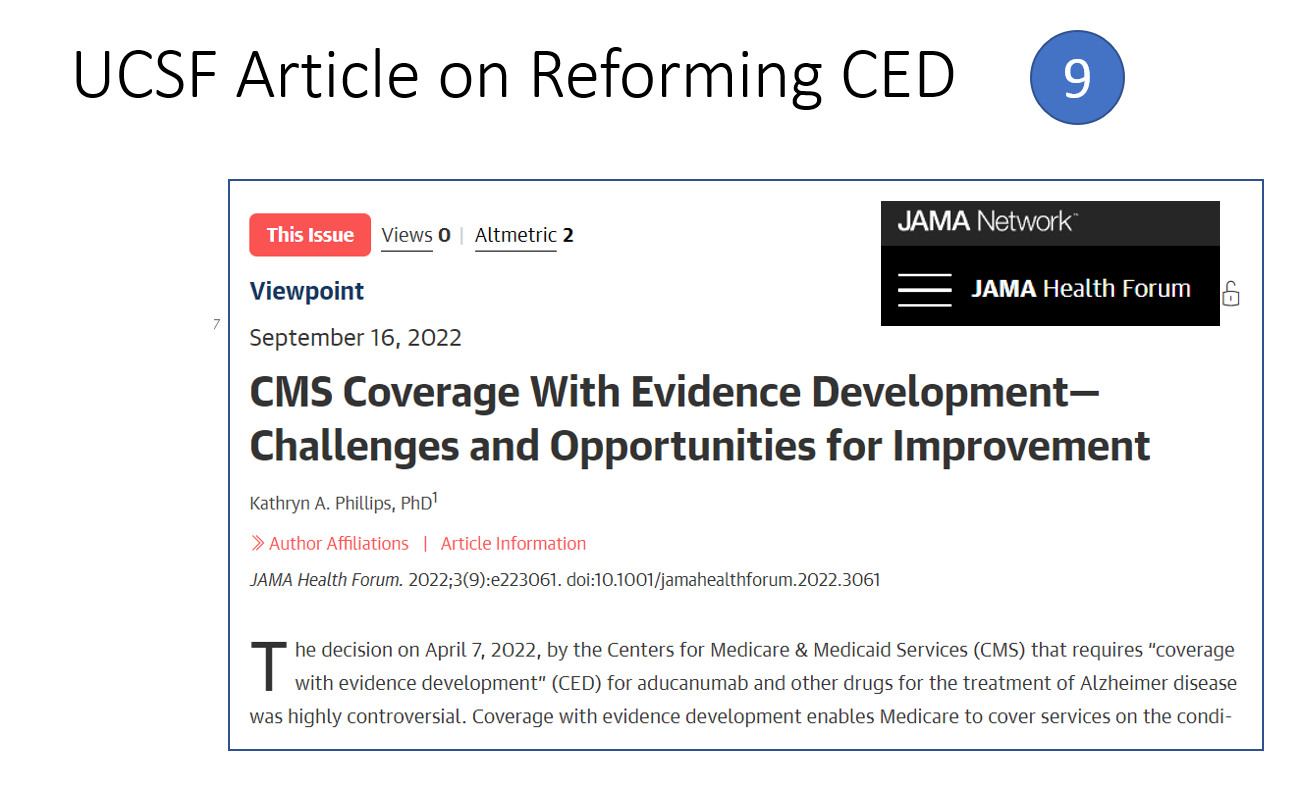
  9. UCSF Phillips Paper on CED (JAMA)
I close with some thoughts on economics and CED, and why CED decisions are so complex for all parties involved.


A few of the more important items cited:

Advamed 8pp on TCET
Advamed home page on TCET (with links to CMS resources like transcripts)
Zeitler AJMC CED paper (28:392-389)
Phillips on CED in JAMA (Sept 16)


UCSF Article Debates Value of Coverage with Evidence Development

We've seen a flurry of activity about CMS "Coverage with Evidence Development" (see below.)  Here's another entry:  A detailed article at JAMA Health Forum on the history and contributions of CMS CED, by Prof. Kathryn Phillips of UCSF.

Find it here:

https://jamanetwork.com/journals/jama-health-forum/fullarticle/2796407


Further background - 

Dartmouth paper earlier this year on CED here.

CMS holds workshops in spring 2022 about a possible future program or group of policies to be called "TCET" Transitional Coverage for Emerging Technology.   In talks given this summer, CMS's Dr. Steven Farmer focused on extensions or variations of CED as a big part of future "TCET."

A week ago, AHRQ released a 35 page review of CED, but focused only on the rather dry checkbox "rules" for CED, such as "Trial must be listed on Clinicaltrials.gov."   Here.  This is like asking if roads meet predetermined rules (like asphalt thickness and width) and not asking whether or not the road goes somewhere useful.

Even more recently, CMS announced a December 7, 2022 "MEDCAC" or public advisory meeting, about CED.  Here.


Thursday, September 15, 2022

Nerd Note: CMS Assignment of OPPS Status Indicators for PLA Codes: Still Perplexing

Beginning around 2014, CMS bundled all laboratory tests in the hospital outpatient setting (including hospital outpatient academic clinics and hospital ER's) - unless the tests were "molecular pathology" tests.  CMS did not define "molecular pathology" tests in regulation, but has very clearly applied this to mean human DNA RNA tests (and not DNA RNA microbiology tests).*

Basically, CMS assigns claims processing status indicators to all lab codes in the outpatient file known as "Appendix B."

The claims status code for human genomics, and COVID microbiology testing, is "A".   This is separately payable as a line item from the lab fee schedule in the hospital outpatient and ER setting.   

Otherwise, the lab test is "Q4" which means conditionally bundled.  It's bundled if there's something to bundle it to, like an outpatient visit or ER visit.   

The two-protein Alzheimer amyloid test 0346U is classified as "Q4" bundled.   That's the signifier I would expect.  But, this is a problem because CMS data shows that most spinal taps for CSF are in hospital outpatient settings.   This is an LDT test from Quest, not the FDA-cleared Fujirebio test.

Several pathogen molecular tests 0351U, 52U, 53U, 54U, are all "Q4" for bundled in the hospital outpatient setting.  OK, I can roll with that.  They're molecular, but not human molecular.

Then there's "E1" which means CMS has deemed the lab test is "not covered by any benefit category, statutorily excluded."  See a list of all status indicators here.

New Change Release Mostly Correct, Sometimes Perplexing

So on September 9, 2022, CMS released CR12885, updates for hospital outpatient policy for October 1, 2022.   Table 3 (PDF page 25) lists two dozen new PLA codes.   Most are easy to understand based on the above rules.  For example, 0332U, which is 8 DNA markers related to cancer checkpoint therapy, is "A," a separately payable human DNA test.

But out of the two dozen new PLA codes, several perplexed me.

  • 0333U is a liver test, surveillance for high risk patients for liver carcinoma, with human cfDNA plus a couple proteins also.  This is "Q4" bundled.  
    • This surprised me because I thought, if a test includes human DNA (even with proteins added) it was "A" unbundled.  I'm pretty darn sure that I had been working from prior examples of this.
  • 0337U and 0338U are oncology proteomic tests, so no surprise they are "Q4" bundled.
  • 0342U is a pancreatic cancer immunoassay test, which is not classified as "Q4," merely bundled, but rather with "E1" which is "not payable at all."   I can't tell why.  
  • 0343U is prostate cancer test, of human RNAs, which should definitely be category "A" but is also categorized as "E1" which is "not payable at all."  It's from MiR Scientific.
Added:  September 28, 2022

Because I was puzzled by 342U and 343U, I downloaded the October 2022 Addendum U, selected all lab tests (including nnnnM and nnnnU codes), and sorted it.  There were a total of 1969 codes (this included the pathology series as I used the whole 80,000 set).  I've put this personal multi tab analysis in the cloud here.   

  • There were 521 "A" codes (payable in APC's, most pathology codes live here).  
  • There were 64 B codes ("not recognized by OPPS"). These were mostly drug screening codes.  
  • 28 codes were E1 ("not payable by statute.")  
    • Here, CMS puts codes with "screening" in the name (like 0091U), but I can't understand how 0221U (CARIS big DNA RNA test) lands here, and I'm a little puzzled by 342U and 343U.   
    • These are the E1 codes, click to enlarge, and the summary of the code name is my own shorthand.


  • One code is "M" (not payable, I believe it because it is a "report," 88291), 
  • 23 are "N" (not payable, mostly CPT add-on codes), 
  • 104 are Q1, 23 Q2, 1188 Q4 (most all clin chem & microbio is Q4, conditionally bundled if here is something to bundle them to, like a procedure or office visit).  
  • 1 is status S. 86927, plasma fresh frozen, which is an oddly placed code and pays via APC 5672.  


__
See my recent  prior article on OPPS Lab bundling "mistakes" - June 2022.

_____

*The actual rules stem from the definition of bundled hospital services in one regulation, and the complex 14 day rule in another regulation.

Pretty bizarrely, 42 CFR 419.22(l) [el] excludes clinical diagnostic laboratory tests from payment under the APC system (bundling).   

Except as provided by 419.2(b)(17), which does the opposite and bundles most lab tests as packaged costs in the APC system (!!!!!).   That's a cause for whiplash.

And - Further details of the bundling and unbundling occur as a result of the date of service rule aka 14 day rule.  42 CFR 414.510.  For example, this sets a separate date of service for "molecular pathology" tests.

Tuesday, September 13, 2022

Biden Speech Reinvigorates "Cancer Moonshot" Goals - September 12, 2022

On the 60th anniversary of the JFK "Moonshot" speech (at Rice University), President Biden gave a speech restating his dedication to a Cancer Moonshot, the program begun as part of 21st Century Cures legislation in December 2016.

See the White House transcript here.   

See the White House fact sheet here.  See announcement of Dr Renee Wegrzyn as first director of ARPA-H here.

See coverage at Reuters here.  

To my eye, the pathway focused on ARPA-H, the recently proposed large translational medicine institution.


_

See an earlier Biden speech on the same topic, February 2022, here


Very Brief Blog: CMS Announces MEDCAC on "CED" - Pivots Off AHRQ Report on CED

In what I believe is part of the run-up to announcements about "TCET - Transitional Coverage for Emerging Technology," CMS has scheduled an advisory meeting on "CED/Coverage with Evidence Development" for December 7, 2022.

See a UCSF Transpers policy article by Kathryn Phillips on CED, at JAMA, here.

##

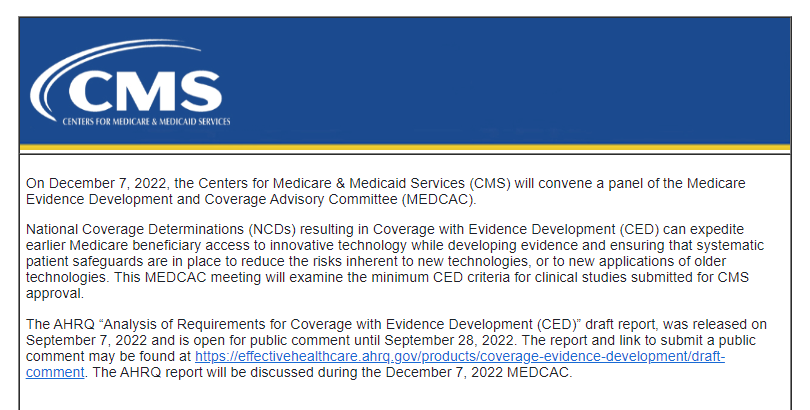
I've clipped the CMS announcement below.

MEDCAC

See the MEDCAC home page and membership roster here.  

CMS has a panel of about 100 potential advisors from which, a couple times a year, they convene a meeting of about 10 selected members on a pre-arranged topic.  CMS holds an all-day workshop with presentations on the topic of interest, discussion by its panelists, and voting by the panelists on pre-arranged CMS questions.  (Questions like: "Does Service X have a net health benefit for Medicare patients?")

The December 7, 2022 webpage is here.  Upcoming and past meetings are archived here.  

BACKGROUND

A few days ago I posted a blog that AHRQ had released a draft evaluation of CED as practiced by CMS, and potential improvements.  See that blog for more information - September 7, 2022, here.  

I recommend for an alternate viewpoint on CMS CED, you also see the academic paper by Ziegler et al. at Dartmouth, published in early 2022 - here.   On September 7, I put the AHRQ document in context of other initiatives like "TCET."

The AHRQ report is written by somebody, on contract, for AHRQ.  Usually there is some fine print footnote somewhere stating the source (e.g. University of Oregon, University of Connecticut, etc).  I haven't seen that for this document.

My Comment:

I have some concerns that the format and analysis is so vague it does not really address core issues. 

The questions from AHRQ simply focus on "the criteria for CED" (which are a set of 13 pretty boring bullet points, e.g. "The trial should be well-designed.")   You can analyze bullet-points like that all day, and it doesn't really tell if the whole CED paradigm is being applied to effective and insightful ends. 

There are no questions like, "Does what we are doing make any sense?"   I mean, there is nothing wrong with a bullet point, "CED studies should not be unnecessarily duplicative" - of course they shouldn't be - but does CMS really have a good way to assess when and whether they are unnecessarily duplicative, to implement the bullet point.   You won't figure that out by reading and re-reading the words of the bullet point.

AHRQ announces up front that "CMS is confident that the CED NCD Process is sound" whereas an alternate stance might be, "The CED NCD Process desperately deserves a hard-hitting and bottom-up evaluation of its overall value."   

For example, you can have 12 carefully written-down rules for good road building (the pavement is this many inches thick, this smooth, intersections are so many feet wide) and examining the rules on the page would never tell you... if people were driving well por terribly, or going places that were useful. 

To make this more concrete, for one recent example, the CED proposed in 11/2017 for cancer sequencing was absolutely ridiculous and un-doable, but CMS staff must have felt that, no matter how "nuts" it seemed, it carefully passed each the 13 AHRQ criteria such as "[checkmark] the study is registered at Clinicaltrials.gov."  Earlier in 2022, I = suggested, for example, that CED could reduce the NPV or ROI of typical medical device products by 2/3 or more, making them unfundable (un-developable) - here

Meeting Structure:

CMS will post questions in advance for December 7, and will expect the panelists to have read the 35-page AHRQ report, as can the public.   CMS hasn't posted questions yet, but they may parallel the questions already used to frame the AHRQ report.  Bonus points if you can tell the difference between "Guiding Questions" and "Key Questions" - I'd get as much value if they just listed 4 questions. 

Guiding Questions.  (1) What are the strengths and limitations of the current CED criteria?  (2) What criteria are used by similar decision-making bodies?

Key Questions:  (1) What revisions to CED criteria may best address limitations while preserving strengths?  (2)  How might the revised criteria be evaluated in the future?

Note, to my point, the first question is not the strengths and limitations of current CED efforts, whic his a really important question, but rather, what are the strengths and weaknesses of the 13 bullet points.  It's like asking, "What are the strengths and weakness of the Senate's rules of order?" (knock the gavel once for X and twice for Y) rather than "What is the value of the current legislative output?"

___________________

CLIP:  ANNOUNCEMENT:

On December 7, 2022, the Centers for Medicare & Medicaid Services (CMS) will convene a panel of the Medicare Evidence Development and Coverage Advisory Committee (MEDCAC).  

National Coverage Determinations (NCDs) resulting in Coverage with Evidence Development (CED) can expedite earlier Medicare beneficiary access to innovative technology while developing evidence and ensuring that systematic patient safeguards are in place to reduce the risks inherent to new technologies, or to new applications of older technologies. This MEDCAC meeting will examine the minimum CED criteria for clinical studies submitted for CMS approval.

The AHRQ “Analysis of Requirements for Coverage with Evidence Development (CED)” draft report, was released on September 7, 2022 and is open for public comment until September 28, 2022. The report and link to submit a public comment may be found at https://effectivehealthcare.ahrq.gov/products/coverage-evidence-development/draft-comment. The AHRQ report will be discussed during the December 7, 2022 MEDCAC.

Sunday, September 11, 2022

AHIP Describes Viewpoints on Medicare Advantage in 79 Page Memo to CMS

This summer, CMS held a request for information on potential new directions for the Medicare Advantage program, a sort of national "temperature check."  

Medicare Advantage is important to anyone working in health services for patients, as it will soon be 50% of the Medicare program.

One interesting entry point (for your next 3-hour flight) is a 79 page memo from America's Health Insurance Plans (AHIP) to CMS on potential changes and new directions for the Medicare Advantage program.

Find the AHIP document here:

https://drive.google.com/file/d/1xGtNXy4px8fdcKTmTlDDqKKIHLezFYTq/view?usp=sharing


See also the Personalized Medicine Coalition comment on Medicare Advantage, here:

https://www.personalizedmedicinecoalition.org/Userfiles/PMC-Corporate/file/PMC-Comment-Letter-on-Medicare-Advantage-RFI.pdf


More after the break.

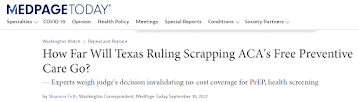
Judge Rejects USPSTF as Source of Healthcare Prevention Benefits!

A Texas-based federal lawsuit brings a decision that USPSTF is simply not a valid body to set national health insurance benefits.  

In addition, in a second finding, even if ACA-USPSTF endorsed prevention benefits regarding HIV prevention were valid, they may be overridden by a company's religious beliefs.


____

A federal court case challenging ACA preventive benefits, including contraception and HIV prevention, gave a victory to the plaintiffs on two different grounds.   

First, the judge ruled that requiring certain benefits such as HIV prevention medications could violate sincerely held beliefs of some employers, and they should be relieved from buying health plans with such coverage.   This is a religious freedom argument; similar to the handling of disabilities, "reasonable measures" must be made to accommodate religious beliefs.   Second, and much broader, many of the preventive care benefits of the Affordable Care Act are accomplished by incorporating recommendations of the US Preventive Services Task Force on a rolling basis.   The judge ruled that USPSTF failed to meet requirements (outside the ACA) for a qualified federal policy body.   

Regarding the USPSTF part of the decision, some odd quirks.   First, ACA actually divvies up preventive benefits into three baskets, (1) those endorsed by USPSTF, (2) those vaccinations endorsed by ACIP (under CDC), and finally (3) women's health benefits endorsed by a group within HHS/HRSA (Health Resources and Services Administration).   The ACIP/CDC and HRSA/HHS bodies did meet the judge's criteria for a body to which the ACA law could reference its coverage mandates.

The ruling handed was down by Judge Reed O'Connor as Braidwood Management v. Becerra (formerly Kelley v. Becerra).

Find the actual case here:

Find the ACA section of law here.  Note, however, the law can only be read in the context of numerous rulemakings, guidance documents, and court cases.  

For news see the following:
  • NY Times here.
  • Reuters here.
  • WSJ here.
  • Forbes here.
  • Health Exec here.
  • The Hill here.  And here (the 2nd focuses on broader legal implications).
  • VOX here (recommended).
  • STAT News here.
  • Health Affairs here.
  • MedCityNews here.
  • MedPage initial story September 7 here, follow up September 10 here.
More after the break.

Friday, September 9, 2022

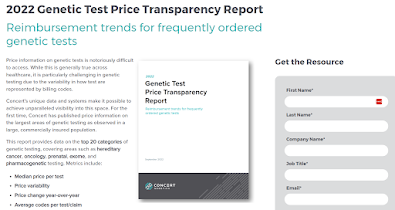
Brief Blog: Concert Genetics Publishes Genomic Price Transparency Report

Often, it's hard to get price transparency data on genetic tests.   One source, dating back to 2016, was the first PAMA survey.  PAMA published a huge data file of paid prices for every lab CPT code, including genetics, so you could calculate your own median, average, SD, and so on.   But that data is approaching 7 years old.

Concert Genetics has just released a white paper with data on the price structure of 20 categories of genetic testing, from oncology to prenatal to pharmacogenetics.  It's free with email registration.

https://www.concertgenetics.com/resources/2022-genetic-test-price-transparency-report/


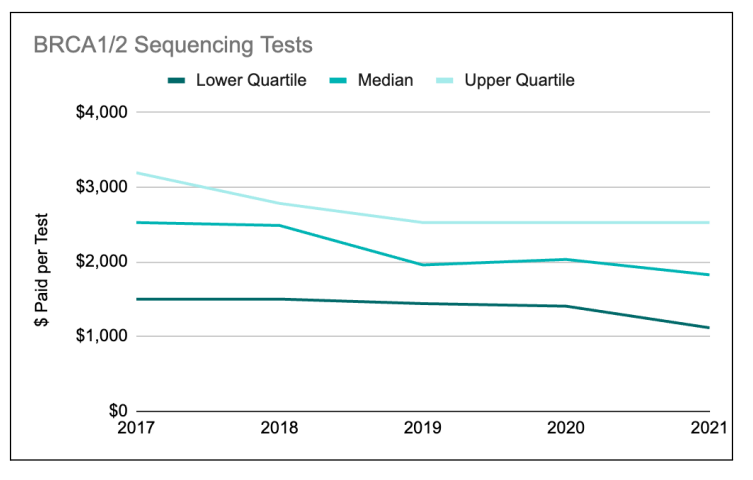
For example, for BRCA testing, the 2017 mean was $2525, with interquartile ranges $1500-3192.   By 2021, the median was $1825, with interquartile ranges from $1115-$2525.


Thursday, September 8, 2022

Very Brief Blog: Biden to Give Cancer Moonshot Speech (JFK Moonshot Anniversary)

Headline - Biden to give a speech on today's CANCER MOONSHOT, on Monday September 12, the 60th anniversary of the Kennedy Man to the Moon speech in 1962.

We'll track it, when it happens.   See news item at The Hill, below.

https://thehill.com/homenews/administration/3632247-biden-to-give-cancer-moonshot-remarks-on-60th-anniversary-of-jfk-moonshot-speech/


Wednesday, September 7, 2022

The 117th Congress: Bonanza of Precision Medicine Proposals Face Legislative Cliff

With the upcoming election, we are in the closing months of the 117th Congress.  I think it's been record-setting for proposals related to precision medicine -- but far more proposals are introduced than pass.  Remember that all of these legislative proposals either get passed or simply expire, at the end of this year.  

Beyond "VALID," here is a brief legislative run-down.   

VALID ACT

This is the most well-known legislative proposal, a wide-ranging revamp of FDA law for diagnostics and the lab industry.  Basically, the core issue is that this legislation would give far more authority to the FDA For LDT tests.   I think one big impact, rarely mentioned, is FDA control over LDT marketing claims.  Another would be a shift to larger- and better-capitalized entrants and labs.   

VALID has been talked about for about a decade in different forms.  It has been tagged to the Senate version of FDA reauthorization, but not the House version, and the outcome is still up for grabs.   This is still under active revision, but see also S. 2209 / HR 4128.  See article at Health Affairs here.   See a subscription Genomeweb article 8/2022, "VALID Act Divides Diagnostic World," here.

SALSA

This proposal, advocated by ACLA and others, would put new guardrails around the implementation of PAMA (CMS triennial surveys for lab pricing) such as surveys every 4 years, use of targeted surveys not complete reporting, and limits to annual price decrements.   See the ACLA two-pager from June 2022 here.  Introduced as S. 4449 / H.R. 8188.  

Medicare Multi-Cancer Early Detection Screening Coverage Act of 2021

As S 1873, HR 1946.  Would allow Medicare to cover multi-cancer screening tests if FDA approved.   Introduced in 1H2021.     June 2022 press release from Rep. Sewell here.  Stakeholder website here.

Medicare: Reducing Hereditary Cancer Act

S.3656, HR 4110.    Would allow Medicare patients to have appropriate hereditary cancer tests BEFORE they have a "personal history of cancer."  Stakeholder webpage here at FORCE.

Medicaid, prenatal genetic screening "Expanded Screening Access Act"

HR 1439.   

Precision Medicine Answers for Kids Today Act (Pediatric intensive care genomics)

HR 5989.  Genomic testing for Medicaid, pediatrics; esp. urgent hospital cases.

Right Drug Dose Now Act (Pharmacogenetics)

HR 6875.   To update the National Action Plan for Adverse Drug Event Prevention to provide educational information on adverse drug events and pharmacogenomic testing, to improve electronic health records for pharmacogenomic information, and for other purposes.


Patent Eligibility Restoration Act of 2022

Numerous articles in the patent field say it's become nearly impossible to get diagnostic test patents due to court cases (precedents) in recent years.   Including a federal appeals court CareDx diagnostics patent case at the beginning of the summer.   I blogged about this and provided some links.  In August 2022, Sen. Tillis introduced the Patent Eligibility Restoration Act S.4734.   See a law firm discussion here and here.  Changes to patent law are rare, but possible.

FIND Act: Medicare Bundling in (Imaging) Diagnostics

As S. 2609, HR 4479.  FIND, Facilitating Innovative Nuclear Diagnostics.   SNM-MI web page here, here.  Both lab diagnostics and imaging diagnostics are subject to important bundling rules that can be counterproductive.   Genomic tests, after an inpatient stay, are bundled for up to 14 days post discharge, a weird regulation that has no parallel in other rules.   Imaging diagnostic tracers also have harsh bundling rules.  In a hospital outpatient setting, Medicare pays for a PET scan, including a nominal amount for a tracer (e.g. $300 for FDG), and any more expensive tracer is simply "bundled."  (In the Part B setting, the scan and tracer are two different line items).  If passed, FIND would unbundle the radiologic tracer, which for some special applications, might cost $2000-3000.   

STATE LAW: BIOMARKERS

Several states have passed, or are reviewing, biomarker legislation.  This is a major focus of American Cancer Society's action fund, ACS/CAN.   Legislation in Louisiana was specific to cancer biomarkers, requiring commercial payer coverage if they were FDA approved, under CMS NCDs, etc.   Legislation in Illinois was similar, but NOT limited to cancer biomarkers (!).   Similar legislation (broad type) recently passed Assembly and Senate in California, and awaits a yay or nay from the Governor.

See a representative press release from ACS CAN in June 2022, here.  See an open access PDF article about the overall effort from The Cancer Letter 11/2021 here.   See the ACS CAN resources page here.   See, for one specific example, the California bill SB 912 here.  See a Milliman report on state by state biomarker coverage, February 2022 here.  See an analysis of SB 912 here.

___

21st Century Cures Act 2.0

H.R. 6000, from Rep. DeGette, is 21st Century Cures Act 2.0 (2022), and contains an omnibus list of FDA and NIH changes.  I have not studied this recently, and it's probably in flux, but I provide the link to H.R. 6000 here.   See a short summary from January 2022 here.   As drafted, it includes ARPA-H, the giant new proposal for a translational medicine institute.  


Trapelo White Paper on Payors and Precision Oncology - "A Battle Royale?"

Trapelo has an excellent series of white papers on precision oncology - home page here.

The newest one states,

  • The Cost and Complexities of Treating Cancer are Astronomical—and on the Rise
  • Now, some US oncologists are collaborating with genomic labs and payers through an evidence-based technology to reduce treatment costs and improve patient outcomes.
According to a post at Linked In, this 8 pp white paper ties to an upcoming presentation at Precision Medicine Leaders' Summit by Debra Patt and Russell Ingersoll.  Download white paper with email registration, here.  It describes the TRAPELO services package and how it smooths interactions between oncologists, (labs), and payers, including prior authorization delays.


In March 2021, NeoGenomics acquired the Trapelo platform for $65M - here.

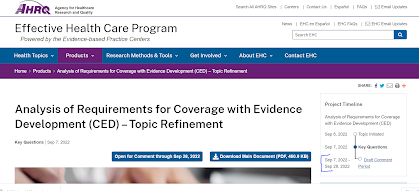
AHRQ Revisits "Requirements for Coverage with Evidence Development"

AHRQ publishes a proposal to edit and update "CED" requirements at Medicare.  This is one activity in the run up to "TCET 2023," Transitional Coverage for Emerging Technologies.

###

MCIT to TCET

Reimbursement experts will recall that the Trump administration developed a new program called "MCIT," which tied Medicare coverage to FDA "Breakthrough Device" status.   The Biden administration formally canceled that, but promises a new program called "TCET," Transitional Coverage for Emerging Technology."   Based on limited early information from CMS, TCET components likely will include pre-meetings with the CMS coverage group, and more use of Coverage with Evidence Development, or CED. 

I always point out that MCIT was a complete policy program, whereas, as of now, TCET is a moniker for a basket of possible proposals still in the future.  

See a two hour webinar on TCET from Stanford Biodesign and Duke Margolis Center, March 2022, here and here.

Sidebars: Academic Review of CED; CED and NPV

  • See an academic review of CED by Zeitler et al, 2022 (entry point here).  
  • I argued in early 2022 that CED, as typically applied, was substantially value-destroying for companies subjected to it (here).  I used an MBA-type net-present-value (NPV) model.

AHRQ Report Released - Comment September 7-28

At the request of CMS, AHRQ has issued a draft report on ways that CED rules might be edited and updated.   This includes a public comment period September 7-28.   

See the draft document, prosed edits to CED rules, and comment information here:

https://effectivehealthcare.ahrq.gov/products/coverage-evidence-development/draft-comment

The 35-page reference document is here:

https://effectivehealthcare.ahrq.gov/sites/default/files/product/pdf/coverage-evidence-development_0.pdf

See a cloud zip file with the draft and attachments here.