Thursday, March 17, 2022

Very Brief Blog: MOLDX Posted Infectious Disease Policy, Now Posts Public Comment Document

Earlier in March 2022, MOLDX posted an elaborate LCD for molecular infectious disease panels.  The elaborate LCD included an elaborate "billing and coding" article.  Entry point here. L38988.  See also the TA document here.

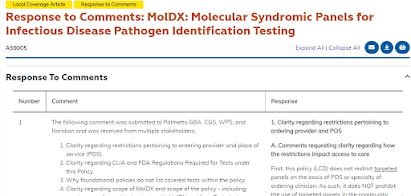
Now, on March 17, they've also posted one of the longest public comment responses, I've ever seen.  Medicare article A59005.  25,000 words.  From the CMS website, the article prints out at 72 PDF pages for me.

(For original comments in their original letter form, I found one online at AMP, the June 2021 AMP / AGA / CAP comment here.)

Find the MolDx response to comments online here:

https://www.cms.gov/medicare-coverage-database/view/article.aspx?articleId=59005&ver=8


Given the length of the Q&A, what's in it?  In the left column, they quote comment letters in full.  In many cases, in the right column, they state briefly "Comment has been answered, see above." or "Thanks for comment."

Most head-spinning moments for me were when stakeholders comment, and I read and re-read this stuff, "This looks like an inpatient policy" and MolDx responds, "This is not an inpatient policy, as we state, "This is not an inpatient policy" quote unquote.  And yet the policy and Q&A comments exchanges repeatedly state for many situations patients must be  admitted as critical care facility inpatients or ER patients." In which circumstances, the tests are bundled to the ER APC visit or the facility DRG visit.


___

See an article sponsored by Biofire on its use in identification in blood culture analysis.  Note, that patients getting blood culture will usually be inpatients (or ER patients) where tests are bundled (except if they are human DNA-RNA).

Very Brief Blog: Two New Pieces about Dr Meena Seshamani, Center for Medicare

CMS has two big arms - the Center for Medicaid and the Center for Medicare.  Under the Biden administration the head of "CM," Center for Medicare, is Dr. Meena Seshamani.

See a new op ed by her on the direction of Medicare at Washington Times - here.

See a new interview with her at JAMA - here (podcast), here (text).

CMS org chart here.

For the annual, multi hundred page MEDPAC report to Congress, March 2022, entry point here.

Very Brief Blog: ARPA-H: Gets First Billion Dollars in Budget Act

Missed this news a few days ago.  $1B for ARPA-H.

In early 2021, we began hearing discussions about creating ARPA-H, a special research agency for translational health research.   ARA = Advanced Research Projects Agency.  It would build off government funding successes and design-of-agency ideas from DARPA, BARDA, Operation Warp Speed and others.  See some links from January 2021 and a research February 2022 Hill hearing - here, here.  I collected some links about Operation Warp Speed in January 2022, here.

The recent March 2022 budget legislation gives ARPA-H its first $1B, starting now and for 2.5 fiscal years.   The legislation also gives HHS 30 days to decide if ARPA-H will be "inside" NIH or administratively an entirely new agency (like NIH, NSF, etc).   

See an article in SCIENCE, 15 March, by Jocelyn Kaiser, here.


Tuesday, March 15, 2022

Very Brief Blog: Jury Awards CareDx $45M in Advertising-Based Lawsuit

In an unusual case, a jury awarded CareDx $44.9M in a false advertising lawsuit against Natera.

But according to an article on Genomeweb, "the jury also found CareDx liable for two instances of false advertising."

See the full article at Genomeweb:

https://www.genomeweb.com/sequencing/jury-awards-caredx-449m-natera-lawsuit-finds-both-companies-engaged-false-advertising


See also coverage at Reuters:

https://www.reuters.com/legal/litigation/caredx-wins-45-mln-verdict-against-natera-false-advertising-2022-03-15/

CareDx and Natera have also haggled over patents (November 2021):

https://www.jdsupra.com/legalnews/caredx-v-natera-extrinsic-evidence-5443760/


Very Brief Blog: JAMA Addresses Alzheimer Testing in View of Patient EHR Access Laws

One of the outcomes of 21st Century Cures (2016) and other legislation has been increased direct access to patient health records, like lab tests, along with interoperability.

In JAMA Neurology this month, see an op ed speculating how these rules should, or could, play out in Alzheimer's disease, as more accurate tests roll into the market.  "Bringing Alzheimer Disease Testing and Results Disclosure into the 21st Century Cures Act," by Largent & Bradbury, here.

The article has a number of interesting citations, including these:

Schindler & Bateman (2021) Combining blood based biomarkers to predict risk for Alzheimer's disease dementia.  Nature Aging here.

Filippi et al. (2022) Amyloid-related brain imaging, systematic review.  JAMA Neurol here.

Jansen et al. (2022) Prevalence of amyloid abnormalities and the Alzheimer disease spectrum [19,000 patients], JAMA Neurol, here.

Very Brief Blog: AMA Launches "CPT Developer Programmer" for Innovators

AMA.   AMA launches a program to help innovators foresee and develop coding for innovative products.  See article on the "CPT Developer Program" at AMA here.  AMA notes it will hold a "developer symposium" in November (I assume November 2022).

See my blog last week on legislation to create a new digital medicine benefit category at Medicare, and notes on recent coding updates in digital medicine at both AMA and CMS HCPCS - here.


Quotes from the AMA CPT announcement - 

The CPT Developer Program facilitates access to the AMA’s expertise, content and resources in medical terminology and coding to those with pioneering ideas at the crucial early stages of product development.

The program is designed to help developers get their innovations in front of the physicians who can use them to help patients. Program participants will have access to a monthly newsletter, quarterly journal and educational webinars on how the CPT code set gets used and why it’s important to innovation.

Here are some other elements of the program.

CPT development licenses. These yearlong licenses allow the developer community royalty-free access to CPT content to build and test innovations in their development stage prior to production.

AMA Intelligent Platform. This central interface allows users to license, access and manage the latest CPT content with modern delivery options including application programming interfaces, web apps and data files.

Developer engagement. Educational and informational opportunities designed to foster collaboration and co-creation with application developers will be offered, including the AMA’s first developer symposium in November.


Friday, March 11, 2022

MolDx MACs Post Final LCD for Infectious Disease Testing

The MolDx MACs have posted a final LCD for infectious disease testing.   The draft LCD was in comment period around May 2021 and finalized at all four MACs on March 3, 2022.  This triggers a 45 day "notice" period (effective date April 17, 2022).   The LCD numbers are L38988 (Palmetto), L39044 (WPS), L39038 (CGS), and L39001/39003 (Noridian).

See the draft LCD here.

See the final LCD here.

See the billing/coding article here.  It's pretty complex at 52 pages.

A "response to comments" was posted a week later, entry point here.

See the "Technical Assessment" guidance document (in Excel) here.  Appeared April 1, 2022.

I have posted a PDF "redline" version of the draft versus final.  There are quite a few changes in the final in this LCD.  (In contrast, a number of LCDs are finalized with minimal if any changes).

Find the PDF redline version here.

I've also put the documents in a single ZIP file here.


Notes

The policy notes it is "not a coverage policy for metagenomic next generation sequencing," or for mass spec or FISH testing.   The policy distinguishes FDA and non FDA tests.  Most of the LCD focuses on when limited panel testing is required (that is, when more than 1 pathogen is tested.)   The LCD also strongly carves out special rules for "expanded" panel testing where "expanded" panel is described as more than 5 pathogens (that is, 6 or more pathogens).

For example, in the >5 pathogens section, bloodstream infection panels are covered "when there is clinical concern for bacteremia" AND ALSO "microbes were seen on a gram stain of blood" AND ALSO the patient is managed in a critical care facility (includes emergency room) AND personnel will rapidly tailor therapy to the result.   Note that from a Medicare Part A, Part B, policy perspective, this seems to limit testing to the hospital and ER setting, where microbial tests are bundled to the DRG or the E.R. facility service anyway (there is no separate payment for MolDx to decide to pay or not pay).  Om tje Q&A document, they insist "This is not a Part A coverage policy" concurrently stating, "Patients must be in a critical care facility." (?!).

For UTI panels, the patient must be at high risk for UTI complications (e.g. elderly) AND (OR) seen in a specialty urologic care setting.

There are also quite strict, and fairly elaborate, rules for the use of panels in GI or pulmonary disease.  Again, for respiratory panels, "the patient must be treated in an appropriate critical care facility," suggesting the patient is already in a hospital or ER, where the microbiology testing would be a bundled service for Medicare patients.

CPT Watchers Note

The policy uses the newest infectious disease panel code, a 2022 AMA CPT code for blood pathogen detection, 6 or more targets, 87154.  This was  crosswalked last fall to $218.

MolDx Watchers Note

I think this is the first time the four MolDx MACs have released a draft or final policy all on the same day across the several MACs.

MAC Watchers Note

I've commented previously that the Novitas MAC issued an extremely vague draft and final LCD for infectious panels (they're covered if timely and expected to affect care).  That might seem like a license to cover anything, but I've warned, the vague wording could also be applied too narrowly by auditors and recoupment entities, creating big headaches for labs.  In contrast, the MolDx LCDs here are quite rule-oriented and granular.  

Thursday, March 10, 2022

Digital Medicine & Medicare Law: Bill Introduced for FDA-cleared "Prescription Digital Therapeutics"

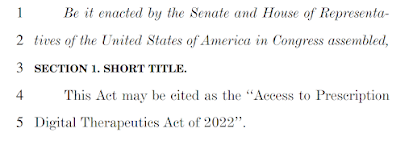
In a March 10, 2022, press release, four legislators announced the introduction in House and Senate of a bill that would create a benefit category and payment authority for FDA-cleared Prescription Digital Therapeutics.  The bills are numbered as S. 3791 and H.R. 7051.

See a press release here:

See a PDF of the proposed legislation:


The bill defines a PDT as a software device cleared, approved, or "de-novo'd" by the FDA for prevention, management, or treatment of a medical condition, primarily using software to achieve its effect.  The definition is added to Section 1861(s) of the Social Security Act, where it would become benefit "GG" if enacted.

The bill includes coding and payment rules, modeled in part on the median-market-price surveys implemented for lab tests under PAMA in 2014 (see SSA 1834A).

Like other proposed bills, the proposal will be assigned to House and Senate subcommittees and could be attached to future Medicare updates.

AMCP supports the act, https://www.amcp.org/About/Media/Press-Releases/amcp-statement-prescription-digital-therapeutics-act


Coding Updates

AMA.  In September 2021, AMA created a code for cognitive behavior app management as monthly physician's supervisory service (to be active in CY2023).   (For a discussion of codes up to the newest one, see a November 2021 article by Foley Lardner here.)

AMA.   AMA launches a program to help innovators foresee and develop coding for innovative products.  See article on the "CPT Developer Program" at AMA here.

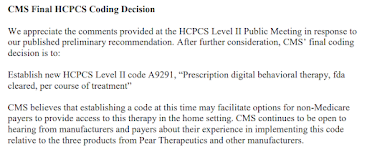
CMS HCPCS.  In early 2022, the CMS HCPCS group approved a HCPCS code A9291, active beginning April 2022, for "Prescription digital behavioral therapy, FDA cleared, per course of treatment."  Announcement here, page 46.


Tuesday, March 8, 2022

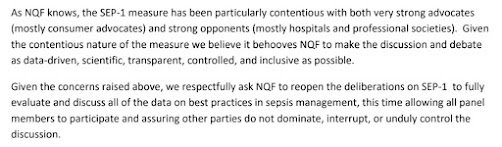
SEP-1 Quality Measure Under "Appeal" At National Quality Forum; CANCELED APRIL 29


Update - NQF "Dismisses SEP-1 Appeal," see Sepsis Alliance announcement, April 29, 2022, here.


Prior Text:

Update - See an April 2022 article in NEJM, that "quality measures" are a "flawed system" for "fixing a flawed system."  Here.  

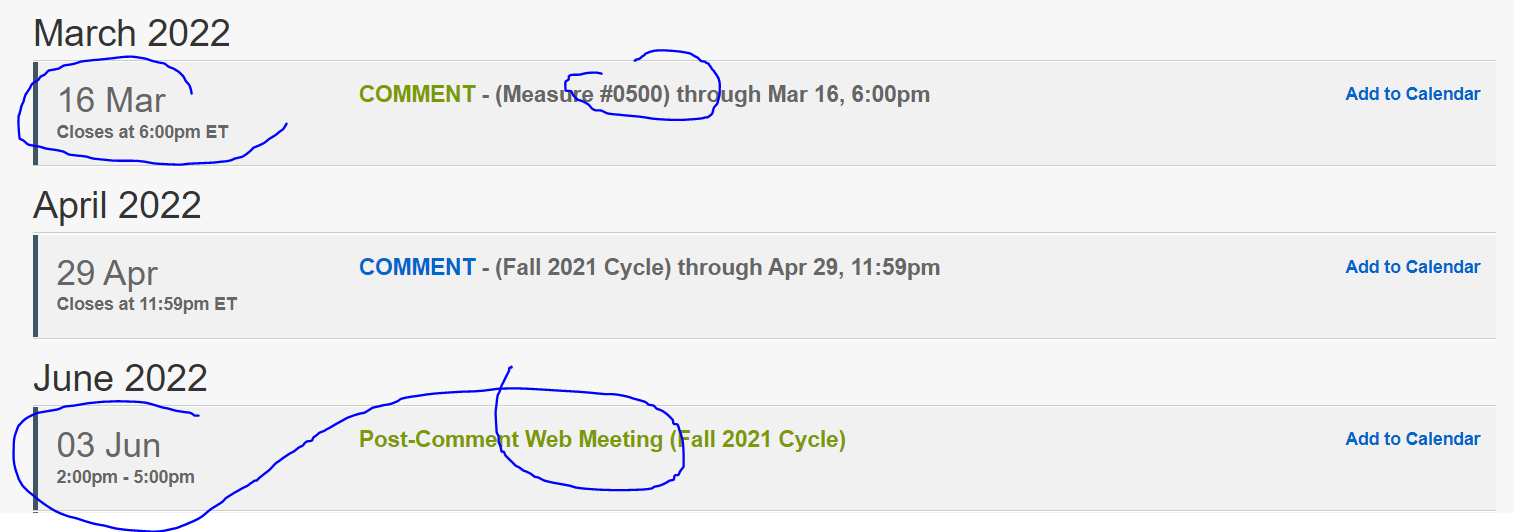
Update - when I wrote this, I understood SEP-1 comments were open to March 16, which is what the website still shows, and would be discussed on video at a April 29 meeting.  Now, I don't see an April 29 web meeting (for SEP-1 to be appended to) and my best reading is that they will be discussed at a video meeting on June 3.

https://www.qualityforum.org/ProjectEventsList.aspx?projectID=86057


_____

As I've described from year to year on this blog, the SEP-1 CMS quality measure has an unusual and colorful policy history (for example here.)

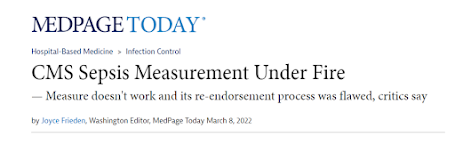
That colorfulness continues.  See a story about an appeal filed against the latest SEP-1 decision by Joyce Frieden at MedPage today, March 8 - here.

Despite a turbulent volume of conflicting literature and opinions, and some strong guidelines or position papers from several medical associations such as IDSA, the quality measure got through its five-year review at NQF this summer with relatively limited discussion.   After public comment cycles it was endorsed as renewed around December 1, 2021.

The NQF website can be devilishly hard to navigate, but it shows that an Appeal of the SEP-1 process has been lodged by a number of major associations, such as IDSA, ACEP, SHEA, and others.

This is the master page for the Patient Safety forum, and it shows COMMENT on the APPEAL is open to March 16, 2022:

https://www.qualityforum.org/ProjectMeasures.aspx?projectID=86057&cycleNo=1&cycleYear=2021

This is the project materials website for the Patient Safety forum, and if you track back to March 3, you'll see the APPEAL document is posted (the two page PDF letter).

https://www.qualityforum.org/ProjectMaterials.aspx?projectID=86057

You can read incoming comments to date on this website:

https://www.qualityforum.org/commenting/publiccommentform.aspx?project=86057&form=206

I've put a cloud copy of the appeal letter here:

https://drive.google.com/file/d/1FZaykTutc0bu24UKN1JQW33GHBcrL768/view?usp=sharing

It sounds like a public or video discussion of the Appeal may occur at the upcoming April 29, 2022 committee meeting.


click to enlarge


Friday, March 4, 2022

AMA CPT Posts May 2022 Chicago Meeting, Posts Lab Tests in Advance

Three times a year, AMA opens a webpage that holds calendars and agendas for its upcoming CPT meeting.  The webpage for the May 12-24, 2022, CPT meeting in Chicago is open.

As usually, the first item to go up is a posting of the Lab CPT submissions for comment and review.   These are posted March 4, and commenters may request to review a packet til March 11, and must turn in comments by March 30 )[per handout].  This allows to be reviewed by internal working groups (MPAG for molecular tests and PCC for lab & pathology stakeholders as a whole).  

All the other non-pathology codes will be posted for comment in a few weeks.

Main web page for Chicago meeting here:

https://www.ama-assn.org/practice-management/cpt/cpt-may-2022-editorial-panel-meeting

[Note, March 8, morning, as I write this, AMA has opened the registration process, but it's not showing up at this hour yet on the webpage.]   The registration pathway is open and it's set up for either "virtual" or "in person" registration for May 12-14, 2022.    (The meetings are always scheduled Thurs-Saturday but rarely require Saturday.)


Lab tests with new or revised coding proposals include:

  • Actin
  • AQP4 antibodies
  • Gadolinium
  • Cytogenomics/optical genome mapping
  • Hep B quant assay
  • MOG-IG1 (multi code set)
  • MAAA tumor methylation classifier (CNS)
  • Respiratory Patho\ogens (editorial revisions)
  • Tick-borne organisms (code set)
  • MAAA-cfDNA for HPV'

Wednesday, March 2, 2022

Reliving Medicare's Dumbest Reimbursement Decision Ever (2009)

Last week, at TRICON in San Diego, I gave a talk on CMS policy and incentives and disincentives to innovation (there are some of both).  It's being written up as a small publication.

I was reminded of an impossible, and quickly rescinded, CMS reimbursement decision in 2009.

Doctors were willingly using Product A, which was 10% the cost of Product B, and someone at CMS made a coding change that made Product A impossible to use.   It's also a case study for what happens when you are making strategic decisions but you lack the ability to think 1 or 2 steps ahead.

And there's a broader lesson for how CMS should incent innovation.   In the ACO world, CMS incents costs savings by "shared savings."  If the ACO's expected Medicare budget is $100M, and it comes in at $90M, it gets to share 50% or $5M of the savings.   But in the RVU system, for example, when a product comes in faster or cheaper, CMS immediately seizes 100% of the savings by immediately cutting the price of the innovation to the least possible level.   It would be smarter if CMS would actually incent providers to use the less expensive thing.

The Story

AVASTIN AND LUCENTIS - 2006-2012

Before 2006, there were very limited treatments for wet age-related macular degeneration, which has an incidence of about 200,000, and a prevalence of about 3M, mostly age 55 and older.   The year 2006 saw the approval of LUCENTIS (ranibizumab), which is similar to AVASTIN (bevacizumab) but has a smaller molecular weight.

Even before Lucentis was FDA-approved, its success was known from Phase III trials, and there were some off-label clinical attempts to use ocular injections of Avastin.  You can still see online debates dating to 2006 (here) and 2009 (here and here) while an NIH-supported comparison trial found the clinical efficacy of the two agents was similar (here) in 2012.  In 2012, CMS held a MEDCAC (public policy meeting) on VEGF treatments in diabetic macular disease as well as macular degeneration, (here).

CODING TODAY

Leaving aside biosimilars codes (Q5108, Q5107), the Avastin code is J9035, 10 mg $67 and the Lucentis code is J2778, 0.1 mg $307.   Dosing of Lucentis is 0.5 mg per eye, or $1500 per eye per month.

CODING FIASCO 2009

As I understand the story, and as retold by the Washington Post in 2013 (here), Lucentis at that time cost about $2000 per injection and Avastin about $50 per injection (J9035 10 mg).  

So far so good.  But not for long.  

Someone at CMS decided to focus not on the apparent $1950 price saving for CMS ($2000-$50), but on the fact that Avastin was given in a much smaller dose (like 1 mg) but was being coded and paid for the smallest available code, "10 mg $50" or so. 

In a still-available document, dated August 28, 2009 (T1803, CR6626) CMS created new code Q2024, bevacizumab, 0.25 mg.   Thus, instead of the ophthalmologist being reimbursement in the $50, or $67, range, he would be reimbursed in the range of $1 per 0.25 unit, or $4 per mg meaning $4 per dose.

https://www.cms.gov/Regulations-and-Guidance/Guidance/Transmittals/downloads/R1803CP.pdf

  • This coding for Avastin's tiny dose with Q2024 now put the ophthalmologist far below cost, including incorporated burdens like compounding fees.  
  • The brouhaha was immediate and loud.  

The August 28 CMS decision led to an October 2  article in Wall Street Journal, ridiculing CMS.  Here (archive here).  

See an October 6 article on the same topic at Healio here.

An OIG report on the topic attributes the recission of the code to letters from Congress to CMS or HHS in October 2009, and the decision to delete the code at the latest by November 2009.  See OIG here.   According to PolicyMed, the Congressional letter came from Senator Kohl (D-WI), here.  Kohl is said to have written, " a variety of medical authorities and advocates are complaining that the new coding system CMS implemented this month will reduce reimbursements to physicians for Avastin to a small fraction of the previous rate.”

Kohl praised CMS's decision to rescind the goofy coding change on October 28, 2009 (here).
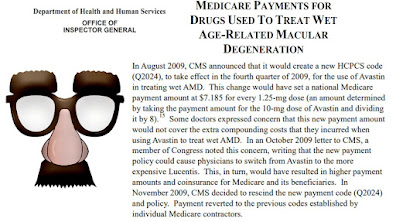
Click to enlarge. From OIG report 2012.


______

I haven't identified the exact transmittal that deleted Q2024, but it was deleted by December 31, 2009, according to current HCPCS records. 

Regarding Q2024, see also T1805, CR6594, also dated August 28, 2009 here.

Picture https://pixabay.com/illustrations/april-fools-day-april-1st-joke-day-4756937/ 

At least one MAC would code Avastin today by J7999, a generic compounded-drug code with local pricing (here).

At the time, in 2009, CMS didn't have an administrator, Mark McClellan having left in 2006 and Donald Berwick having arrived in 2010 (a job he held only 18 months).  Here.

There's CMS rulemaking around hospital outpatient drug pricing for Q2024/C9257 (citing Q2024 as deleted), November 20, 2009 74 FR 60491.

Kohl issued a press release October 28, 2009, praising CMS recission of the code, ad the press release contains a link to a PDF letter to CMS, but that link is now a dead link.  See press on the press release at MedPageToday from AAO here.

A note in Fierce Pharma October 14 basically quotes the WSJ October 2 article.


Telehealth Extension Introduced, But Would Block Telehealth Orders for Genomics

The US healthcare system, certainly for Medicare, is looking at a "telehealth cliff" when the emergency rules around telemedicine end.

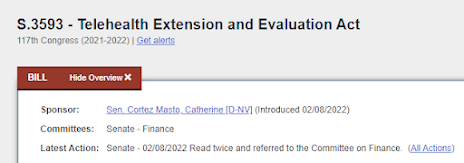
On February 7, 2022, Sens. Masto (D NV) and Young (R IN) introduced the Telemedicine Extension and Evaluation Act.   JDSupra here.  S.3593 website here.

The bill apparently attempts to implement a MEDPAC suggestion in Spring 2021, recommending that CMS block telemedicine orders for genetic tests due to perceived fraud in this space (e.g. a telemed doc in Tennessee orders 1000 expensive genetic tests one morning for nursing home residents in Florida).

Draft Bill Impacts Genomics in Telemedicine

S.3593 contains language blocking orders for DME and "costly laboratory tests," the latter defined as tests in the top quartile of payments.   (A quick sort of the Medicare fee schedule places the top 1/4 of prices at $140 and up, but that's not volume-weighted).

The bill does allow telemedicine based orders when the patient is also an in-person patient of the provider.


See a  mid-December 2021 OIG report on genetics teste growth, and genetics test fraud (including telemedicine), entry point here.


FDA Releases Summary of Clinical Effectiveness for PAIGE Prostate Pathology System

Last fall, I covered the FDA de novo clearance of the PAIGE prostate pathology system using artificial intelligence (e.g. here.)

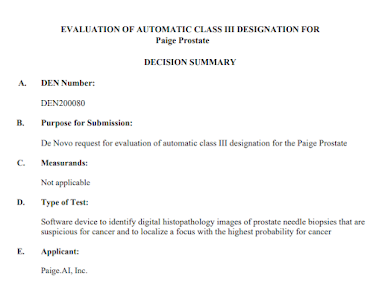
It's a de novo clearance, DEN200080, and the original documents included an FDA press release and an FDA clearance letter.   

Now, the FDA has released a detailed 25-page decision summary of exactly what data was required for the PAIGE marketing authorization, and how FDA evaluated the data.  Find it here:

https://www.accessdata.fda.gov/cdrh_docs/reviews/DEN200080.pdf


__

To see a listing of all De Novo clearances, showing approval letter immediately and summary of effectiveness after a delay, web page here.

See my March 2022 article on the more advanced state of AI in radiology, here.

Digital Pathology: Triangulating Our Path by Looking at Radiology's Experience

There's a steadily rising number of articles about digital pathology in the mainstream pathology journals and trade journals.   See:

  • "A look ahead to AI based assistance in anatomic pathology" - CAP TODAY, February 2022 here.
  • "Cytopathology - At the center of AI implementation" - CAP TODAY, August 2021, here.
  • CAP has a home page for "AI in Pathology" - here.  
    • Citing, for example, Haymond, "Rise of the Machines: AI and the Clinical Laboratory" here and Rashidi, "Machine learning in healthcare and laboratory medicine," here.
      • See also...a survey, how pathology stakeholders are reacting to digital pathology, Heinz 2022, here.  See a review of breast cancer and machine learning, Lee et al,  here.
    • CAP also has a standing AI committee now, here.
  • Fall of 2021 brought the first AI approval in anatomic pathology, for PAIGE and assisted or second-reading use in prostate biopsy pathology -
    • See coverage at Fierce Biotech here, at FDA here, at 360DX here.
    • Summary of Effectiveness, DEN200080, recently released by FDA here.
AMA
On the pure policy side, AMA has a workgroup on digital medicine, its Digital Medicine Payment Advisory Group, DMPAG, here.  

CMS
And CMS is now devoting several pages of its annual outpatient rulemaking (Part B rulemaking) to how to dollarize the RVU's and value of artificial intelligence, software, and licensing or per-click fees.   (E.g. 86 Fed Reg 65037ff, 65100ff, etc, November 19, 2021).  On the Part A side, CMS has granted temporary new technology add on payments (NTAPs) to radiology software that prioritizes a reading cue for the cases with the mostly-likely-dangerous conditions (VizAI here.)  

Journal of the American College of Radiology
While important policy or research articles on AI appear now "at regular intervals" in the major pathology journals, I think none of our lab journals approach the density of activity on AI innovation that can be seen in Journal of the American College of Radiology.  

I've been following JACR for over a decade (I used to have a lot of projects involving PET scans), and it's a fascinating journal.  

While it publishes original clinical research, a large proportion of all articles are devoted to breaking technologies, new policy initiatives, and "technology of change" issues.    Such topics certainly do occur in pathology journals, like J Molec Diagnostics, and when they appear, they are likely to be a committee's high quality position paper, but they're much less common on an issue-to-issue basis.

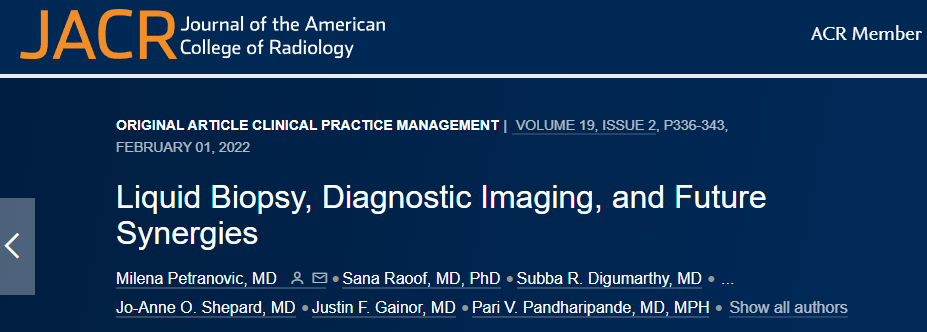
JACR has its main website here.   For example, as I'm writing today, one current top title is:

JACR: Over 100 Recent Titles on Radiology and Artificial Intelligence

Over at PubMed, you can search all articles by "journal name."  Instructions here.  A pre-made search on the JACR journal title here.   For example, a crude search of the journal title JACR and the simple keyword "intelligence" (for artificial intelligence) yielded 195 unselected articles out of 5,568 in JACR as a whole.

click to enlarge


To allow the reader to scan the headlines, from present towards the past, I've clipped 111 manually selected titles from JACR on artificial intelligence or machine learning, and pasted them in a separate blog here, as well as below the break in this article.  The articles run from current (February 2022) backwards to the end of 2018.  I've also put a bibliography export file in citation BIB format in the cloud here.

Separately, I informally classified the 111 articles below, into five general categories - 

#22 classified as "business,"
#40 classified as "implementation,"
#14 classified as performance and clinical reports,
#27 classed as "AI and people," (e.g. "How residents view AI"),
#8 classed as directly related to FDA, basic development, or other.

  • ORGANIZED BY GROUP:  I've taken the 100 recent article titles from JACR and displayed them in the five groups, over here.  
  • ORGANIZED REVERSE CHRONOLOGICAL:  Directly below, in this blog, the 100 recent articles on AI from JACR are displayed in backward chronological order.
  • See another Radiology-AI article here: "AI attempts to tack radiology provider shortage," MedCity, nere.  
  • See FDA approval documents for the Radiology-AI system GLEAMER for AI-enabled fracture detection, here.
  • See a 2021 JAMA article, on the theme, "AI research in COVID is mismatched to the clinic," for example, 84% of clinical studies used CT but only 39% of AI studies.  Here.
Update - See an April 2022 headline, "First autonomous X-ray analyzing AI cleared in the EU," here.  VIZ.AI nabs $100M in new funding, April 2022.  And AIDOC nabs its 9th FDA approval, here.

Tuesday, March 1, 2022

Very Brief Blog: Bill to Promote Pharmacogenetics Introduced

On February 28, 2022, legislators introduced the RIGHT DRUG RIGHT DOSE NOW Act, key sponsors Eric Swallwell (CA) and Tom Emmer (MN).

  • See press release at Emmers web site here.
    • See a PDF of the 17-page bill here.
  • See deep dive/subscription coverage at Genomeweb here.
  • See some pre-publicity, from December, at the PharmaGKB Blog website here.
  • For a website for advocates "Fourth Cause" here.
From "Fourth Cause," which also posts a bill summary,

How does the Right Act address the barriers?
  • Require an assessment and update of the National Action Plan for Adverse Drug Event Prevention;
  • Create educational campaigns on preventing adverse drug events, in part through the use of evidence-based PGx information.
  • Incentivize updates to electronic health record systems to ensure that healthcare providers are alerted to interactions between medications and genes when making prescribing decisions;
  • Enhance reporting systems that would assist with the reporting of PGx-associated adverse drug events; and
  • Authorize sustained funding for PGx implementation research and guideline development.


See an article in Genomeweb a few weeks ago that EHR's have been slow to support genomics (here'; carried in Modern Healthcare also here.)