Thursday, January 5, 2023

Webinar from Rady: AI and Whole Genomes, January 25, 2023

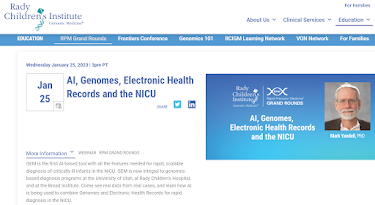
Just saw an interesting advertisement for Rady Children's Institute Grand Rounds in Genomics, for January 25, 2023 (3 PT).  Topic is AI, Genomes, Electronic Health Records and the NICU by Mark Yandell PhD of Univ. Utah.

Find the registration here:

https://radygenomics.org/rpm-grand-rounds/


CME available.  Explained as:

  • The NICU is the first point of contact and frontline for the battle against human genetic disease. This seminar will inform you as to the scope and diversity of genetic disease in the NICU and will help you to better: 
  • Grasp the complexities engendered by ‘big data’ for rapid diagnosis of critically ill newborns, and why Artificial Intelligence (AI) and Machine Learning (ML) are needed for optimal use of today’s enormous online clinical resources.
  • Better understand key AI concepts such as explainability, transportability and Bayes factors, and why they are important.
  • Understand how clinic notes and accessory factors such as a newborn’s ancestry, consanguinity and sex are used for AI-assisted diagnosis.

Tuesday, January 3, 2023

Brief Blog: CMS Publishes 2023 Lab Fee Schedule

I noted in a prior blog that CMS had updated its webpage of PAMA rules, indicating 0% PAMA-based lab fee cuts in CY2023.  This is based on the December 2022 federal budget bill.

On January 3, 2023, CMS published the full A to Z lab fee schedule for CY2023.  I believe the publication was delayed due to pending legislation and uncertainty.

Find the 2023 fee schedule here:

https://www.cms.gov/Medicare/Medicare-Fee-for-Service-Payment/ClinicalLabFeeSched/Clinical-Laboratory-Fee-Schedule-Files

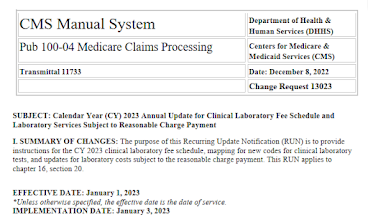
See related PDF file, "CR 13023," here.  This file is 21 pages long and includes crosswalk/gapfill instructions and new code information (e.g. PLA codes from 0355U up).

https://www.cms.gov/files/document/r11733cp.pdf

Total Codes; PLA Codes

The lab fee schedule is 1922 codes long this quarter.  Almost 400 of those are PLA codes.

Gapfill Codes

It looks like about 45 codes are in the "gapfill" process because they have indicator "L" locally priced and fee schedule price "0".  A G-code created in 2021, G0327, remains priced at "0" or unpriced; this is not in gapfill but is a placeholder code for liquid biopsy colon cancer screening test (no such test is yet approved by FDA).

Price Ranges

Prices run from $2.17 urinalysis to 0211U, tumor exome and other sequencing, $8455.   (I'm leaving out code 81416 which is "exome sequence analysis, comparator exome" and is an anomalous price at $12,000 (!!)  resulting from the PAMA 2018 process.)  

A dozen codes are $5000 and up. 

Sequestration

Fee schedule prices generally remain exactly the same as last year (e.g. tumor panel 81455 is $2919.60 again).  Sequestration federal budget cuts (e.g. -2%) apply after the fee schedule process (read here, question 4) and during actual payment, "claim adjustment reason #253 sequestration" is applied.

Long Descriptors in 2023 Column "I"

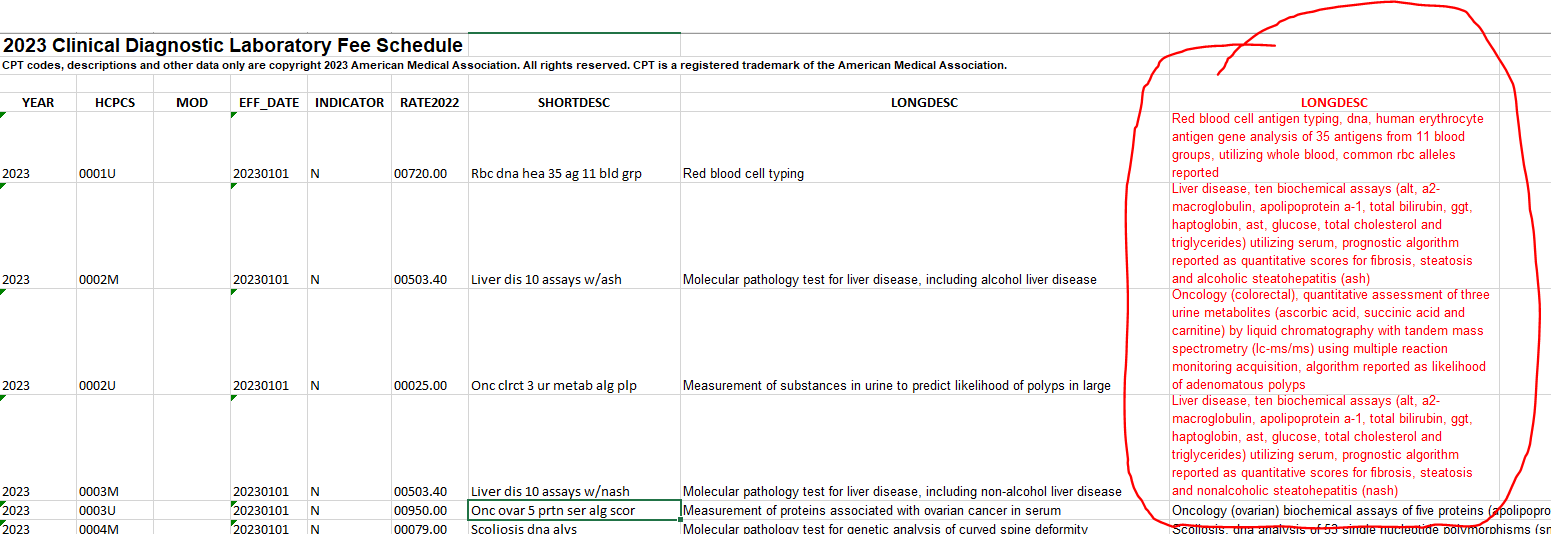
In some past quarters - I had Q12022 handy - CMS lists code, price, short descriptor (provided by AMA, limited to around 25 characters) and a "long descriptor" which to my knowledge isn't generated by AMA and is often 5-8 words long (for PLA codes).

Last quarter and this quarter, Q12023, CMS lists short descriptor (provided by AMA), that "long descriptor" (often 5-8 words) and then, the entire long descriptor (the full code text) published by AMA.

Like this, 2022:


And with AMA full text long descriptor now in Q1 2023:


  ####


Sunday, January 1, 2023

Brief Blog: CMS Updates Webpage for Latest PAMA Pricing Rules

CMS has updated its PAMA regulations page based on the December 29, 2022 federal budget bill. 

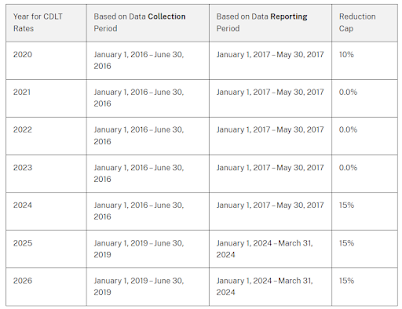
 There will be no PAMA rate cuts in CY2023, but there will be a three year block of rate cuts that are capped at 15% per year (2024, 2025, 2026).  

Background

The original PAMA legislation for lab pricing envisioned the Period 1 three year fee schedule as 2018, 2019, 2020, with 10% caps on rate cuts.    Then, Period 2 would occur, a three year fee schedule for 2021, 2022, 2023, with 15% cpas on rate cuts.

Congress has set the cap at 0% (no reduction) in 2021, 2022, and now 2023.   However, the "three years of 15% caps" idea is still in the legislation and should now come out of hibernation and occur in 2024, 2025, 2026.   After that, there are no caps on the size of rate cuts in each new PAMA cycle.

CMS updated its web page accordingly.

https://www.cms.gov/medicare/medicare-fee-for-service-payment/clinicallabfeesched/pama-regulations


Brief Blog: AMA Releases Latest Quarter of New PLA Codes

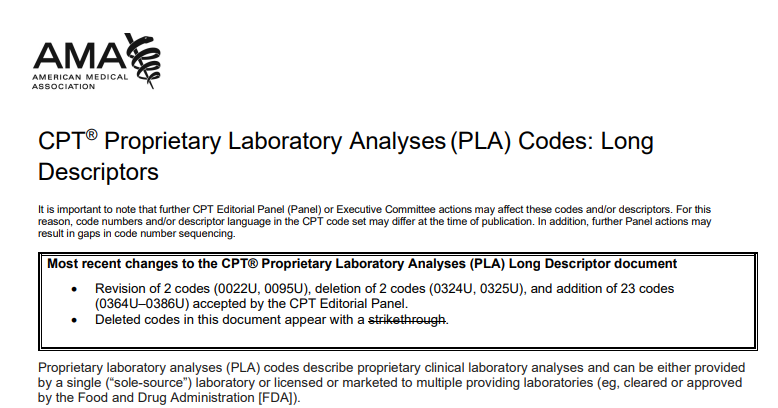
On December 29, 2022, AMA CPT released the latest cycle of new PLA codes, representing codes submitted for review on October 1, 2022.   The codes just released will be effective on April 1, 2023.

Two codes were revised (0022U, 0095U), two deleted (0324U, 0325U for cancer cell culture), and 23 new codes from 0364U to 0386U were created.   Codes 0022U are Oncomine Dx (the Thermo Fisher FDA-approved NGS test) and 0095U Elisa analysis of esophageal biomarkers.   

Among many others, Mayo got a neurofilament light chain plasma test (0361U) and Quest got a large tumor panel (523 DNA, 55 RNA).  These and other codes from 0355U up, will enter the CMS pricing meetings in June 2023.

See the full report here:

https://www.ama-assn.org/system/files/cpt-pla-codes-long.pdf

AMA publishes new PLA codes on a rolling basis each quarter, dropping those codes that appear in the annual CPT publication.   The CY2023 AMA code book runs up to 0354U, so during 2023, each quarterly "new PLA" publication will start with 0355U and end with the newest code of the quarter.


Friday, December 30, 2022

Congressional Budget Guidance to CMS: Sepsis, WGS, Alzheimer's, TCET, More

At the end of December, Congress passed the $1.7T budget bill, which makes for a 1700 page PDF.  It's HR 2617, home page here, final PDF format here.  

Most of the Medicare details show up around page 1175, Title IV, Subtitles A-D with various Medicare extenders and provisions.  

E.g. 4121 provides coverage for marriage and family therapist services, 4136 relates to disposable negative pressure wound care devices.  Section 4114 delays PAMA lab test pricing by a year.  Section 4127 requires OIG to report on "Safe harbor for contingency management," e.g. where drug treatment patients receive a reward like a Starbucks card for showing up for drug counseling and whether that is a program kickback.  See also a March 2022 OIG Advisory Opinion #22-04 on this.

Genomeweb has an open access article highlighting top line budgets ($6.6B FDA [half user fees], $47B NIH, $9B CDC. 

But to understand more, you'll also want to see the 800-page Congressional Record document issued on December 20 (pp 58553-59323), the "Explanatory Statement" of additional instructions from Congress.  Here you'll find actions that various stakeholders are noting in press releases, but which may not always be explicit in HR 2617.

Below the break, I'm clipping a number of paragraphs related to AHQR and CMS.   

Topics include:

AHRQ, budget $373M.   Items mentioned here:

  • Antimicrobial resistance.
  • Primary care research.
  • Diagnostic error research ($20M).
  • Grief care.
  • Heart disease research.
  • Maternal health.
  • Long COVID ($10M).
  • Organ availability.
  • Disabilities.
  • Sepsis ($750K; pediatrics, maternal, nursing home, rehab, pandemic, total public costs).
Turning to CMS, special topics include:
  • Bundled payment for AD diagnostics (PET, Amyvid, radiopharmaceuticals.)
    • Not mentioned, proteomics for hospital-based CSF tests also bundled under CLFS rules.
  • Cardiac CT access.
  • CT colonography (encouraged to consider).
  • Diabetes technology (CMS & FDA uncoordinated).
  • E&M policies.
  • Rural hospital closures.
  • Sepsis - CMS and CDC to develop new (or use existing) measures, cf. measures adopted in NY State.
  • New public reports re sepsis care data.
  • TCET - Transitional Coverage for Emerging Technologies.  Report in FY2024 to Congress.
  • WGS - Whole genome sequence, guidance for state officials, Medicaid.  Includes WGS, WES, gene panels.
Clipped below.

Thursday, December 29, 2022

House Releases 47-page Report on Adulhelm Approval Process

Anticipated since 2021, the House released a 47-page report on the approval process for the Alzheimer drug Aduhelm (aducanumab), with rapid coverage at WSJ and NYT.  WSJ describes the report as, "an 18-month investigation by the Democrat-led House Oversight and Reform Committee and the Energy and Commerce Committee," with quotes from Rep. Maloney (D, NY) and Pallone (D, NJ).  WSJ adds, " Republicans didn’t contribute to the report, according to spokespeople from both parties."

Find the report here.

Find the initial NYT article here.

Find the initial WSJ article here.

Find the initial STAT article here.  

   STAT with focus on pricing here.

Biopharma Dive here.

In other Alzheimer news, 

  • ICER released a report on health economics-based pricing for lecanemab, news story here.  
  • An international group reported a better blood test for Alzheimer's based on a new monoclonal for "brain derived tau" - Gonzalez-Ortiz et al., here.  
  • Bloomberg reported that Fujirebio and others are hot on the trail of an FDA-approvable blood test for Alzheimer's, here.  
    • Fujirebio already has an FDA-approved, CSF-based Alzheimer test from May 2022.


Monday, December 26, 2022

Journal Club: Two CAP Today Articles on Digital Pathology, AI in Pathology

In the December issue, CAP TODAY has two articles on digital in pathology.  The first is focused on digital pathology implementation per se, the second on trends for AI in pathology.

Digital Pathology here:

https://www.captodayonline.com/digital-pathology-now-and-where-to-from-here/

This article also features a link to article(s) on the Mayo website about their AI plans and systems, here.

AI in Pathology here:

https://www.captodayonline.com/artificial-intelligence-in-pathology-the-tools-the-talk/


For supplemental reading on medical technology change, from our colleagues in the field of radiology, see Bluth op ed in J Amer Coll Radiol this month - here.

For an interesting article on the fast pace of AI (absorbing 4 gb, then later 750 gb of data) see Gil Press end of year review in Forbes, here.


Thursday, December 22, 2022

CMS Alzheimer News: PET Scan NCD Delayed; Alz Assoc Requests Drug Coverage Revisited

 A few pieces of year-end Alzheimer news on the CMS front.  An NCD about amyloid PET scans is delayed.  A new request for expansion is submitted, for the very narrow NCD on Alzheimer drug coverage.

AMYLOID PET SCANS

Years ago, CMS reviewed the then-new amyloid PET scan biomarker AMYVID, and determined it would only be covered in endorsed clinical trials.  (One of these, IDEAS, was completed).   The NCD included a flat limit of one scan per patient. 

Now, there will potentially be Alzheimer drugs that require two or more serial amyloid PET scans.  In mid 2022, CMS announced it was revisiting its Amyloid/PET NCD, and posted an expected draft decision deadline of December 16, 2022.   Entry point here.

OK, the news:  That deadline has come and gone, and CMS posted a notice it was continuing to review recent data on the topic. Find update here, which states:

December 15, 2022 // CMS will not be issuing a proposed NCD on Beta Amyloid Positron Emission Tomography in Dementia and Neurodegenerative Disease today. A proposed decision is forthcoming after CMS has reviewed newly published evidence that is relevant to the proposed NCD.

That recent news, of course, is the lecanemab clinical trial, Van Dyck et al, November 29, 2022, NEJM here.


LIMITED DRUG COVERAGE FOR AMYLOID DRUGS

In 1H 2022, seems like a long time ago, CMS announced very limited clinical trial for the FDA-approved Alzheimer drug Aduhelm, with the result that the drug was essentially off the market. (Alz. Assoc comment here.)  

The NCD applies prospectively to future approvals of future amyloid drugs, something that riled some stakeholders and led Congr. Buchanan to introduce legislation - "MERIT" forbidding NCDs to have "class action" on all drugs in a class (here).  News item here, here.

What's new.  With a press release and an 11-page open letter to CMS, Alzheimer Associate asks CMS to substantially expand drug cover for this class of drugs.

NCD request letters are always worth reviewing to see how different stakeholders approach the problem.  It's an issue of providing thorough evidence, but not going on forever (10pp not 100pp).   It's an issue of convincingly stressing the positive, while not failing to mention or  deal with reader objections and counterarguments.   It's a tough balance and letters like this often go through a number of  re-writes.   

__

About the same time, ICER has released a pretty negative report on the health economics of  Alzheimer drugs.  Here.

For comparison, see a 14 page MolDx LCD request letter here.  For an extra type of comparison, see ACLA's short white papers and press releases on the validity and value of NIPS testing, here

__

For the CDC pages from HR 2617 and from Congr Record, here.

Tuesday, December 20, 2022

ACLA Press Release Fights Negative Media re Non-Invasive Prenatal Screening (NIPS)

The year 2022 saw some negative press about prenatal circulating DNA screening tests, from New York Times on January 1, from ProPublica on December 6.

In April ACLA issued a short rebuttal linked to a more detailed 3 page PDF on NIPS.

Now on December 12, ACLA specifically addressed ProPublica concerns and labeled it "misleading information" that "fails to provide an up-to-date picture."  Find the new ACLA press release here.

The December ACLA comment makes 6 points:

  1. NIPS is a screening test (it is not a diagnostic test, it is used to trigger other tests).
  2. NIPS is a significant advance over the prior status quo.
  3. Use of testing is voluntary.
  4. Only health care providers can order NIPS.
  5. Laboratories that offer NIPS have high standards.
  6. ACLA is actively engaged in regulatory reform discussions on Capitol Hill.


__
It's a jump, but for comparison, you might see new Alz. Assoc. letters re evidence & validity to CMS, here.


Very Brief Blog: Senate Finance Bill Released: PAMA Bumped a Year; no VALID

What is probably a final year-end financial bill was released on December 19, 2020, and two items of lab news.

One, a one-year delay of PAMA is included (Section 4114).  A bigger  PAMA reformed (abbreviated SALSA) didn't make it in.

Second, there is no "VALID" bill, meaning the end of FDA regulation of LDT's for this Congress.    (Recall that recently FDA leadership warned they may approach LDT regulation via FDA rulemaking (unless its general device authority) if VALID didn't pass).

##

The bill isn't final til its voted and signed, so stay tuned.  ACLA applauds the draft legislation, December 20.

##

PDF here per NYT.  Physician fee cuts tempered at 4112, telehealth extension 4113, coverage of marriage and family counselors in Part B at 4121.  Some singular items like lymphedema treatment 4133, negative pressure wound devices 4136, certain non-opioid treatments 4135.

The bill also gives FDA better authorities to withdraw accelerated approvals (per Endnotes).

Per NYT, the bill contains $858B in military spending and $772B in domestic programs.


Photo by George Dolgikh: https://www.pexels.com/photo/several-gift-boxes-1666069/

Sunday, December 18, 2022

CMS CCI Edits for 2023: Some New AMA DNA-RNA Codes "Mutually Exclusive"

Every fall, CMS releases new edits called "P2P" Procedure to Procedure Edits, which are pairs of codes are unpayable on the same claim.  (These are released as gigantic Excel spreadsheets).  And every fall CMS also releases its manual for correct coding in each area of AMA CPT.   

These documents have been released for 2023.  There are only tiny changes in the lab section of the manual, and regarding the new genomic sequencing tumor codes for RNA, CMS only quotes a phrase already in the code descriptor itself.  

Of more interest, I think they allow both a DNA code and an RNA code for solid tumors and for hematologic cancers (both, 5-50 gene range), but CMS pivots and doesn't plan to allow the 50+ tumor gene code to be used with its new RNA-only sibling codes.  

The New CMS Resources

NCCI home page here.

Find the new P2P edits in Excel here.

Find the new coding manual for 2023 here.

The AMA GSP CGP Changes

Basically, AMA has three familiar codes for cancer genomics, 81445 (solid cancer, 5-50 genes), 81450 (hematolymphoid cancer, 5-50 genes), and 81455 (any cancer, 51+ genes).  

These 3 codes are defined as representing either DNA only reports, or DNA/RNA reports when the DNA and RNA is done in an integrated procedure.   

New.  When RNA is done as a separate procedure, or later, AMA has new codes.  

These are 81449 (RNA analysis, 5-50 genes, solid cancer), 81451 (RNA analysis, 5-50 genes, hematolymphoid cancer), and 81456 (RNA analysis, 51+ genes, any cancer.

Let's list them as AMA does:

  • 81445 (5-50 genes, solid cancer, DNA or DNA/RNA analysis)
    • 81449, same but RNA only
  • 81450 (5-50 genes, hematolymphoid cancer, DNA or DNA/RNA analysis)
    • 81451, same but RNA only
  • 81455 (51+ genes, any cancer, DNA or DNA/RNA analysis)
    • 81456, same but RNA only
AMA adds some clarifying text to its discussion page for sequencing procedures.  Regarding these RNA codes, AMA writes,
  • Testing for somatic alternations in neoplasms may be reported differently  based on whether combined methods and analyses are used for both DNA and RNA analytes, or if separate methods and analyses are used for each analyte (DNA only, RNA only).  
    • For...a single combined method, use 81445, 81450, 81455.  
    • For targeted genomic sequence analysis of RNA when performed using a separate method, report 81449, 81451, 81456.  
  • For...DNA analysis AND RNA analysis performed SEPARATELY rather than via a combined method, report 81445, '50, '55 for DNA analysis AND REPORT 81449, '51, '56 for RNA analysis.

This fall, CMS priced the new RNA codes at the same price as their sibling DNA code, so if you are able to report both, the CMS payment would exactly double.

I would think that on the lab bench, RNA analysis is always at least partly separate from DNA analysis (reverse transcriptase etc), and there's no clear instruction for "partly separate" methods, so I am sure there are some dotted lines to be filled in at some point.  Alternately, the running of "partly separate methods" might lose out financially against a decision to shift lab chemistry towards "wholly separate" methods for the DNA and for the RNA.  

CMS P2P Codes and DNA/RNA Analysis

The P2P edits  are literally hundreds of thousands (100,000's) of lines long, and I'm not guaranteed to be reading them correctly.  

However, what I think I found, is that the 5-50 gene versions of RNA and DNA codes are NOT edited against each other (do NOT deny in tandem), but the 51+ versions ARE edited against each other (if you bill 81455, you can't bill any of the RNA codes).   See graphic: 


In other words, as I am reading this, 81445/81449 are "not" classed as mutually exclusive, but 81455/81456 "are" classified as mutually exclusive.  

Regarding the nuances of "separate method," CMS in its manual only quotes the same phrase the AMA uses:


Footnote

An AMA workgroup is working in 2022, 2023, on further revisions to the tumor genomic sequencing codeset (e.g. here).

There are other examples of mutual exclusive procedures; for example, cytogenomics codes (81228, '229 (constitutional), 81277 (cancer), 81349 (germline by low pass NGS) appear to be generally blocked from use at the same time as tumor genomics codes (like 8145, '50, 55).   (Again, all the combinations and where they appear in the tables make it a bit confusing).  Shown below, if you bill 81228 microarray, they don't want to pay on the same day for tumor codes 81445 to 18456.


__
JAMA provides a brief review of the growing uses of RNASEQ in healthcare. 


Very Brief Blog: ARHQ Draft Report on Pre-Eclampsia (Hypertension in Pregnancy)

 I've occasionally run across projects to develop better biomarkers for pre-eclampsia in pregnancy and for the risk of progression to  eclampsia.

AHQR is running a 2022/2023 topic on the project.  In March, they posted a project plan and took comment; the plan is still online.

https://effectivehealthcare.ahrq.gov/products/hypertensive-disorders-pregnancy/protocol

In November 2022, they posted a 76 page draft report with a 150 page appendix, and they are taking public comment til January 10, 2023.  

https://effectivehealthcare.ahrq.gov/products/hypertensive-disorders-pregnancy/draft-report#field_report_title_1

Biomarkers are not a focus at all.   Topics include (1) whether to use home blood pressure monitoring, (2) value of diuretics, (3) value of magnesium sulfate.

There are a couple very short passing remarks regarding biomarkers (to predict response to treatment, or, to predict seizures related to magnesium therapy, but blink and you'll miss these).  See a recent LANCET article on, "Clinical tools and biomarkers to predict preeclampsia," McDonald et al, PMID 34954654, open access, here.   Review articles like that apparently live on a different planet than the AHRQ scope of review.

I've put the half-dozen or so relevant documents in a cloud Zip file here.


Friday, December 16, 2022

Very Brief Blog; CMMI Issues Annual Report to Congress (113pp)

The Center for Medicare & Medicare Innovation / CMMI, has published its annual report to Congress, the 2022 version weighing in at 113 pages.

Report here.   Coverage at RevCycle here.   See Laura Beerman's recent HealthLeaders article about CMMI here.


Thursday, December 15, 2022

Brief Blog: New Medicare Advantage Regs; Focus on New Coverage Rules & Misleading Advertising,

CMS has released proposed rules for Medicare Advantage (& Part D).  The rules cover numerous topics but the headline focus from CMS has been on "misleading advertising" in Medicare Advantage plans.

Note that there are also many pages, and new regulations, on how Med Adv plans must implement LCD coverage, other coverage, and clinical trial coverage (notes at bottom of blog).

____

The term "misleading" occurs 28 times in the proposed rule and 4 times in the Fact Sheet. (The term "fraud" occurs 34 times).

Note that, separately, CMS has proposed regulations that would affect prior authorization and require electronic submission and adjucation in Medicare Advantage, Medicaid, and Exchange Plans (here).   Congress had also proposed some statutory changes around Prior Auth, but only focused on Medicare Advantage. 

As usual, CMS issues three documents, a press release, a fact sheet, and the actual rule.   The typeset publication will be 12/27 in Federal Register.  Comment to February 13.  

The rule doesn't occur in isolation.  

  • CMS notes that a "request for information" last summer drew 4000 comments.
  • In October, 2022, CMS vowed to crack down on misleading M.A. marketing.  Here
  • The Senate recently looked at misleading M.A. marketing.  Here.
  • Initial press coverage Dec 14 from AP and from Fierce Healthcare.
    • The latter covers both the prior auth rule (12/7) and the misleading marketing rule (12/14).


COVERAGE:  LCDs, CLINICAL TRIALS, CLARIFICATIONS

CMS promises to clarify regulations for M.A. plans regarding clinical trials; see  rule preprint p 390ff and section G / Regulation 422.101, 422.109.  

See also discussion of Med Adv having "basic coverage" such as by reference to LCDs at page 130ff.   This is a basic idea in Medicare, but it is being beefed up by rulemaking and provides stakeholders a good change to comment.  (Also related are rules about utilization management and prior auth, p. 148ff).


Brief Blog: Palmetto Issues "Vitamin D" LCD; Hews Tightly to Guidelines

Medicare LCDs often stick closely to major guidelines, and we see that's the case again in a new LCD issued by Palmetto, for Vitamin D testing.

Code 82306 Vitamin D is one of the very highest codes in Medicare Part B, paying $191M in 2021 (6.5M uses).  

Palmetto has issued two clinical chemistry LCDs with breakneck speed.  One for magnesium was proposed September 1, received zero public comments, and was finalized December 8.   (Here). 

The LCD for  Vitamin D testing was issued the same day, September 1, but finalized on December 15, requiring an extra week to respond to the comment received.   Final LCD L39391 here.  Response to comment article A59276 here.

I've clipped the Q&A after the break.  Palmetto added conditions if they were endorsed by the Endocrine Society for Vitamin D testing.  Sarcoidosis, other granuloma disorders, are accepted.   Because they are not endorsed by Endocrine Society, claims for fibromyalgia and psoriasis are denied.