Friday, September 2, 2022

Fact Checking the NYT: Conviction for "$77M Blood Testing Scheme"

On Friday September 2, 2022, up popped a NYT article on a "biotech executive conviction" for a "$77M scheme" involving false claims for COVID and other blood testing.  See the article here:
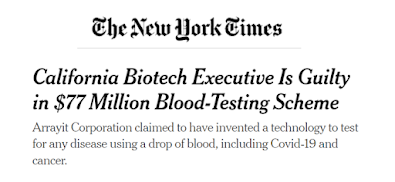
https://www.nytimes.com/2022/09/02/business/mark-schena-arrayit-fraud-theranos.html?searchResultPosition=1

I went to the CMS database for 2020 claims paid by doctor or lab - here.  Searching for ARRAYIT, there were only two payable claims lines in CY2020, 86001 (allergy testing) and 86003 (IgE blood testing).  

_____

Quoting the NYT, we read:  "Mr. Schena was convicted of a total of nine federal charges, including conspiracy to commit heath care, wire and health care fraud and three counts of securities fraud. He faces up to 20 years in prison for conspiracy to commit health care fraud and conspiracy to commit wire fraud, as well as 20 years for each count of securities fraud."

The article says that recruiters and doctors got kickbacks and bribes that involved running (or ordering) tests for 120 allergens, "regardless of medical necessity."   We also read that "submitted fraudulent claims to Medicare and private insurance for unnecessary allergy testing. The company billed more per patient to Medicare for blood-based allergy testing than any other laboratory in the United States, the Justice Department said. Some commercial insurers were billed more than $10,000 per test."

As with other Department of Justice Medicare cases, anybody can look up payment records for that lab or doctor, at least, until December 2020.  (2021 claims will be released next spring).   

In the 2020 database, ARRAYIT had only two paid claims lines, for 86001 and 86003.  There were a trivial 216 patients getting 216 tests for 86001.  However, there were 215 patients getting 13,392 tests ($68,433) for 86003, IgE testing.

Dollar Volume

At least for CY2020, and from these Medicare Part B records, that isn't much.  Total 2020 Part B payments for 86003 were about $11.7M, so the Arrayit $68,433 was only 0.6%.  38 entities were paid more than that for 86003, including about 10 over $200,000 and the highest, Labcorp, at $2M.   

Tests per Patient

Regarding tests per patient, at 62 paid tests per patient, Arrayit ranked 14th in the US.  Six entities were paid for between 75 and 99 tests per patient (not necessarily on one day).   (The data shows 84,000 patients and 2.2M services, or an average of 27 per patient).  

"The company billed more per patient to Medicare for blood-based allergy testing than any other laboratory in the United States, the Justice Department said."  It's possible the company billed more tests per patient to Medicare than any other entity- who knows, they could bill 500 tests per patient - but they were only PAID for about 60 tests per patient, and the total 2020 dollar volume in Medicare Part B was modest.   

(This contrasts to genetic test fraud reports from DOJ, where they name one or another lab as getting $25M in payments, and yes, you can look it up and the CMS data shows just that.)

The original Justice Department press release is here:

https://www.justice.gov/opa/pr/medical-technology-company-president-convicted-77-million-covid-19-and-allergy-testing-scheme

See some additional docket and indictment materials here.  It is noted that the jury decision was September 1, 2022, and the sentencing hearing is set for January 30, 2023.

https://www.justice.gov/criminal-vns/united-states-v-mark-schena

"Superseding Indictment," 19pp

https://www.justice.gov/criminal/file/1406701/download


##

See coverage of this case at FierceBiotech here.


Brief Blog: Genomeweb Genetics Fraud Article; Further Documents

A couple weeks ago, I published and article (and a video) on Medicare fraud as evidenced by Department of Justice documents, which the reader or a journalist can easily cross-reference to the named lab's Medicare payments in the prior year.   Article here.  Invariably, year on year, huge crazy payments form Novitas and FCSO MACs, and paid for genetic testing that was ridiculous on its face.  No "AI" needed.     

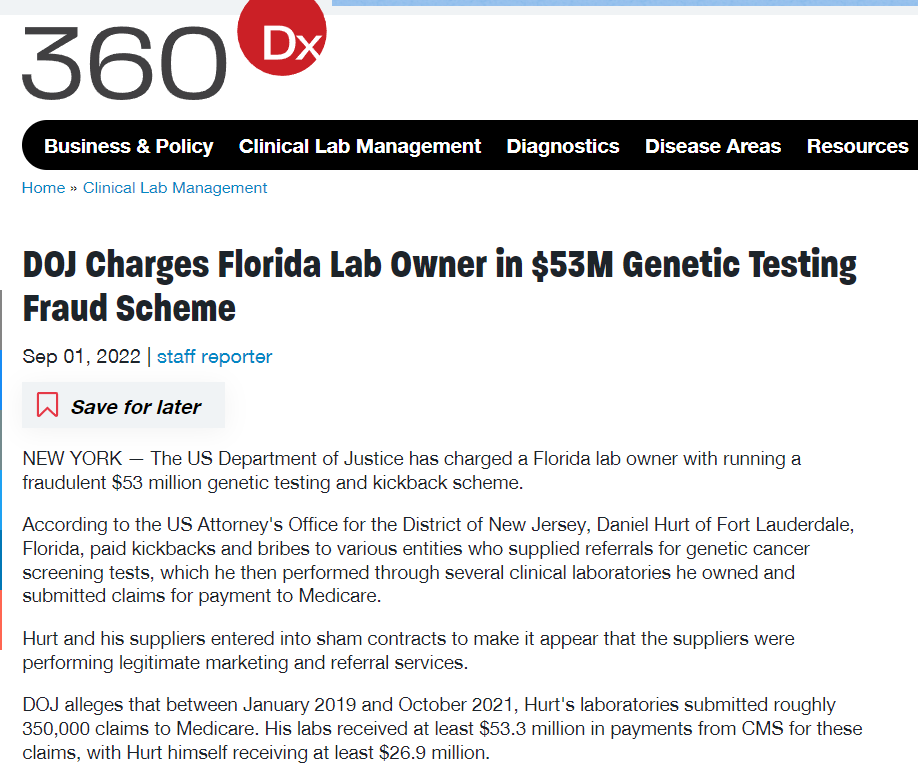
Today's news, another DOJ press release in the ongoing saga, covered by Genomeweb.   The Genomeweb articles about $53M of genetic testing fraud (their headline) is here.  

Stated as a lab with operations in Houston and Ft Lauderdale.   Going to a public database of genetic test payments by Medicare in CY2020, there was just one Medicare genetics lab based in Ft Lauderdale, which had $27.5M in payments from FCSO, of that, lo and behold, $24M for "tier 2 codes" which the MAC chose to leave on unedited status (auto pay) year...after year...after year...as these press releases from DOJ have been pumping out since 2019, three years ago.    Along with avalanches of payments for muscular dystrophy, Noonan syndrome, Usher syndrome, etc.  


See 3 minute video, based on this blog, here:

-----------
Genomeweb links to the DOJ press release here:

https://www.justice.gov/usao-nj/pr/florida-lab-owner-charged-53-million-health-care-fraud-and-kickback-scheme-related


But THAT, in turn, links straight to actual court documents, which some readers might enjoy (if you like watching burning buildings and cars going off cliffs, you'll enjoy this 13-page court document):

https://www.justice.gov/usao-nj/press-release/file/1529726/download


The court documents cite payments for sceptical-looking genetic testing through at least October 2021.  This is stomach-churning, because the claims fraud patterns and the ease of instantly detecting them were obvious by (at the very latest) July of 2019, per other DOJ documents under Operation Double Helix.  

I wrote about 81408 as the "fraudomatic" code in October 2020, two years ago, based on data that the MAC and CMS had a year earlier than that, but had just released publicly in October 2020.  And it was all covered in detail in Dark Report in December 2020 ....but Novitas payments (per this new DOJ document) were still gushing out into late 2021 in the same unimpeded manner.

Thursday, September 1, 2022

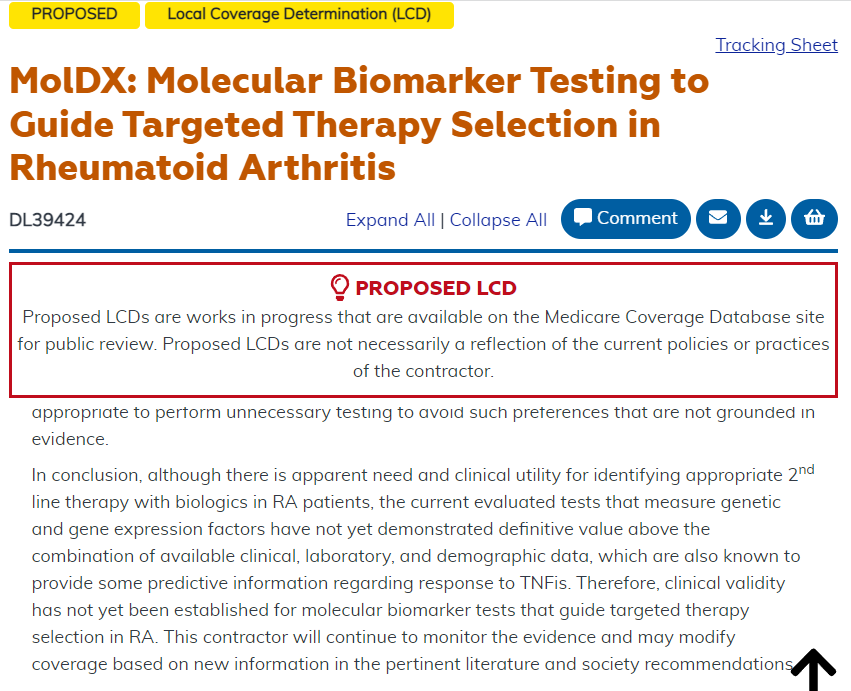
MolDx Releases Draft LCD for Molecular Therapy Selection in Arthritis (Doesn't Like It)

MolDx has released a brand new LCD for public comment, under the title, MolDX: Molecular Biomarker Testing to Guide Targeted Therapy Selection in Rheumatoid Arthritis, LCD DL39242.

Find the listing of newly released draft LCDs here.  Open DL39424 here.  Comment runs until October 15. 

When you click on the link, you get both the LCD page and, for me, a pop open window that floats on top that gives a summary with the issue, the requestor (if any), and links to documents.  Note that the issue description is terse:  "This LCD outlines non coverage for this service with specific details." 

The request is a two-page cover sheet to a submitted dossier (not provided).  The two-page cover sheet here gives a table of contents of what was submitted, but not the actual content.  For example, we don't know what indication or intended use was requested.  (See *) The cover sheet is also undated, so we don't know the time lag between the LCD request and the execution (so to speak).   The requested coverage is for the PrismRA test.  We do read here, in the new cover materials, there was a contractor advisory meeting back on December 7, 2021.

While the request was from PrismRA, the non coverage is broader, "Current molecular biomarker tests to guide targeted therapy selection in Rheumatoid Arthritis (RA) are non-covered by this contractor."  Note that MolDx now only directs itself to molecular tests, so a proteomic RA test would be out of scope.

The LCD has 88 citations.

The contractor meeting for this topic, and others in the past two years, are posted here:

https://www.palmettogba.com/palmetto/jmb.nsf/DID/B7ML3E2571

Note that the December 7, 2021 meeting is listed in order under its "posting date" which was 1/13/2022.  I wrote about it a bit, at the time.  

No billing article is attached.  (A billing article could be pro forma, even with a non coverage LCD, such as "for denials and appeals, bill this way."  However, such a draft article wouldn't attract much public comment.)

I wasn't able to identify a CPT (or PLA) code for PrismRA, suggesting it doesn't yet have a defined Medicare price.  The website for the test is here:  https://www.prismra.com/

The parent company appears to be in Waltham MA, so it isn't immediately clear why there is a MolDx LCD, since MolDx doesn't process Massachusetts claims.   The parent company SCIPHER raised $110M six months ago - here.


(*)
In contrast, I found a different LCD, related to melanoma, that had a full 14-page LCD request letter as an attachment.  That could be a useful model for readers, unlike the LCD request in this article today, which is basically redacted til only a table of contents is left.


Hold On to Your Hats: MolDx Updates Hereditary Cancer Testing Spreadsheet (NGS PF 006 now V5)

MolDx has a new hereditary cancer testing LCD this summer, which is heavily dependent on two supporting documents, a billing and coding article, AND, a technical assessment worksheet in Excel.

Longstanding LCDs like L36163 (BRCA testing) and L36370 for Lynch syndrome have been retired. (*)

In their place is a composite LCD for all hereditary cancer syndromes, L38972.  This basically states that hereditary cancer panels are covered if the patient has a (personal) cancer diagnosis, a "clinical indication" for germline testing, a "risk factor" for inherited cancer, the test has completed a MolDx TA, and in particular:

  • The test performed includes at least the minimum genetic content (genes or genetic variants) with definitive or well-established guidelines-based evidence required for clinical decision making for its intended use that can be reasonably detected by the test.
  • Because these genes and variants will change as the literature and drug indications evolve, they are listed separately in associated documents, such as the MolDX® TA forms.
The LCD conforms to requirements in NCD 90.2 for NGS testing in cancer patients.   (However, the tests are not required to be NGS tests, as occurs in NCD 90.2).   

  • TIP: NCD 90.2 defines what is a CMS "clinical indication" and "risk factor" which I can never remember without looking it up (more here).   A risk factor is "not a clinical condition" (e.g. age is a risk factor, and so is family history) but a clinical indication is something "clinical" like a medical sign, symptom, or test result.    The LCD requires a personal history of cancer, AND a clinical indication (not listed) AND a clinical risk factor (not listed); but the NCD directly defines a personal history of cancer as already being a clinical indication (previous link).

The LCD is then dependent on a billing article, A58679.  This MolDx billing article generally blocks the use of 81162, the standard two-gene BRCA code, because there is no cancer where this is the only gene recommended for testing.  Since "medically necessary use of BRCA" only occurs in panels, MolDx requires it to be billed in panels (either a CPT panel like 81432 or a MolDx local panel under code 81479.)

But wait, there's more: MolDx TA Article Associates Genes and Cancers

But wait, there's more.  Every panel covered under LCD L38972 must be approved through a MolDx tech assessment, which is Form NGS PF 006 V5.   Find it on the MolDx technical assessment page here.  (While you're at it, don't forget to carefully study the FAQs as well, here.)

Form NGS PF 006 V5 has been updated effective August 31, 2022.

Comparing V4 and V5

I've put an archival August 26 version of V4 in the cloud here.

The original version had one tab, beginning with the Z code for the test, and the indications for use (e.g. "breast cancer.")   Note that guidelines tend to view these hereditary tests categorically, like "HBOC" (hereditary breast and ovarian cancer) and "Lynch syndrome."   However, Medicare requires the patient to have a particular personal cancer, so "breast cancer" is the entry point, not 'HBOC" or "Lynch."  MolDx then asks several preanalytical questions (#4), analytical questions in general (#5), and post analytical questions (#6, eg "Who signs out these results?")  Question #7 asks for sample types, and the largest question was Question #8, detailed benchtop validation data in clinical (or non clinical) samples.

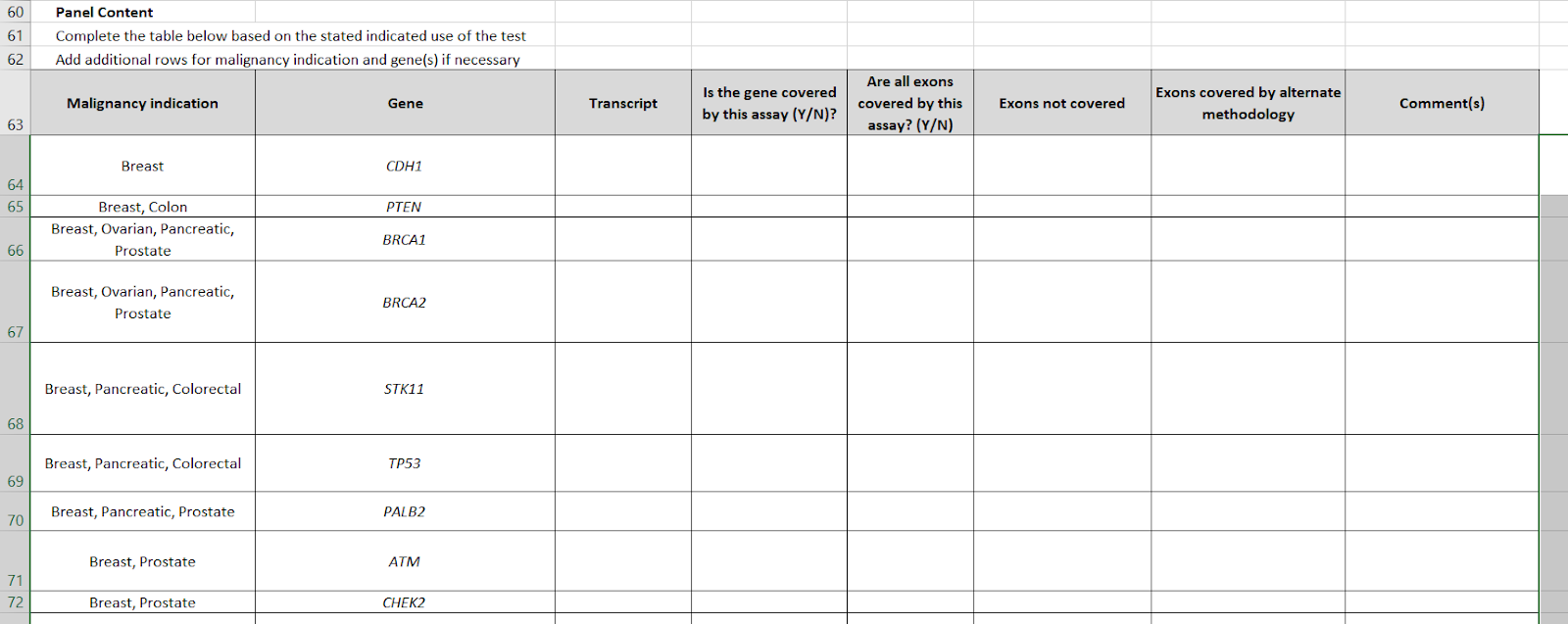
Then, a key table was #9, required genes.    This listed 24 genes and which cancers each one was required for.   

OK, now update to V5.

V5 is divided into three tabs.   

The first tab is "test information" and requires an attestation that the information is accurate to the best of the lab director's knowledge and was performed in the CLIA lab associated with the Z code, not somewhere else.  (There were some labs cited in Operation Double Helix and other DOJ operations that primarily referred genomic tests out to some other lab, said Reuters.)

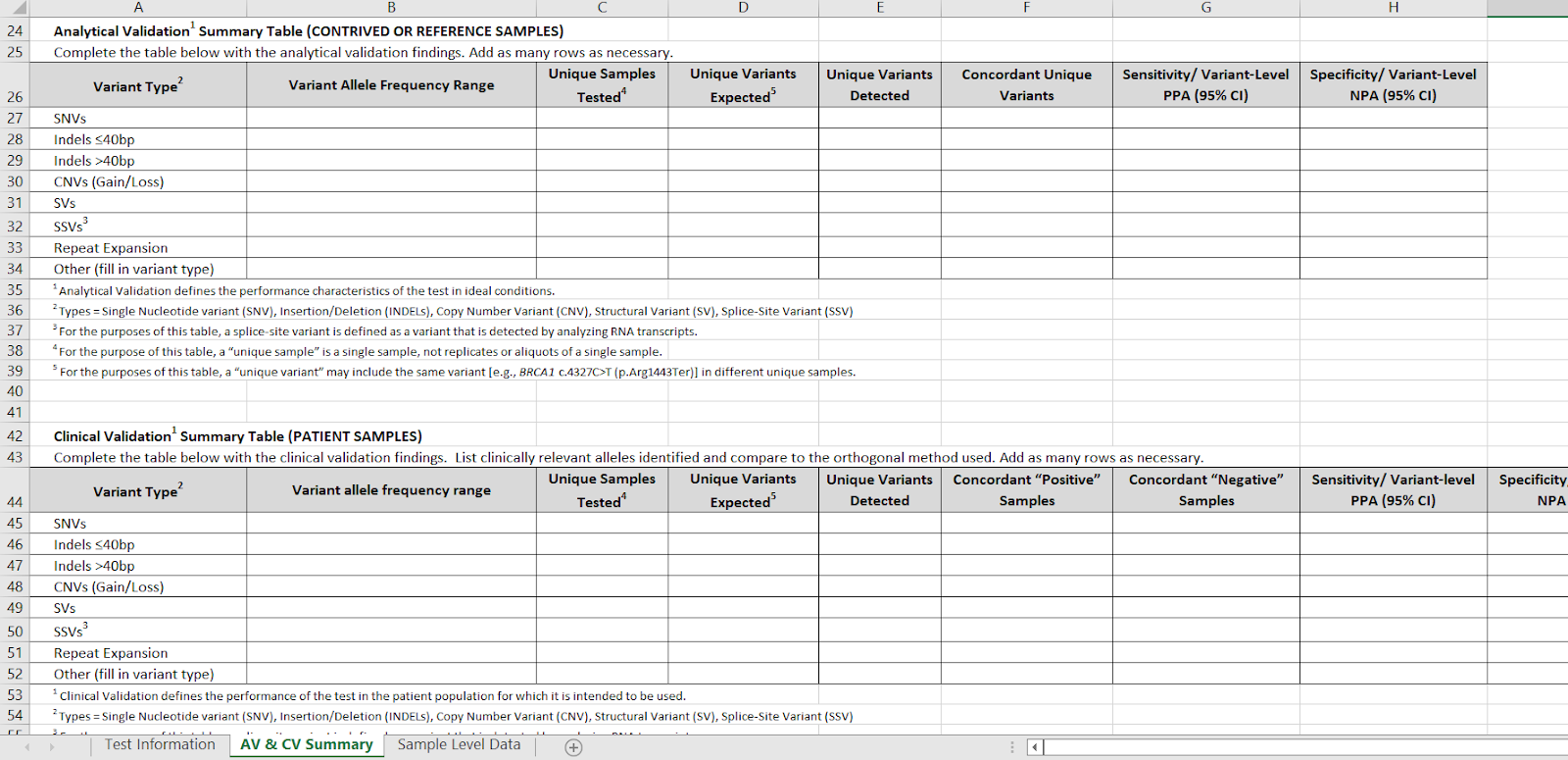
Tab 2 has separate detailed tables for analytical validation on contrived or reference samples (e.g. Coriel) and clinical PATIENT validations.   These two tables are now placed adjacent to one another for easier comparison.

The table for gene-cancer associations has been inverted.  Whereas V4 was a list of genes, and a column with the names of cancers, now we have "malignancy indication" as the first column, which may be multiple (e.g. STK11 is "breast, pancreatic, colorectal") and a gene list.  The gene list has been raised from #24 to #35.   In particular, conditions like tuberous sclerosis and neuroendocrine cancers, have been added.  

There is now a third tab, which is "Sample level data."  This table has 7 columns:  Sample identifier, Cancer type, sample type, Variant class, Gene (BRCA), Variant (C4327C>T), and variant class ("Pathogenic.")   


___

If you like Lynch syndrome, see an August 29, 2022, case study in the My Gene Counsel series at Precision Oncology News by Turna Ray.  It's about not diagnosing "Lynch syndrome" without genetic confirmation.   Which reminds me of a 2019 blog, in which I noted Medicare defines high risk cancer screening literally as if they've never ever heard of Gregor Mendel.
___

(*)

MolDx LCDs and articles have different reference numbers depending on the jurisdiction; I have used Noridian reference numbers here.


Friday, August 19, 2022

Very Brief Blog: A MAC Statement of Work, 2021 (Jurisdiction 15 A/B MAC)

One of the smallest jurisdictions for a Medicare MAC is A/B MAC J15, which is Ohio and Kentucky.  It currently belows to the CGS MAC, which shares ownership links with Palmetto MAC.

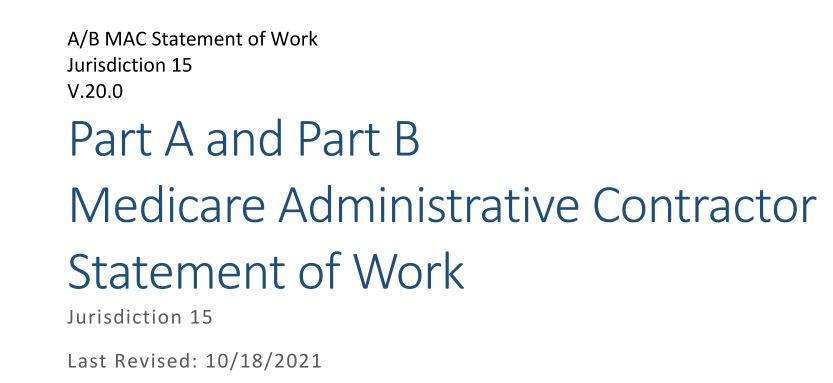
The MAC was put out to bid last October, 2021, and I ran across a 172 page Statement of Work.  If you'd like a current MAC SOW as a reference, here's a link to it:

https://govtribe.com/file/government-file/attachment-2-j15-ab-mac-statement-of-work-dot-pdf

TOPIC:  MACS AND FOIA

For example, page 157-158 talks about running a FOIA office at the MAC, something that has quite variable diligence and quality at different MACs.  (See my blog, Lamest FOIA Response Ever, here.)

TOPIC:  MOLDX

J15 is part of the MOLDX policy system, but there is nothing about MOLDX or molecular testing in the SOW for J15.  That is executed via a separate MAC-to-MAC agreement.  However, the last time I checked, MOLDX was included as part of the statement of work baked into the MAC for JM, which is Palmetto.

TOPIC: DIALOG WITH MEDICARE ADVANTAGE

Page 169 talks about how MACs are obligated, as part of their SOW, to share information with Medicare Advantage plans and "maintain an ongoing dialogue with these entities" to provide the MA plan with "information...needed to administer their plans."   MA plans are supposed to match FFS Medicare in terms of coverage.


Thursday, August 18, 2022

DOJ Releases Bonanza of "Telemedicine Fraud" Documents, Most Implicate Genetics and Novitas MAC Payments

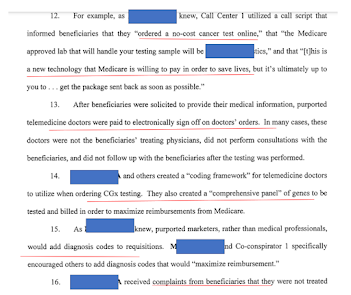
The Department of Justice has recently released a treasure trove of indictments and related documents under the umbrella of "telemedicine fraud."

However, the reader will quickly note, the problem isn't the "telemedicine."  They aren't worried about the costs of a $45 telemedicine call.  They are worried that the calls would result in $10,000 of improper genetic test orders, one after another.  Some cases involved DME rather than genetics.

See a DOJ project home page here:

https://www.justice.gov/criminal-fraud/telemedicine-enforcement-action

See a July 20 2022 press release here:

https://www.justice.gov/opa/pr/justice-department-charges-dozens-12-billion-health-care-fraud

Of special interest, see the couple dozen court documents here:

https://www.justice.gov/criminal-fraud/telemedicine-court-documents

Once you identify names of labs from the court documents, in a few seconds you can look up that lab's 2020 payments from Medicare:

http://www.discoveriesinhealthpolicy.com/2022/07/medicare-releases-detailed-database-for.html

CMS Cloud data CY2020 here, which went live on July 27, just 7 days after the DOJ postings.

https://data.cms.gov/provider-summary-by-type-of-service/medicare-physician-other-practitioners/medicare-physician-other-practitioners-by-provider-and-service

Even easier, see a ready to use 3400 line spreadsheet of all Medicare's 2020 payments for genetic test codes (811nn 812nn 813nn 814nn 815nn):

https://docs.google.com/spreadsheets/d/10HIXvrIPx1DA9EW7Loh0zZ3OKUyR59bR/edit#gid=1860210251

See a 3 minute video about the websites:

https://www.youtube.com/watch?v=LQ4URECsQ9s


click to enlarge


See also:  Two article in the 9/18/2022 DARK REPORT on telemedicine and genetics fraud.

Update: The Lab Industry, Through the Lens of Tier 2 Genetic Codes

Key point: You can look at labs named in public website DOJ documents, and in a few moments, see exactly what codes and claims they were paid for in 2020 by Medicare Part B.

____

What Are Tier 2 Codes?

Back around 2013, AMA CPT brought out a new coding system for lab tests.  Tier 1 codes were named codes (e.g. BRCA or EGFR) numbered 811xx to 813xx.   Tier 2 codes were 8 "buckets" or complexity levels, any one of which might refer to dozens or hundreds of possible genetic procedures (e.g. procedures that measure 2 or 3 exons or procedures that measure 4 to 9 exons).   These were numbered 81401-81408.

2017: Low Volumes of 814XX Payments

These codes were not initially priced by CMS, and payments as late as 2017 were only around $72M, of which $9M or 13% of payments were for 81408, the highest code which pointed to full sequencing of rare genes.  (They were rare genes, hence, that's why they weren't Tier 1 codes).

In 2018, with the first PAMA pricing cycle, all the Tier 2 codes were suddenly priced, and priced as high as $2000 for 81408.

The Tier 2 Industry Grew Rapidly 2018-2020

The Tier 2 coding industry grew rapidly, based on Medicare Part B data that is public.   In 2018, payments rose to $190M (of which $120M, or 65%, for 81408).   In 2019, payments rose to $381M, of which, $284M or 74% for 81408.   In 2020, payments slipped a little to $358M, of which $206M or 58% for 81408.   CMS will release 2021 data in Fall 2022.


In July, Medicare released detailed Part B payment data for every lab (or doctor) and CPT code, for CY2020.   You can get all the data from CMS via easy to use public web resources here.

DISTRIBUTION BY STATE: DON'T MESS WITH TEXAS

Relative to all US genetic payments, the pattern for Tier 2 payments is unusually, with 56% of payments going to 1 state, Texas.   

Together, TX, LA, and FL get 78% of payments, and PA/NJ add 11%.   These are all Novitas (or FCSO) policy states.  

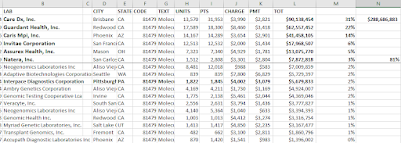
The table below shows a lab in California, a MolDx state, getting $26M for Tier 2 codes, but I understand from other research that MOLDX generally doesn't pay for Tier 2 codes, or very little, and so this CA listing may be an anomaly related to an NPI or Tax ID issue.  If we stipulate that the CA listing is some kind of anomaly (doesn't reflect Noridian claims), then all the Tier 2 payments, practically, were in Novitas and FCSO states.


DISTRIBUTIONS OF LABS FOR EACH PLA CODE

You can also take the largest PLA code, 81408, and see how its 2020 utilization was distributed among individual Medicare labs.  (The original CMS data, linked above, includes lab names, street addresses, etc).  

About 100 labs had at least a few payments for 81408, but the top two labs had about 10,000 patients each for about $20M each.  Of the 100 labs billing 81408, the top ten garnered $134M of the $206M available in 2020.  (One lab had about 4 claims of code 81408 per patient).


DOJ Telemedicine/Genetics Documents

I leave as an exercise for the reader.  The DOJ has a long webpage of cases it is pursuing related to telemedicine orders for genetic tests (in some cases DME equipment).  Here:

https://www.justice.gov/criminal-fraud/telemedicine-court-documents

If you look through the DOJ documents for named labs, and then, refer back to the public CMS claims database I've been talking about, you can see in a few seconds the paid claims billing pattern for each lab that is named and cited by the DOJ.  It's public, and literally at one's fingertips.


MolDx Coverage of Psychiatric Pharmacogenetics: What's Up?

In 2020, MolDx brought out a groundbreaking new LCD for Pharmacogenetics, which tied coverage to CPIC and FDA recommendations, updating coverage in sync with the updates to those coverage resources.   (This summer, 2022, Novitas has offered a draft LCD that would tie or sync its cancer genomic coverage to external resources like NCCN.)

Find the current version of the LCD L38335 here, and the current billing article A57384 here.

While the body of the LCD focuses on gene:drug pairs endorsed by CPIC and FDA.  However, the billing article also has a section called "Multi Drug Panels."  These list 5 tests that are covered EITHER for (a) depression, (b) other psych disorders, or (c) both.   

The current table of coverage for psych gene panels reads like this:

What about pricing?   Go to the DEX online database (email registration required) and you can look up each test and the price MolDx assigns it.  Genesight pegs in at $1568 currently. 

But Wait, There's More

Oddity #1
If you track Genesight, you'll find two entries in the DEX database.  The first entry for Genesight is entitled Genesight Psychotropic, and it describes the Genesight test in detail, but has a flag, "Not Covered" under DEX.    The next entry after that is Genesight Psychotropic Multi Gene, which is stated as "covered" for $1568.   I believe that MolDx current management philosophy viewed the "single test" for Genesight as not covered (hence the term: Not Covered), but if the test is defined differently as a multi-gene test, with reporting criteria that match those required by the LCD, then it IS covered.


GeneSight Coding is Changing

Last year, AMA CPT introduced a new coding for 6 or more PGx genes, a code which CMS is pricing this summer and which will be effective 1/1/2022.   Right now, the expert panel recommendation is to gapfill the test, although crosswalk alternatives are available.  Most priced PLA codes for PGX gene panels have been a lot more than 6 genes.   

Myriad now has a PLA code for its Genesight test, and as of now, recommendations are to crosswalk it to an existing PGX gene panel of about the same size, priced around $1300.  It's code 0345U, effective October 1 (CMS price to be effective January 1).  The crosswalk proposal is to 0175U, Genomind PGX Express, which is also 15 genes, like Genesight.  0175U is $1336.  


Data is In: Only MOLDX MACs Ever Followed Correct Coding Edit about "1 code for NGS Procedure"

For a number of years, the MolDx program has had billing articles and other instructions that when two or more genes are sequenced together, only 1 unit of 81479 (unlisted code) should be reported, and no code-stacking is allowed.  See the current MolDx article A57880 here.

Several years back, a similar rule crept into the National Correct Coding Initiative (NCCI) edits for Medicare and Medicaid.   This led to a huge pushback from many stakeholders, that "code stacking" in some sequencing situations was fully appropriate, and converting every 2 or more genes into code 81479 (requiring manual processing) would be a nightmare.

By 2020, and it's the same in 2022, CMS had adopted an NCCI rule (Chapter 10 of the correct coding manual) that you were carefully instructed to code any way you wanted.   

Section 8 of Chapter 10, Part F, states that if a lab reports multiple genes with NGS, it should report only ONE unit of service of ONE sequencing code.   If not specific code is available (for example, the genes don't fit the BRCA panel 81432, or don't fit the definition of a tumor panel 81445), then use code 81479.    OR ELSE, they also MAY REPORT stacked sequencing codes that are "medically necessary."   So basically, you can use a panel code (81445) or 81479 or code stacking - dealer's choice, per these multiplex rules.

The data is in for 2020 code usage.  Basically, no MACs except MOLDX MACs used 81479, so we can conclude by inference NGS MAC and FCSO MAC and NOVITAS MAC  weren't trying to apply or enforce a rule that multiple genes should be switched from code stacking to 81479.  It's proof by absence, so to speak.

__

I've put the spreadsheet of 81479 payments for CY2020 in the cloud here.

Basically, almost none of the 81479 payments, totally $288M dollars, went to labs outside of MolDx jurisdictions.  (The level of exceptions is topped by Interpace, in PA, which got $5M of 81479 payments but likely for specialty testing, not as an alternative to code stacking).  

click to enlarge


Wednesday, August 17, 2022

What's Going On at Novitas? Multiple Companies with Press Releases!

I generally portray the US Medicare system as having four approaches to Genomics policy:

  • National coverage decisions, of which there are a few important molecular ones
    • Exact Sciences FDA approved Cologuard; Foundation Medicine and other FDA CGP tests; a recent NCD that will cover FDA approved future LBx tests for colorectal screening.
  • The MOLDX System
    • This is an elaborate policy system that operates over several MACs and 29 states.
  • The NOVITAS System
    • This includes First Coast (Florida) which shares an ownership profile with Novitas.
    • Includes PA and nearby states, and TX and nearby states.
  • The NGS MAC System
    • This includes 3 midwestern states (MN WI IL) and NY and New England
Each of these has distinct features.  The NCDs are issued rarely, and only on FDA approved tests.

MOLDX has a very elaborate system that is pretty well known and too large to do justice in a short summary.  But a key feature is that new tests and codes generally are nonpayable until after a careful review.  There's no "autopay" feature.

The NOVITAS system, I've generally had the impression, had a lot of "uncontrolled" codes that did just autopay (especially Tier 2 codes) at least from 2018 to 2020.   In contrast, NGS MAC and MOLDX had almost zero payments for Tier 2 codes.  At NOVITAS, they were way over $400M a year, dominating all Medicare spending and sometimes paid to labs featured in Department of Justice investigations (e.g. here).

The NGS MAC system had minimal payments for genomic codes (811xx through 815xx), except they happened to have the geography of two of the largest codes, the Exact Sciences Cologuard test and the Foundation Medicine CGP test.  

Changes at NOVITAS

In 2021, 2022, some changes at NOVITAS.  

  1. First, they hired a molecular pathologist medical director in in 2H 2021, Dr. Patrick Mann.  Linked In here.
  2. Second, they produced a unique approach to oncology genomics policy, offering a draft policy that focused directly on paying for genomic tests endorsed by NCCN or a couple other groups.  I understand this triggered a lot of "push back" at a public comment meeting, so we'll see where that goes.   See DL39365 at CMS.  It's described by Novitas in this way:
    1.  Novitas writes, "Multiple reconsideration requests have been received regarding a variety of molecular pathology services. This is a rapidly evolving field and area of study; therefore this LCD addresses testing of DNA and RNA in the context of oncology through the use of multiple evidence-based third-party databases."  
    2. Comment was extended to 9/6/2022.
  3. I've seen at least three different labs this year that asserted in press releases or websites that they have "Medicare Coverage" - all in Novitas states - but at the least, I myself couldn't find particular verification as to what that coverage was via the Novitas website.  (A FOIA request for this information fizzled, too).   Hence my guess that Novitas may have a "we pay until we review" policy.
  4. But it's possible Novitas is backing off of the "tests are covered until we review them" position.   Two press releases:
    1. Pacific Edge Bio issued a press release it was halting stock trading back on July 31, relative to new positioning from Novitas.   Entry point here.
    2. Although it dates back to June, a press release about a large molecular lab in a Novitas stae, Texas, shutting down in Texas and potentially moving operations.  Read it - Here.   I noted in the CMS 2020 public database by lab, that this lab's payments were substantial $26M.  See also another document about this firm.
So overall, a lot of activity occurring around the Novitas MAC and its molecular policies.

__

I think Novitas is supposed to post a recording or transcript of its open meeting (in June, on DL39365), but I couldn't find that.  I know it's supposed to post records of a "CAC" meeting.
___
THe lab in Point 4.2 above had a press release it was leaving a Novitas state, Texas.   I also ran into a press release about a company that was leaving a MolDx state, Alabama, and moving to Florida - here.


Medicare Part B: Miniscule Use of Tumor Genomic Profiling Code 81455

It's been nearly ten years since the AMA CPT creating a code for tumor genomic profiling - 81455, currently priced by CMS at $2916.   Let's put two facts together and see what happens.

  • AMA is holding a multiple-month workshop series on updating the coding system for tumor genomics.
    • See the August 18 invitation here (archive here).
  • CMS recently released data, by lab, on CPT utilization in CY2020 - here.
Here's the answer.   The CY2020 payments, in Part B, for CPT code 81455 were minuscule.  

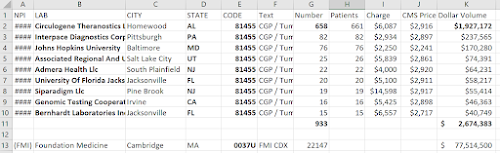
There were just 933 uses of code 81455, to 9 different labs, paying $2.67M.

And with 2/3 of those payments going to an Alabama lab, Circulogene Theranostics (at 658 cases for $1.9M).

See table here:

click to enlarge

Interestingly, Johns Hopkins billed less than the fee schedule (only $2250) and the highest charge was from Siparadigm in NJ, at $14,595 per test (CMS pays $2917).  

Of course, a lot more cases went through the Foundation Medicine code, the FDA approved test under PLA code 0037U with 22,147 cases and $77.5M dollars.   

Are More Uses of 81455 Hiding?

Or we should say, are more cases of large-panel comprehensive tumor profiling hiding.  Well, yes, and no.  

Are they submitted as PLA codes (other than 0037U)?   Well, I haven't gone through every possible PLA code, but I already know: the top 10 PLA codes are 95% of PLA billing, and none of them (except FMI) is a tumor panel.  (Data view here).  

So if there are PLA codes, for CGP, in CY2020, they're a few hundred thousand dollars or less.  

And MOLDX doesn't use code 81455.  Any large gene panels for tumors at MolDx will come in under code 81479.  

Now, that's in total about $250M a year (almost no MACs except MolDx ever use 81479). But, a lot of that $250M goes to labs like Myriad and CareDx and goes for things other than CGP.   

Within MolDx CGP, Caris got $41M for about 14,000 cases of 81479, most or all of which I assume is CGP and with an ASP of $2916, the same price as 81455.  Said differently, Caris is not all that far behind Foundation Medicine.

Conclusion?  Public Health Data Can't Just Track 81455

One conclusion is that if someone in the public health sphere tries to use 81455 to track Medicare payments for large tumor panels, they'll be far off.  They'll find only 933 cases of CGP, when the actual CGP volume was over 35,000 cases, by adding just FMI (0037U) and Caris (81479) alone.  They billed with 0037U and 81479, not 81455.

__

Note.  Alabama is a MolDx state, and Circulogene was paid for 81455, which MolDx management says, it doesn't use as an active code.   Possibly Circulogene was paid from somewhere else (e.g. with a TIN or NPI in a different state).  Circulogene is in the DEX registry, with some tests "covered" and some "not covered;" I didn't see an obvious CGP test that was "covered."


Monday, August 15, 2022

NOVITAS MAC: The Lamest FOIA Response Ever?

Both CMS and MACs have to follow federal regulations in responding to FOIA requests, and provide documents that are not otherwise protected (due to national security, due personal information like birthdays, due to bona fide protected business secrets).   

I've done many FOIA requests to both CMS and MACs, and this week I got by far the "lamest" FOIA response ever - from NOVITAS MAC, and on a timely topic.  See below.


___

The topic: Coverage  Decisions that are not LCDs or Posted

This summer, I've gotten a lot of requests about companies that announce Medicare coverage, but there's no public supporting documentation that you can find, like an LCD or an Article coming from the relevant MAC.   

On June 12, I wrote a blog about this topic on June 12 (here).  Even more recently, on July 31, a company halted trading when a new draft LCD appeared to possibly supercede previous coverage that wasn't clearly laid out in any particular LCD or article (here).  

Enter FOIA requests.  

The federal government, including CMS and its MACs, have FOIA offices or FOIA officers and they respond to Freedom of Information Act requests by providing relevant documents.   The starting position is that documents on file are releasable, unless they fall into a stated protected category, such as national security, business secrets, personal information (like birthdays), etc.  See the CMS FOIA pages here.   

MACs must have a FOIA office and follow FOIA rules - see their SOW here.

I've personally gotten FOIA responses as voluminous as a big PDF representing two years of emails on a topic, variably redacted for confidential information.   Generally, I've seen that every FOIA response includes appeals information (e.g. the address of a higher-level FOIA appeals officer).    In the case of Noridian MAC, when faced with possible "business secret," they forward the PDF's to their regional office for a decision on what is releasable. 

___

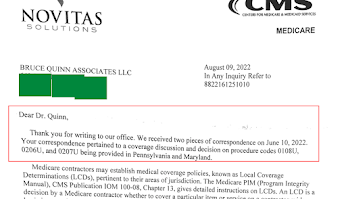
In June, I requested from Novitas FOIA information on coverage decisions (such as emails) about codes 0206U/0207U (Discern Neurodiagnostics Alzheimer skin cell test) and 0108U (Barret's esophagus test).  I did this because I had gotten client requests about the coverage process, after the client seeing saw a press release or website indicating the test was covered by Medicare.   In the case of 0108U, the test had been validated by CMS as "covered by Medicare" because that's a step in the ADLT process (here).

Here are the Novitas code-specific requests and response:  cloud PDF.

It's the lamest FOIA response I've ever seen.  

It opens by acknowledging my request as "correspondence" and providing a reply from the "Customer Service Center."   Novitas seems to deliberately avoid using the word "FOIA" in its response to my FOIA request.   They don't even pretend to be following FOIA laws and regulations in responding to my FOIA request.  They simply give some boilerplate paragraphs about the ability fo MACs to make coverage decisions and ability to publish LCDs.   They they close with a "Customer Service Survey" request ("How are we doing?")  (??!!).

Let me say again, I've been around the block many times with FOIA requests, and they've always included FOIA logging numbers, an answer that is written with respect to FOIA rules, and finally, a FOIA appeal method if I was not satisfied.   

This FOIA response is NOT satisfactory!  I believe the next steps for em are to either (1) file a FOIA appeal with CMS (which will bring a senior level FOIA official quickly into the exchange) or (2) file a new FOIA request with the CMS FOIA office in Baltimore (rather than the local NOVITAS FOIA office), either of which will pull the process back on track with FOIA rules and regulations.  Update August 19: I filed an appeal with CMS, Baltimore, on the original requests (codes 0108U, 206U 207U).

__


I believe there's a body of case law that Medicare MACs have to respond to FOIA requests under FOIA rules.  And I believe all Medicare MACs have FOIA webpages on their websites.   However, I've also read that Medicare Advantage plans don't have to respond under FOIA in the same way (interesting paper here).

See CMS "FOIA Processing Guidance" for Contractor FOIA requests, pdf here.   Exemptions described p. 10ff.  MAC rules described at many points in this 79 page PDF.   MACs must log and account for FOIA requests, for example.   Appeals rules at page 15.  A model letter shows the required information to the customer about his appeal rights (page 40).  

Thursday, August 11, 2022

House and Senate Say: Improve the USPSTF

Bullet - Report Language from House and Senates proposes USPSTF funding, asks for improvements and reforms.

Background

The United States Preventive Services Task Force endorses services that are required coverage under the Affordable Care Act for commercial insurance.  And the USPTF is a gatekeeper for endorsements that can lead a service to be adopted as a preventive service for Medicare (via an NCD).   So the USPSTF is pretty important.   While preventive services can be of many different types (e.g. smoking counseling), some are diagnostic tests.  It's generally felt that after a new preventive diagnostic test is approved by FDA, USPSTF is both a gateway and a barrier to becoming a preventive medicine insurance benefit.

Eshoo Pallone Letter

A few weeks ago I covered a detailed and strongly-worded letter from Representatives Pallone and Eshoo to Health and Human Services, asking HHS to modernize and speed up the USPSTF - here.  Besides the blog, I did a brisk and entertaining video.   

New News - Report Language

Now there's new news.  Each summer, House and Senate release hundreds of pages of "report language" as part of the annual budget process.   They make requests of agencies (these polite requests from the Hill are not as hard to get as new laws).   Sometimes it sounds like log-rolling, "The Senate asks NIH to prioritize research on Disease XYZ" and the NIH responds the next year, "Disease XYZ is a high priority for us and we continue to use appropriate opportunities to invest in XYZ research."

This summer, both House and Senate include report language directed towards speeding up and improving USPSTF.

House here:
Senate here:

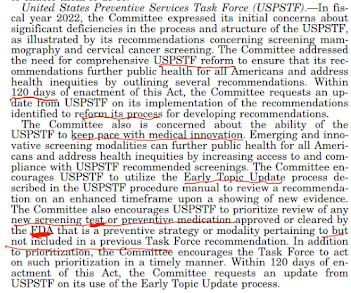
House; Click to enlarge

House asks for "comprehensive USPST reform" and asks for an update on this reform within 120 days.   House also raises concerns whether USPTF keeps up with innovation, and whether it prioritizes new tests (or medications) approved by FDA for prevention.  The House wants an update on USPSTF's plans for an Early Update Process.

Comments at Senate are similar:
Senate; Click to enlarge


What's Up at USPTF

I stumbled across the ANNOUNCEMENTS page at USPSTF, which work a look.


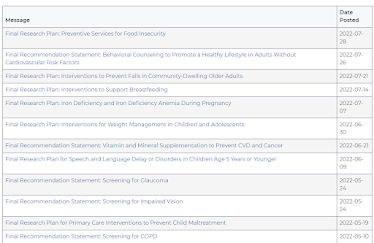
USPSTF has a dizzying-broad range of activities, as shown below.   Prevention for food insecurity, prevention for anemia in pregnancy, prevention to prevent falls; prevention for screening for impaired vision, and so on, prevention to prevent child maltreatment.   It's not all colonoscopies and mammograms.  This is just a few weeks' snapshot:


Carol Mangione MD is the current Chair (day job - Chief of internal medicine, UCLA).   Michael Barry MD is Vice Chair, Wanda Nicholson Vice-Chair (day jobs - Director of Informed Medical Decisions, MGH; Director of Patient-Center Women's Health at UNC, respectively).  

I believe I read recently the budget is in the $10M ballpark. The whole budget of AHRQ is $350M.


Tuesday, August 9, 2022

CMS Publishes Voting Recommendations of Lab Advisory Panel for New Code Pricing

 We've gotten one more benchmark in the annual cycle of the new lab code pricing process.  CMS publishes voting records of the Clinical Diagnostic Laboratory Test panel.  They reviewed and voted on 105 agenda items in mid July.

Find the two day video archive as well as the PDF voting records here:

https://www.cms.gov/Regulations-and-Guidance/Guidance/FACA/AdvisoryPanelonClinicalDiagnosticLaboratoryTests

By my tally, the panel voted in substantial majority to gapfill 25 codes, and the panel split (at least 3-4 members going off tangent) on about 17 codes.   The rest of the codes (105-25-17 or 63) got crosswalk votes that were unanimous or nearly so.   About 5 codes got votes for a fraction-based price (e.g. 1.5X an existing code).   

Next step:  CMS releases its proposed prices in early September 2022, triggering a public comment period.

Biggest news of the meeting was that CMS reversed many years of prior (verbal) policy and allowed panelists to vote to crosswalk a new to the price of a test that is not yet priced yet, but is in the gapfill process.   I believe most presenters, in June, thought this was not possible because previously CMS has always said it was not possible.  It's also not possible to fulfill the agency's crosswalk information request, which includes listing the price of the crosswalked code.

There are pro's and con's to crosswalking a new code to an existing code that is unpriced and still, itself, being gapfilled.   In an index case at the meeting, a lab hoped its new code could be crosswalked to its own, and virtually identical code, that was being gapfilled at a price it liked.  So crosswalking the next code, to the in-process gapwalked sister code, saves everybody trouble. 

BUT, this could also go haywire.  

Worst case scenario!  Imagine a code that has no presenter or information at the summer meeting.  CMS puts it into gapfill, since CMS has no information.  The lab also provides no information to the MACs during the gapfill process, and as a result, is on its way to getting a desperately low price.  Would you want your new code to be crosswalked to that code, just because your code text was kind of similar?  And you have no real say in it?   No.


Thursday, August 4, 2022

Very Brief Blog: CMS Releases Final Inpatient Rule, FY2023

Each spring CMS publishes proposed Part A inpatient rules, and finalizes them around August 1.  Find the information here:

  • Press release here
  • Fact sheet here
  • Advance copy of final rule (typescript) on this page.
    • The paginated Federal Register rule will appear August 10.
Rulemaking adjusts payments in quality systems, such as excess readmissions.  There is also a long series of applications for New Tech Add On Payments (NTAP), which I'll review in the near future.