Wednesday, August 23, 2023

AI Corner: YouTube Video: Andy Stapleton Reviews "SCITE"

Even if you're not interesting in subscribing to SCITE.AI - a knowledge tool and research facilitation service based on AI - you might enjoy watching what it can do in a lively fast paced video.

The energetic Australian science vlogger Andy Stapleton PhD reviews a range of science, and often AI, topics several times a week (165k subscribers).  This week he tackles a live demo of SCITE, which is sort of like PubMed on nuclear-powered AI steroids.  

See the Scite.ai website or watch the video, but SCITE is basically like AI wedded with other information sources like PubMed.  (It's $20/mo, after a free week).  There's also a Chrome plug-in for Scite that pulls in some Scite features while you're browsing places like PubMed in the original.


###

Fittingly, I imported the YouTube review link into the software "Readwise Reader" [a recent addition to the Readwise app), and then Readwise Reader auto generated an AI summary (it calls this Ghostreader) from the YouTube link.

This video will discuss an AI tool called "scite" that can assist researchers with various aspects of their work. The tool offers an "assistant" feature that allows researchers to ask questions and receive answers from the full text of millions of research articles. Additionally, the tool includes a writing assistant that can help with grant proposals and papers. Scite also offers a dashboard where users can track their own papers and receive alerts for new research in their field. The video concludes by recommending the tool for researchers at all stages of their work.

##
How big is SCITE?  Here's from their blog:

What does scite’s coverage look like? At the time of this writing (you can always go here to find updated numbers), scite has records on over 175 million publications, and has ingested the full text of over 33 million scholarly articles. From these articles we have extracted 1.8 billion citation statements, making scite the world’s largest citation database.

First Approval of a Whole Genome Test in Medicare: From MolDx to Wash U; $3228

Update, coverage at Genomeweb September 19 here.

##

MolDx has issued the first-ever approval of a whole-genome test in cancer, the Chromoseq WGS test from Wash U for blood cancers.


####

https://medicine.wustl.edu/news/medicare-approves-washu-medicines-whole-genome-test-for-blood-cancers/

Medicare patients now have coverage for ChromoSeq, a novel test for two blood cancers developed by the Washington University School of Medicine in St. Louis. This is the first whole-genome sequencing test for cancer to receive reimbursement authorization from the CMS - specifically, from the MolDx program, which provides genomic policy for 28 states, including Missouri.

The coverage is for patients with acute myeloid leukemia or myelodysplastic syndrome; Medicare and Medicare Advantage patients nationwide have access to the test if it is provided via Wash U.  The DEX portal (operated by MolDx) shows a price of $3228 for the test. 

The press release remarks,

“This approval reflects the power and clinical validity of ChromoSeq to assess the full range of genetic mutations responsible for some of the most deadly blood cancers, which can help guide treatment decisions for individual patients,” said Richard Cote, MD, the Edward Mallinckrodt Professor and head of the Department of Pathology & Immunology, which runs the pathology service in collaboration with the clinical sequencing laboratory at WashU Medicine’s McDonnell Genome Institute. “Private insurance companies often follow Medicare’s lead in coverage decisions, so we expect that there will be demand for this test across the country. This approval stands as a testament to the vision of WashU physician-scientists Eric Duncavage, Dave Spencer, Molly Schroeder and their team, who spent years developing and validating this test.”  


To Learn More

For an open access 2023 review of AML, see Premnath & Madanat.  For a 2023 paper on molecular cytogenomics in AML, also open access, see Nilius-Eliliwi et al.  For a 2023 German aper on  ALM genomic complexity, open access, see Klever et al. 

For a 2021 WashU paper on Chromseq, NEJM here.  

  • Extensive orthogonal confirmations were employed.  
    • Writing, "Whole-genome sequencing is a potential replacement for conventional cytogenetic and sequencing approaches."  
  • 16% of patients had a clinically important molecular reclassification.[*]  
  • The CMS coverage came weeks after NCCN included WGS in guidelines for ALM management.  


__

AI Corner [*]

Compare the original 260 word abstract from NEJM 2021, and a 600 word GPT summary here.

__

For two 2023 WashU papers on genomics of myeloid malignancies, open access, see Abel et al and Slade et al.

__

See AML and chromothripsis as an example for using the subscription AI-powered citation database Scite, here.


Sunday, August 20, 2023

Reuters: Georgia Man Sentenced to 27 years; $463M Genetics Scheme; Florida Court

I recommend you go right to the open access Reuters story, here:

https://news.yahoo.com/georgia-man-sentenced-27-years-225638653.html

For more detail:

https://www.justice.gov/opa/pr/lab-owner-sentenced-463m-genetic-testing-scheme 

See another DOJ publication, which includes a photo of a Ferrari:

https://www.justice.gov/usao-sdfl/pr/convicted-lab-owner-ordered-forfeit-over-187-million-health-care-fraud-proceeds

##

Another lab owner in a different case pled guilty in 2020, according to 360Dx, and was sentenced recently to 18 months prison time plus $77M restitution. 

Reuters:

Georgia man sentenced to 27 years in jail over $463 million genetic testing scheme


By Kanishka Singh

"WASHINGTON (Reuters) - A Georgia man who was convicted late last year for his role in a $463 million genetic testing scheme to defraud Medicare was sentenced to 27 years in prison on Friday, the U.S. Justice Department said in a statement.

Minal Patel, 44, of Atlanta, owned LabSolutions LLC, a lab enrolled with Medicare that performed sophisticated genetic tests. Patel conspired with patient brokers, telemedicine companies, and call centers to target Medicare beneficiaries with telemarketing calls falsely stating that Medicare covered expensive cancer genetic tests, according to prosecutors....."

NEJM: Neumann and Tunis ask, Can CMS Be an Effective "HTA?"

In a new Op Ed online at NEJM, Neumann and Tunis ask if CMS can be an effective Health Technology Assessment organization (HTA).   For example, the agency's "TCET" program for new technologies proposes to rely heavily on evidence evaluation and CED (coverage with evidence development.)   

Neumann and Tunis note that there are several billion dollars allocated for implementation of IRA - drug price negotiation in Part B &D - and some of that may play out as HTA-like activities.  If, like me, you haven't been closely following IRA drug news, here's a long report from Latham & Watkins.

Find the HTA essay here:

https://www.nejm.org/doi/full/10.1056/NEJMp2305280?query=featured_secondary


###

The article doesn't have an abstract, but here's a ChatGPT summary of it.

CMS and Health Technology Assessment: An In-depth Analysis

The Centers for Medicare and Medicaid Services (CMS), originating in the 1960s, started as the Health Care Financing Administration (HCFA) primarily to pay claims for public insurance. Congress intended HCFA to fund private medical facilities and professionals without intervening in medical practices to avoid suspicions of “socialized medicine.” However, a lingering challenge was to ensure the efficacy of prescribed and financed services and products.

While the Food and Drug Administration (FDA) endorsed the safety and efficacy of drugs and high-risk medical equipment, questions persisted about their application to Medicare patients, often older and sicker than those in FDA's clinical trials. Such trials often underrepresented women and non-White participants. Generally, CMS funded “accepted” medical procedures. Although authorized to reject funding for non-essential items or services, CMS seldom conducted its evaluations. Only controversial or expensive technologies were occasionally assessed against the “reasonable and necessary” standard. Moreover, CMS outsourced various local coverage decisions to regional Medicare Administrative Contractors.

Recognizing its broader mandate, HCFA rebranded as CMS in 2001. [*] The agency emphasized the need for evidence-based evaluations of new health technologies, seeking to ensure they beneficially impacted Medicare beneficiaries. Consequently, the “coverage with evidence development” (CED) option emerged, allowing payment for potential technologies while necessitating further studies to reinforce evidence validity.

Recent developments underscored the need for CMS to intensify its health technology assessment (HTA) role. In 2016, the FDA initiated breakthrough status for critical illness devices based on preliminary evidence, creating a dilemma for Medicare over their coverage amid substantial uncertainties. In 2021, the Trump administration proposed extending coverage for such breakthrough devices post-FDA approval. However, the Biden administration, apprehensive about potential inefficacies and risks, repealed this regulation. The subsequent proposal was geared towards engaging CMS more deeply in setting evidence-based standards for medical device coverage.

Another complication is the escalating number of high-cost drugs, prompting inquiries about Medicare's evaluation mechanisms. For instance, the potential expansion of Part D coverage for obesity medications, which could strain the program financially, demands meticulous assessment. Additionally, new cell and gene therapies, often lacking long-term data, pose a challenge. The debate surrounding Alzheimer’s drugs epitomizes the intricacies of evaluating new treatments that obtain FDA's accelerated approval. In 2022, CMS adopted a unique stance for Alzheimer’s treatments, endorsing coverage only within the context of randomized clinical trials. The episode revealed occasional disparities between Medicare’s and the FDA’s criteria, sometimes warranting CMS's independent evaluations.

The 2022 Inflation Reduction Act, which obligates Medicare to negotiate drug prices for selected therapies, further magnifies CMS's role in HTA. Mandating evaluations of a drug’s benefits, risks, and comparative effectiveness, this act allocates $3 billion over a decade for its implementation. With such substantial funding, CMS is poised to become a prominent HTA entity globally.

Nevertheless, challenges abound for CMS. The political quagmire concerning government intervention in medical practice, potential obstructions to innovation, and health care “rationing” concerns persist. Notably, though, CMS's evolution into a dominant HTA entity reflects the absence of such an organization at the federal level, given historical opposition. A few recommendations could bolster CMS’s mission:

  • Resource Enhancement: Congress should allocate resources to CMS for recruiting experts in clinical research, trial design, epidemiology, and biostatistics.
  • FDA Collaboration: CMS and the FDA must enhance their coordination, focusing on early discussions, manufacturer engagements, and addressing disparities between their respective requirements. While synchronization might complicate product approval and coverage, lessons from the FDA's extensive experience across medical domains can significantly benefit CMS.
  • Strengthening CED: Although the existing CED framework is lengthy and often doesn’t lead to significant coverage policy modifications, leveraging advancements in databases and analytical techniques can significantly refine it.

In conclusion, as a responsible payer, Medicare's scrutiny of technology efficacy for its beneficiaries is prudent. Recent developments thrust Medicare into the HTA limelight, necessitating that it fully embrace this role and amplify its capabilities to align with these evolving responsibilities.

####

[*]

If you like topics like the rebranding of HCFA as CMS, see a fine 2015 essay on that kind of history, from Kinney, entry point here.

NQF Loses National Contract (February 2023); Absorbed by Joint Commission; Battelle Takes Over

There's a $20M-plus annual national contract for an objective, multi-stakeholder registry for quality measures.  For years, it's been NQF, the National Qualify Forum.  (See Wikipedia here, NLM StatPearls here.)  It's a big deal; the CEO made north of $600K.

I'm a little late to the party here, but NQF lost its contract in early 2023, which was awarded to Battelle.   Now in August 2023, NQF will be absorbed into the Joint Commission.

The Battelle version of the national health measures registry is up and running as the Partnership for Quality Measurement PQM.


Friday, August 18, 2023

BCBS Evidence Street To Shut Down in December 2023

BCBS Evidence Street was both an entity for evidence libraries for BCBS plans, and also an entity that could contract and sell projects to fund itself and its expansion.

The Evidence Street web site held a large library of evidence reviews.

If you go there today - 

https://www.bcbsaoca.com/evidencestreet/

You get a splash screen over-riding the website that says the platform will "sunset" on December 29, 2023. Click to enlarge.
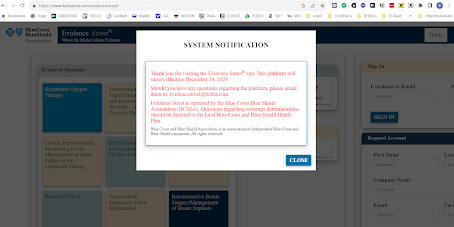
Click to enlarge

Thanks to policy expert Dr Joel Brill for pointing this out.

Evidence Street doesn't have a Wikipedia entry but ChatGPT (which I can't further verify) gives this short description of Evidence Street. I can concur with what GPT4 writes, but I can't verify it further since my general knowledge of E.S. is limited to having heard a few talks by its leadership.

[ChatGPT4] 

Blue Cross Blue Shield (BCBS) established the Evidence Street program to provide an impartial platform to assess the clinical effectiveness and value of medical products and technologies. This program evaluates the scientific evidence concerning medical interventions, including drugs, devices, and biological products. The goal is to promote data-driven decisions and ensure that members receive treatments that are both clinically effective and offer good value. Key stakeholders, like medical product manufacturers and the broader healthcare community, submit their clinical evidence to Evidence Street. Then, BCBS uses this information to form coverage policies and make other critical healthcare decisions. By doing so, Evidence Street plays a pivotal role in fostering transparency, consistency, and informed decision-making across the healthcare landscape. This initiative underscores BCBS's commitment to improving patient outcomes and promoting the efficient use of healthcare resources.

I understand it grew out of an earlier division or operating unit called BCBS TEC, tech assessment.   By spinning out as Evidence Street, they wanted to create an entity that could bid on contracts and RFPs and grow.

ChatGPT

Yes, that's correct. Before Evidence Street, the Blue Cross Blue Shield (BCBS) Technology Evaluation Center (TEC) was responsible for assessing medical technologies to determine their clinical effectiveness. TEC played a crucial role in ensuring that emerging technologies met appropriate standards before they were covered by BCBS insurance plans. However, as the landscape of healthcare evolved and the importance of evidence-based decision-making increased, there arose a need for a more expansive and flexible platform.

Spinning out to form Evidence Street allowed BCBS to establish a more distinct, agile, and focused entity. With its independence, Evidence Street could potentially attract a broader range of stakeholders, respond more dynamically to industry needs, and provide work to outside parties. This move reflected the larger trend in the healthcare industry towards transparency, stakeholder engagement, and evidence-driven decision-making. The creation of Evidence Street was a strategic step to ensure BCBS remained at the forefront of evidence evaluation and maintained its reputation for rigorous, impartial assessments.

Are "HAYES" and "ECRI" also players in this space (fee-for-service evidence evaluation?)

ChatGPT

Yes, both HAYES and ECRI Institute are prominent players in the healthcare evidence evaluation space.

HAYES, Inc.: HAYES is recognized for its evidence-based health technology assessments. Their reports focus on the clinical effectiveness and safety of new or unproven medical technologies. HAYES provides these assessments to health plans, providers, and healthcare institutions to help them make informed decisions about adopting and covering these technologies. Their systematic reviews and analyses are aimed at determining whether a technology improves health outcomes and is safe for patients.

ECRI Institute: ECRI is an independent, non-profit organization that dedicates itself to applying scientific research to healthcare policy and practice. They provide a broad range of services, including evaluations of medical devices, procedures, and drugs. ECRI also conducts accident and forensic investigations, helping to improve patient safety. They are known for their rigorous, evidence-based approach, and their findings are often used by hospitals, health systems, and other healthcare entities to guide purchasing and policy decisions.

Both of these organizations, like Evidence Street, help fill a crucial need in the healthcare system by evaluating the efficacy, safety, and cost-effectiveness of medical technologies. Their analyses and recommendations often play an integral role in shaping healthcare policy, patient care strategies, and reimbursement decisions.


Could we add the ICER organization in Boston?

ChatGPT

Certainly! The Institute for Clinical and Economic Review (ICER) is another notable player in this space.

ICER: Based in Boston, the Institute for Clinical and Economic Review is an independent non-profit research organization that evaluates the clinical and economic value of prescription drugs, medical tests, and other health care and health care delivery innovations. Their reports and assessments provide objective, detailed analyses on the efficacy and cost-effectiveness of medical interventions, and they often play a significant role in informing healthcare payers, providers, and policymakers in the U.S. Their goal is to ensure that patients have access to care at a price that aligns with the value it brings to the system, and they aim to create a healthcare system that is both sustainable and beneficial to patients.

By offering evidence-based recommendations on pricing and coverage policies, ICER works alongside other entities like HAYES, ECRI, and Evidence Street to provide stakeholders with crucial insights to guide decision-making in the rapidly evolving healthcare landscape.

Thursday, August 17, 2023

AI Corner: Contrast and Compare Two Genomeweb Articles (Children's Hospital Colorado and Duke)

This week, Genomeweb had two somewhat similar headlines:

  • Children's Hospital Colorado Embraces Precision Medicine via 'Institutional Approach'
  • Duke University Health System Aims to Enroll 100K Participants in Precision Medicine Study

We know that ChatGPT can summarize articles intelligently and efficiently, but here, I was more interested in "contrast and compare" to see what it would come up with on its own, without further pointers from me.

Below, the task to ChatGPT was summarize #1, summarize #2, and then contrast and compare.

###

Summary of "ARTICLE ONE" - Children's Hospital Colorado Embraces Precision Medicine via 'Institutional Approach':

  • Children's Hospital Colorado has established the Precision Medicine Institute, a philanthropy-funded effort aimed at integrating precision medicine into their organization. The institute operates as a "horizontal" service line, working alongside clinical and operational departments. It focuses on developing diagnostics, therapies, and patient education related to precision medicine. The goal is to ensure that precision medicine interventions reach patients by addressing access barriers and delivery mechanisms. The institute collaborates with other hospital departments, such as Precision Diagnostics Laboratory, to enhance patient care through precision medicine. 
  • The institution-wide approach aims to make precision medicine a core aspect of medical practice. The success of the institute is measured by patient access to genetic testing, timely test result delivery, usefulness of results in treatment, clinical trial enrollments, and improved patient outcomes. 
  • The institute is primarily funded through philanthropy and aims to become self-sustaining.

Summary of "ARTICLE TWO" - Duke University Health System Aims to Enroll 100K Participants in Precision Medicine Study:

  • Duke University Health System and Nference, a software company, are launching the OneDukeGen Genomic Sequencing Study and Biorepository. The collaboration aims to recruit over 100,000 Duke Health patients to donate blood or saliva samples and health data for DNA and RNA sequencing. Researchers intend to analyze the data to uncover patterns that could lead to new detection, treatment, prevention, or cure methods for various diseases. Leftover samples will be stored in a biorepository for future research. 
  • The study employs the MyChart patient portal to engage potential participants and plans to involve diverse community groups. 
  • The collaborative effort aims to bridge the gap between scientific discovery and clinical practice, revolutionizing healthcare delivery at Duke.

Contrast and Comparison:

Both articles focus on the integration of precision medicine into healthcare institutions, albeit with distinct approaches and emphases:
  1. Institutional Approach vs. Research Study: The Children's Hospital Colorado article discusses the establishment of an institutional framework, the Precision Medicine Institute, to weave precision medicine into patient care across various hospital departments. In contrast, the Duke University article highlights the launch of a research study, the OneDukeGen Genomic Sequencing Study and Biorepository, with a specific focus on collecting genomic data from patients to advance scientific understanding.
  2. Scope and Focus: The Children's Hospital Colorado's approach involves integrating precision medicine broadly across the organization, focusing on diagnostics, therapies, education, and patient access. Duke University's effort centers on a research study with the primary goal of analyzing genomic data to uncover patterns for disease understanding and potential treatments.
  3. Funding: The Children's Hospital Colorado's Precision Medicine Institute is primarily funded through philanthropy and seeks self-sustainability. On the other hand, Duke University collaborates with a software company, Nference, to leverage their analytics platform for the research study.
  4. Patient Engagement: Children's Hospital Colorado emphasizes collaboration with other departments within the organization to promote precision medicine adoption. Duke University engages potential participants through the MyChart patient portal and plans to involve community groups for a diverse cohort.
  5. Outcome Measurement: The success of the Precision Medicine Institute is evaluated based on patient access to genetic testing, timely result delivery, usefulness of results, clinical trial enrollments, and patient outcomes. In the case of the Duke study, success is measured by uncovering patterns and connections between genomic data and patient health data to enhance disease understanding and potential treatments.
In summary, both institutions are actively embracing precision medicine, but the Children's Hospital Colorado takes an institutional approach to integrate it across patient care, while Duke University focuses on a research study to uncover insights from genomic data.

##
Nference has raised over $150M. [BQ].
GPT studies NFERENCE here. [BQ].
##

Bonus.
Are you aware of any projects similar to the DUKE project?

ChatGPT
As of my last knowledge update in September 2021, there were several projects similar to the Duke University precision medicine project, aimed at collecting genomic data from large cohorts of participants for research purposes. However, please note that developments in this field may have occurred since then. Here are a few examples:

All of Us Research Program (formerly Precision Medicine Initiative): This is a project by the National Institutes of Health (NIH) in the United States. It aims to gather health data from a diverse group of one million or more people across the country to advance precision medicine. Participants provide genetic data, lifestyle information, and health records to fuel research on a wide range of health conditions.

UK Biobank: This large-scale project in the United Kingdom collects data and biological samples from 500,000 participants to better understand the links between genetics, lifestyle, and disease. It provides a valuable resource for researchers studying various health conditions.

Personal Genome Project: Founded by geneticist George Church, this project aims to create a public genomic database by recruiting volunteers willing to share their genetic and health information. It emphasizes open access to data for research purposes.

Framingham Heart Study: Although not solely focused on genomics, this long-running study has collected extensive cardiovascular data from multiple generations over several decades. It has contributed to our understanding of heart disease risk factors.

American Gut Project: This initiative collects microbiome data (bacterial communities in and on the human body) from participants to understand the role of the microbiome in health and disease.

Genotype-Tissue Expression (GTEx) Project: This project aims to create a comprehensive public resource that describes genetic effects on gene expression across multiple human tissues. It provides valuable insights into how genetic variations influence gene activity.

100,000 Genomes Project (UK): This project focused on sequencing the genomes of patients with rare diseases and cancers, aiming to improve diagnosis and treatment options.

China Kadoorie Biobank: This study, based in China, aims to collect data and biological samples from half a million participants to study genetic, environmental, and lifestyle factors influencing chronic diseases.

Remember that the landscape of precision medicine and genomics research is rapidly evolving, and new projects and initiatives may have emerged since my last update. It's always a good idea to consult recent sources or news to get the most up-to-date information on similar projects.

##

Bonus 2.  I asked GPT4 some questions about my office video camera, a Sony ZV1, and it sounds like it is really "thinking" spatially and logically, in providing answers.  Here.

Bonus 3.  I asked GPT4 to summarize the Georgia election indictment, also discuss it from the viewpoint of Lewis Black, and from the viewpoint of an originalist constitutional scholar.  Here.

Wednesday, August 16, 2023

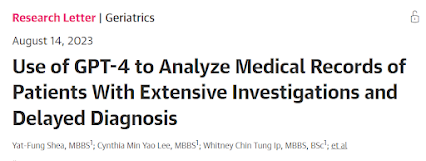
AI Corner: Shea (JAMA); AI Tackles 6 Hard Cases, Does Well

Debate and articles swing back and forth on AI vs doctors as diagnosticians.  For a large scale article, see Singhal et al. here.

For a modest article with a great online supplement, and open access, see Shea et al. here.  They gave six hard problematic cases to GPT4 and to six doctors, the AI somewhat outperforming the doctors in the six sample.   I'm citing it in part because they have an online PDF with all the cases and all the AI answers and reasoning.  33 page supplement here. 

##

PS - In my hands, GPT4 correctly diagnosed the complex, August 17, 2023 NEJM case study.

https://brucedocumentblog.blogspot.com/2023/08/ai-corner-gpt4-nails-nejm-case-study.html


Monday, August 14, 2023

The Lord Giveth, Taketh Away: CMS Rescinds Coverage for LDT PSA Test under NCD for PSA Screening

Back on June 15, 2023, I published the surprising announcement that CMS was covering an LDT PSA-related test under the NCD for prostate screening.   This would be unusual, because of CMS's preference (both stated, and observed) for only handling FDA-authorized tests under NCDs.

The wheels turn.   On August 3, 2023, CMS issued a transmittal - CR 13278 - which retracts coverage for test. Test 0359U is no longer covered under the NCD as a national prostate screening test.


Friday, August 11, 2023

AI Corner [Humor] : ChatGPT Discusses Senator Warner's Letter to Google re AI & Healthcare

On August 8, 2023, Senator Mark Warner sent a 3 page letter to Google regarding risks and problems that may occur secondary to its release of healthcare-focused AI, like MedPaLM2, to health systems like Mayo.

Find the letter here.

Find an open access article by Katie Adams at MedCity here.

See an essay about the situation below.   I only fed ChatGPT-3.5 the 3-page Senate letter, and asked it to write up a discussion and a headline.

> > > I then asked GPT to discuss the letter in the tone of Lewis Black instead. 


###

Senator Warns Google CEO About Risks of 

Premature AI Deployment in Healthcare

[ChatGPT]

Senator Mark Warner expresses his concerns to Mr. Sundar Pichai, the CEO of Alphabet Inc. (Google's parent company), about the deployment of Med-PaLM 2, an artificial intelligence (AI) system developed by Google for medical purposes. In the letter dated August 8, 2023, Senator Warner acknowledges the potential of AI to improve patient care but voices apprehensions about the premature deployment of unproven technology. He is worried that such deployment could lead to the erosion of trust in medical professionals and institutions, exacerbation of racial disparities in health outcomes, and increased risks of diagnostic and care-delivery errors.

Senator Warner highlights the competitive rush among technology companies, including Google, to develop and deploy AI models following the increased attention on AI technology, citing the launch of OpenAI's ChatGPT as a catalyst. He also references previous concerns raised about Google's partnerships with hospital systems that involved training diagnostic models on sensitive health data without patients' knowledge or consent.

The senator specifically addresses Google's Med-PaLM 2, which is designed to answer medical questions, summarize documents, and organize health data. Despite these intentions, Google's research has shown that Med-PaLM 2's answers often contain inaccurate or irrelevant information compared to physicians' responses.

Senator Warner poses a series of questions to Mr. Pichai, asking about Google's assessment of potential risks and failures associated with Med-PaLM 2 in a medical context. He inquires about data privacy measures, the documentation provided to hospitals, the frequency of model updates, the training data's privacy implications, patient awareness of AI involvement in their care, and the presence of opt-out options.

Implications:

  1. Trust and Medical Practice: The letter raises concerns about the trustworthiness of AI-driven medical solutions. Premature deployment of AI in healthcare without proper validation could undermine patients' confidence in medical professionals and institutions.
  2. Racial Disparities: Senator Warner suggests that deploying unproven AI technology could worsen existing racial disparities in health outcomes. If AI systems are not thoroughly tested and validated across diverse populations, they might inadvertently perpetuate biased outcomes.
  3. Diagnostic and Care Errors: Unreliable AI-generated medical information could lead to misdiagnoses or incorrect treatment decisions. This poses serious risks to patient safety and well-being.
  4. Data Privacy: The letter highlights concerns about the use of sensitive health data to train AI models. Unauthorized use of such data could violate patient privacy regulations and erode patient trust in data-sharing practices.
  5. Regulation and Accountability: The letter underscores the need for clear standards, guidelines, and ethical considerations when deploying AI in healthcare. This reflects the growing awareness of the necessity to regulate and hold tech companies accountable for the impact of their AI solutions.
  6. Transparency and Informed Consent: Senator Warner's questions about patient awareness and opt-out options indicate a growing emphasis on the need for transparency in AI use in healthcare and the importance of informed patient consent.

In summary, Senator Mark Warner's letter to Google's CEO raises important concerns about the potential risks and implications of deploying unproven AI technology in the medical domain. It highlights the need for careful evaluation, transparent communication, and responsible deployment of AI systems to ensure patient safety and trust in healthcare practices.

###

Please write a 150-word discussion of the same Warner letter to Google, but in the snarky humorous tone of a commentator such as John Oliver or Lewis Black, who thinks the letter is paranoid and unnecessary and shows little insight about AI.

ChatGPT

Oh, hold onto your stethoscopes, folks, because Senator Mark Warner has penned a letter to Google that reads like a wild conspiracy theory pamphlet. 

Apparently, he's convinced that Google's Med-PaLM 2 AI system is going to unleash a medical apocalypse of epic proportions. Picture this: AI-generated band-aids that randomly burst into flames, or maybe Google's AI becomes a doctor who diagnoses everything as a case of the dreaded "Googloid Fever."

But wait, there's more! Warner's worried about "eroding trust" in medical professionals because of AI. As if trust wasn't already eroding due to WebMD and the entire internet diagnosing us with diseases we can't even pronounce. And don't even get me started on his fear that AI will make medical errors. Because human doctors have NEVER misdiagnosed anything, right?

It's almost adorable how Warner thinks Google is secretly plotting a health takeover. Yes, folks, Google's main goal is to turn us all into hypochondriacal robots. So, Senator Warner, before you sound the alarm on the AI apocalypse, maybe take a deep breath, grab a virtual chill pill, and let the rest of us non-paranoid folks embrace the AI healthcare revolution without envisioning a sci-fi dystopia at every corner.


__

Warner's letter closes by quoting Singhal et al., Nature (July 12; 620:172, 28pp, "Large language models encode clinical data." More about Singhal.

Very Brief Blog: Web Event September: Patients, Doctors, Shared Decision-Making

 One of the challenges of precision medicine is the complexity of decision-making, especially when this meets up with shared patient-family-health care provider decision-making.

There's a webinar on September 7, 2023, at 12 PT / 3 ET, with a great roster of speakers.

Find it here:

https://courses.accc-cancer.org/products/precision-medicine-resources-for-better-shared-decision-making#tab-product_tab_speakers

Speakers to include:

  • Nikki Martin, Lungevity
  • Zac Getty, Fight Colorectal Cancer
  • Sue Friedman, FORCE
  • Alejandra Alvarez, PANCAN
  • Claire Saxton, Cancer Support Community
  • Jennifer Klemp, moderator, Univ Kansas


Thursday, August 10, 2023

MolDx Proposes Revisions to Transplant Molecular Testing Policy (L38568); Open for Comments

Over the past year, CareDx share price rose and fell with variants in MolDx's billing article for molecular testing for organ transplants.  Other companies in the space have had their own decisions to face.

On August 10, 2023, MolDx offers a new draft LCD for molecular rejection testing.   The LCD number is unchanged (we had LCD DL38568 back in 2020 and now DL38568 for 2023).  The oldest title under this LCD number was "Liquid biopsies for solid organ transplantation."  

EXISTING ACTIVE LCD: Molecular Testing for Solid Organ Allograft Rejection (here) 

NEW DRAFT PROPOSAL: (same title)  (here)

There will be an open public comment meeting (Palmetto) on September 18, 2023.  The comment period runs August 10 to September 23.   See also coverage at Genomeweb here.

MolDx notes that back in November 2022, it held a two-day, publicly streamed contractor advisor (expert advisor) meeting.

The LCD revision is officially listed as "contractor initiated" but it surely occcurs in the context of numerous complaints, requests for clarifications, and meetings.

These updates are News.  For example, Genomeweb ran an extended premium article on August 8, 2023, (here).  After the revision of a prior MolDx billing article after which CareDx actually withdrew its official revenue guidance.  See an open access article about CareDx Medicare coverage August 9, 2023 (here).  And, CareDx stock this year has traded in a broad range from $7 to $17, sometimes moving abruptly.

Nerd note: As of today, August 10, the LCD has no "associated documents" like new draft billing articles.  These may appear a bit later than the draft LCD itself.  For these LCDs, the billing articles can be very important.

###

OK, so What's Up?

The MAC says that the LCD is changing, besides its title, only "for clarity" and "only comments pertaining to the changes for clarity" will be considered.

MolDx inserts language about the CAC meetings last November:

Contractor Advisory Committee (CAC) Summary

Kidney and Liver Allograft CAC

On November 16, 2022, Noridian and Palmetto jointly facilitated a CAC to discuss molecular testing for the diagnosis of acute rejection in kidney or liver transplant recipients where GEP, dd cfDNA, and multiomic tests were discussed. The subject matter experts (SMEs) expressed a high degree of certainty that there is sufficient evidence to support the use of molecular tests like dd cfDNA in kidney allograft patients.

Heart and Lung Allograft CAC

On November 17, 2022, Noridian and Palmetto jointly facilitated a CAC to discuss molecular testing for the diagnosis of acute rejection in heart or lung transplant recipients where GEP and dd cfDNA tests were discussed. The SMEs were unanimous that the evidence is sufficient to support the use of GEP and/or dd cfDNA for surveillance of acute organ injury to help replace an unnecessary biopsy. However, they also agreed that there is a lack of data to support the routine use of molecular combination testing. Moreover, they did not endorse the use of molecular diagnostic tests in lieu of biopsy in patients with a very high clinical and laboratory suspicion for acute rejection and who can also safely tolerate a biopsy. All SMEs agreed that these tests do not discern the etiology of organ injury, indicating that they had a high degree of confidence in the detection of allograft injury, but additional clinical testing was necessary to discern the cause.

Substantive Revisions to LCD

There are a number of revisions to the body of the LCD, besides the insertion of the public meeting text I just showed.   I have included a cloud PDF that redlines the current version (R1 July 2023) and the new version (DL38568 August 10 2023).

SEE THE REDLINE:

https://drive.google.com/file/d/1LC4Lbp6peSnxZKfAkHUP9QLwIy2Qo0XP/view?usp=sharing

  • The LCD now opens with "Definitions," But nearly all the so called "Definitions" are actually abbreviations.   "CV = clinical validity," is not a "definition" of clinical validity!, it is an abbreviation.
  • Requiring an affiliation with a transplant center is struck out.
  • Molecular tests are covered after the result of relevant pre-tests are known.
  • Molecular testing "in lieu of" a surveillance tissue biopsy, is covered no more often than the surveillance tissue biopsy would have been covered.
  • Banff classification always updates to "^the most current" one.
  • The text formerly stated, "only one test...unless a second test is reasonable and necessary."  
    • Now it states "only one molecular test" is covered, and "unless a second test (etc)" is struck out.
  • There is some general explanation that patients get both serologic monitoring tests and MAY get surveillance [protocol] biopsies as well.
  • A sentence that split rejection into either cellular- or antibody-mediated is struck out.
  • "Sophisticated methods" become "advanced technology methods."
  • There is a literature discussion comment that conjoint gene expression and cfDNA testing improve management "in certain circumstances"...but this is never defined.   
  • There is a remark that only 18% of transplant centers perform routine, surveillance kidney biopsies, attributed to the advisors meeting in November.
    • It's not clear what is intended by this.  The risk-benefit profile of ddDNA testing and physical CT-guided biopsy are very different, so the decisions and use cases are different.  Amniocentesis as a first test is less common in the NIPT era, for example.  
Is there really no change in coverage?

The new draft belabors that there is "no change in coverage" and only changes for "clarity."  

However, there seem to be some changes in coverage.  For one example, in the prior version, tests could be ordered "by physicians considering the diagnosis of AR affiliated with a transplant center" and now "affiliated with a transplant center" is literally struck out.   That seems more like "a change" than "a clarification."  Another section said, "only one test is covered unless..." and that is changed to "only one test is covered. [period]"

Citations

No new citations were added; the 35 citations are the same as the current LCD.   The year distribution is 1991-2020, with the median year of publication being 2017, and no publications cited after 2020.  Assuming the LCD is finalized in 2024, the youngest publication will be 4 years old.


Coverage Rules and Discussion Section Should Be Independent 

Although the only impact on covered care (for clarity) should be changes in the "coverage" section (e.g. the "bottom line" for payment) there are a number of changes to the summary-of-evidence section too.   

Reading numerous LCDs, I usually feel that LCDs should be written for complete clear rules for "coverage" only in the "coverage" section.  This section's functional text should not be dependent on back-and-forth interpretations of verbal nuances (where two readers can easilyi differ) that are found down in the often-rambling "review of evidence" discussion section.  I was recently tasked with reading an LCD, which was not particularly long, on bladder cancer biomarkers (L36678) and found it very confusing what the actual, bottom line, plain-old coverage rules were.  Besides scattering coverage remarks around the LCD like an Easter egg hunt, the labeled "coverage" section was bloated with extraneous remarks unrelated to coverage.    

__

I ask ChatGPT to assess this blog.


Wednesday, August 9, 2023

AI Corner: ChatGPT Endorses Spellberg's "PITCHING TO THE HOSPITAL C-SUITE"

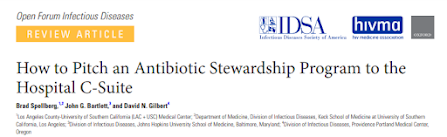
One of my all-time favorite articles about health policy is the open-access article, Pitching to the Hospital C Suite, by Spellberg of USC.  Nominally, it's about how to  seek resources for Antibiotic Stewardship Programs in a large hospital system.  However, it's really like a "Harvard Case Study" of how hospital and healthcare dynamics work, flipping from the perspective of the Infectious Disease division to the perspective of the CEO and back again.   Find the 2016 article here.    

I fed the article (via a text splitter) to Chat GPT and then asked Chat GPT to appraise the article.  Results below.

##

Can you summarize, from a strategic viewpoint, the main values of reading the article Pitching to the Hospital C Suite by Spellberg? It is one of my favorite articles and I often recommend it for its insights into decision making. What do you think of it? Aim at a summary of about 300 words.

ChatGPT-4

Certainly! The article "Pitching to the Hospital C Suite" by Spellberg offers vital insights into the complex and strategic process of proposing and implementing medical programs within a hospital setting, specifically focusing on Antimicrobial Stewardship Programs (ASPs). 

Here's a summary of its main values from a strategic viewpoint:
  1. Understanding Financial Dynamics: The article emphasizes that a successful pitch must not only focus on clinical benefits but also provide a comprehensive financial model. This includes understanding modifiable variable costs, projecting savings, and estimating additional revenue that could result from the proposed program.
  2. Tailoring the Proposal: Spellberg advises on tailoring the proposal to the unique interests and concerns of the C-suite. By offering various levels of intervention, the proposal can align with the resources and desired outcomes of the hospital, increasing its appeal.
  3. Emphasizing Clinical Importance: While financial considerations are crucial, the article also stresses the importance of antibiotic stewardship from a patient, societal, and hospital perspective. The inclusion of tangible benefits like lower rates of infection provides a strong argument for adoption.
  4. Building Credibility: The article highlights the significance of personal influence and credibility with decision-makers. By establishing rapport through consistent interaction and preparedness, proponents can better navigate competing priorities and gain traction for their proposal.
  5. Strategic Planning: The detailed guidelines in the article enable readers to create a robust and credible business plan. By meticulously addressing everything from staffing and cost to revenue projections and regulatory alignment, the article serves as a roadmap for constructing a persuasive proposal.
  6. Real-World Application: By incorporating real-world examples and calculations, the article transcends theoretical advice and offers practical insights that can be directly applied to actual scenarios.
  7. Broader Relevance: Though the article centers on pitching ASPs, the principles and strategies it elucidates are versatile and can be adapted to other hospital programs and initiatives, enhancing its value beyond the specific context.

From my perspective, "Pitching to the Hospital C Suite" is a well-articulated and practical guide that combines financial acumen, strategic planning, and a deep understanding of healthcare dynamics. It bridges the gap between clinical aspirations and the pragmatic considerations of hospital management, making it an essential read for anyone looking to influence decision-making within a healthcare setting. The article's multi-faceted approach provides a holistic view of how to successfully navigate the intricate landscape of hospital administration and advocacy, making it a valuable resource that you recommend with good reason.

##

This is how the original abstract reads by the authors:

Hospitals will soon require antibiotic stewardship programs. Infectious diseases specialists must craft business plans to engage hospital leadership to fund such programs. In this article, we review key cost and revenue elements that should be covered in such plans.

Society is placing increasing emphasis on the importance of antimicrobial stewardship programs (ASPs). New regulatory standards require hospitals to implement ASPs. Infectious Diseases (ID) specialists will need to help design and implement such programs at hospitals. A critical component of establishing such programs is submitting a business plan to hospital leadership justifying the cost and structure of the ASP and explaining what benefits the hospital will gain in return. In this article, we explore typical elements of such business plans and describe how hospital leadership may evaluate and determine the value of such plans. Understanding hospital costs and revenue models is critical to creating a viable and realistic business plan to support ASPs.

Catching Up with DARK REPORT: From 81408 Fraud to Z Codes

 I've subscribed to the trade journal DARK REPORT for years.   I'm sorry I haven't been to their outstanding spring conference - Pathology War College - in New Orleans since before 2020.

There are a number of highlights in the July 31 issue.

  • 81408 FRAUD
  • Z CODES - WHERE ARE THEY GOING
  • DIGITAL PATHOLOGY - WSI CASE STUDY

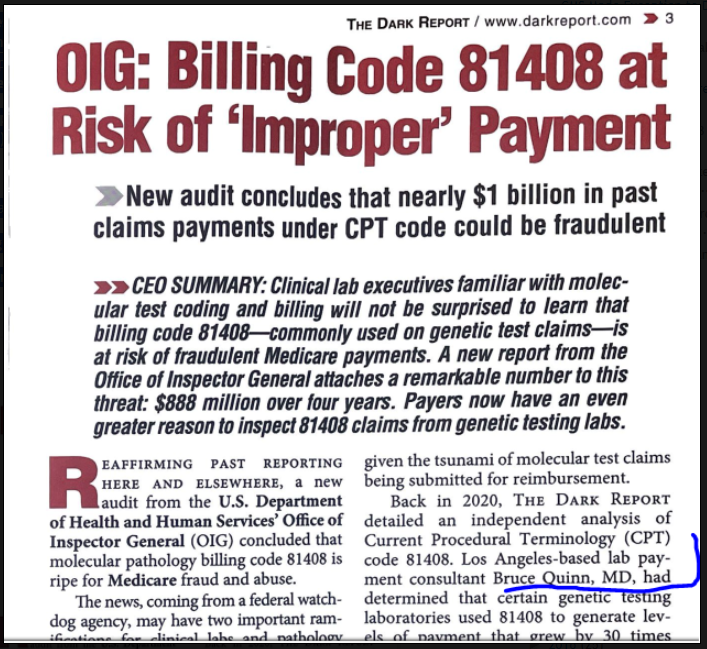
Regarding 81408 fraud, the bring readers up to date on the July 2023 OIG report about a billion dollar of easy money autopaid by the Novitas and FCSO MAC's the last couple years.  See my blog here and the OIG report here.  See Genomeweb here.

  • 81408 Death Watch?   OIG wrote that "there were no longer payments on [81408] by December 31, 2021."  
  • Well, I hope so, but we'll find out in October 2023, in a couple months, when CMS releases payments by CPT code for ...CY2022.

 Regarding Z codes, they initiate a new section, VIRCHOW, about the intersection of the lab industry and managing care.  There's a several-page article speculating on how slow or fast Z codes will spread in the insurance industry.   Another article states that United Healthcare has delayed Z codes for several months (formerly August 1).

Regarding digital pathology, they have a long article about the full-on adoption of whole slide imaging (WSI) at Universit of Louisville.

___

Dark media also have a free weekly newsletter, TDR INSIDER. 

See also their blog series, open access, Dark Daily.

They offer a current webinar on Z codes, $195, here.


Tuesday, August 8, 2023

Very Brief Blog: Open Meetings for Notorious Novitas/FCSO Oncology Biomarker LCDs

 In June, Novitas and FCSO posted identical twin, final "Oncology Biomarker" LCDs that were extremely long and tortuous, and including voluminous material never given to public comment in the draft.  (The finals were hugely longer than the drafts).

In early July, the LCDs were withdrawn or postponed, and new versions of each were released around July 27.  The "new versions" are the same as the "final" versions of June, but this time in their full form, they will be exposed to public comment.   In some places they make sense, of course, but in many places they are bizarrely written and unreadable or uninterpretatible.  They come with massive, 80-part confusing billing articles as well.

I squeaked into the Novitas August 11 registration this morning - the FCSO registration for August 10 reported "closed."

There will be public meetings.  For Novitas, a public meeting August 11, 2023, at 10 ET.  It's listed as open for four hours (for me, from 7 pacific to 11 pacific).  

https://www.cms.gov/medicare-coverage-database/view/lcd.aspx?lcdid=39667&ver=9&stateRegion=all&contractorNumber=all&proposedStatus=C&sortBy=commentStart&bc=11

For FCSO, a public meeting August 10, 2023, at 10 ET. [likely closed]

https://www.cms.gov/medicare-coverage-database/view/lcd.aspx?lcdid=39668&ver=8&stateRegion=all&contractorNumber=all&proposedStatus=C&sortBy=commentStart&bc=11