Tuesday, May 16, 2023

United Healthcare: STAT says Colonoscopy restrictions are "Stunning"

There's a very long article at STAT but I think it's open access, about major proposed or imminent changes in colonoscopy coverage at United Healthcare.

https://www.statnews.com/2023/05/15/united-colonoscopy-insurance-cost/

Apparently it's not brand new, but new to me today.  See also Fierce Healthcare,

https://www.fiercehealthcare.com/payers/unitedhealthcares-prior-authorization-policy-colonoscopies-draws-more-fire?itm_source=parsely-api


Here's a quote:  In May, the American College of Gastroenterology drafted a letter, alongside the other gastroenterology societies, to UnitedHealthcare pleading once more for them to cancel the policy. A total of 175 different professional and medical organizations signed on. But they’re not confident their appeal will change anything. The sense they’ve gotten from their meetings with United is that the policy is “not negotiable,” Early said.

Here's some catch-up, also from STAT's article.

When gastroenterologists learned in March that UnitedHealthcare plans to barricade many colonoscopies behind a controversial and complicated process known as prior authorization, their emotions cycled rapidly between fear, shock, and outrage.

The change, which the health insurer will implement on June 1, means that any United member seeking surveillance and diagnostic colonoscopies to detect cancer will first need approval from United — or else have to pay out of pocket.

A multi-stakeholder complaint letter to UHC is here.

__________

I asked GPT4 to review the associations' letter, critique it, list potential improvements, and then rewrite it.    Here.

GPT4 Solves a Model Prior Authorization Decision for a Molecular Test

This is an artificial case history, but shows that GPT4 can apply prior authorization rules to a medical record.  {The rules are fake}.

_________________

In this task, you will assess whether a patient's medical record meets Anthem’s coverage criteria for residual disease PCR testing.    Anthem requires five criteria:

1. The patient is less than 85 years old.

2. The patient has previously been treated with cyclophosphamide or vincristine.

3. The patient has B cell leukemia.

4. The patient has not had a residual disease PCR test in less than 30 days.

5. The patient is being treated by an oncologist.

Here is the medical record to analyze.  Please respond by discussing the five criteria above, for Mary Doe, in light of her medical record.  Please note that this is a mock up case, so evaluate it for the criteria above, some aspects of the record may be fictional.


MEDICAL RECORD START


Date: May 16, 2023

Doctor: Dr. Bruce Quinn

Physician Specialty: Oncology

Mary Doe is seen in clinic visit today complaining of nausea and shakiness.  She had difficulty sleeping last night.   

History.  Mary is a 70 year old woman.  She was diagnosed with hypertension at age 65 and takes hydrochlorthiazide with good control.   She had a wrist fracture after a fall at age 67 and healed well with no residual complaints.   At age 68, she developed several episodes of infection and was anemic and had lost 15 pounds.  She had intermittent fevers at night, which she had not experienced since menopause at age 51.   She was diagnosed with plasma cell leukemia.   It could be identified with PCR for a distinctive translocation t(4,14).  She was treated with four months of cyclophosphamide therapy.   Since then, evidence of leukemia has been absent on flow cytometry and molecular testing.   She had her last PCR TRANSLOCATION test on May 4, 2023, which was negative.

Physician exam:  The patient’s blood pressure is 120/90.  Her pulse is 80.  Her temperature is 37 C.   She appears comfortable.   Physical exam is otherwise normal except for mild brusing on the left upper arm.

Labs:  White count is 6000.   Hematocrit is 40%.   Urinalysis is normal.

Plan:  Patient says she feels better today.   Her mild symptoms seem to be resolving.  Order a PCR TRANSLOCATION test and run an AI prior auth analysis for it.   Ask Mary to return in 7 days, but call us if symptoms worsen.

SIG / Bruce Quinn MD     

END MEDICAL RECORD.  

PLEASE START AI ANALYSIS FOR ANTHEM PRIOR AUTH CRITERIA

ChatGPT

Based on the medical record, here's how Mary Doe's case aligns with Anthem’s coverage criteria for a PCR translocation test:

Age: Mary is 70 years old, which satisfies Anthem's criterion that the patient be less than 85 years old.

Previous Treatment: Mary's record states that she was treated with cyclophosphamide therapy for four months. The criteria include cyclophosphamide as an acceptable previous treatment, so this criterion is met.

Type of Leukemia: Mary has been diagnosed with plasma cell leukemia, not B cell leukemia. Although plasma cells are a form of mature B cells, the medical and insurance communities do not always consider them as such due to their distinct characteristics and treatment approaches. Therefore, based on Anthem's specific requirement for B cell leukemia, this criterion is not met.

PCR Translocation Test Timing: Mary's last PCR translocation test was performed on May 4, 2023. As today's date is May 16, 2023, only 12 days have passed since her last test. This does not meet Anthem's criterion that a test should not be performed less than 30 days from the previous one.

Specialist Treatment: Mary is being treated by Dr. Bruce Quinn, whose specialty is Oncology. This meets Anthem's requirement that the patient is being treated by an oncologist.

In conclusion, Mary's medical record meets three out of the five criteria set by Anthem. She does not meet the criteria for the type of leukemia (B cell leukemia) and the timing since her last PCR translocation test. Therefore, based on the provided criteria, her PCR translocation test may not be covered by Anthem insurance.

____

OK, that was good.   I am not an oncologist, but as a physician, I would have thought that plasma cells were a form of mature B cell that makes antibodies.  Can't the terms be used this way?

ChatGPT

Yes, you're correct. Plasma cells are indeed a type of mature B cell that produces antibodies. They are part of the B cell lineage and are formed when B cells are activated by specific immune responses. However, in a medical context, the terminology can sometimes be more precise.

When an insurance company, like Anthem, specifies "B cell leukemia" in their coverage criteria, they are likely referring to types of leukemia that specifically arise from B cells at an earlier stage of development, such as Chronic Lymphocytic Leukemia (CLL) or Acute Lymphoblastic Leukemia (ALL).

Plasma Cell Leukemia, on the other hand, arises from plasma cells, which are indeed a type of mature B cell, but this form of leukemia is typically categorized separately due to its distinct characteristics and treatment protocols.

Therefore, in a strict interpretation of the insurance criteria as stated, it may be argued that Plasma Cell Leukemia does not meet the requirement of "B cell leukemia". 

However, a case could also be made for coverage based on the fact that plasma cells are part of the B cell lineage. It might require further clarification from Anthem regarding their specific definition and criteria.

It's always a good idea in such cases to consult with the patient's oncologist and the insurance company to make sure the correct and most beneficial course of action is taken.


art / bing.com/create

GPT4 Analyzes a New England Journal Patient Case (65 y/o woman w neurologic signs)

I haven't tried giving GPT4 any dense clinical questions before.   

After reading a new book, The AI Revolution in Medicine, May 2023, co-authored by one of the top AI people at Microsoft (Lee), and at Harvard Med School (Kohane), and an excellent journalist (Goldberg), I realized GPT4 can already do pretty well at digesting clinical histories.

  • From the NEJM, here is a text of a recent complicated medical case study of a 65 year old woman.  
    • NEJM source here.  Text only, here.  
    • (The actual case results are here.  Not easy to figure out, it is lymphoma of CNS.  The NEJM poll didn't get this one, Cadasil was voted 44%, CJD 21%, lymphoma 10%.)
  • GPT4 can also summarize patient-doctor dialogs into clinical notes.


###

GPT4 READS THE NEJM CASE AND ANSWERS:

 GPT4 Assessment:

This 65-year-old woman presented with a complex set of symptoms including worsening neuropsychiatric symptoms (anhedonia, decreased energy, sadness, poor concentration, suicidal ideation), physical symptoms (weight loss, unsteady gait, recurrent falls, left-side weakness), and cognitive symptoms (impaired recall, mild inattention). While initially diagnosed with depression, her symptoms have progressively worsened over the past year, despite changes in her psychiatric medications. 

A number of neurological tests have been performed, which, while revealing some abnormalities (e.g., increased signal intensity in the pons and periventricular distribution on T2-weighted imaging, patchy hyperintensity involving the centrum semiovale, corona radiata, internal capsule, and corticospinal tract bilaterally on T2-weighted fluid-attenuated inversion recovery (FLAIR) imaging), have not definitively diagnosed her condition. 

Furthermore, her physical and cognitive decline appears to have progressed despite psychiatric and physical therapy interventions.

Plan:

Given the atypical presentation and progression of symptoms, it is necessary to consider additional diagnostic possibilities beyond a primary psychiatric disorder. The presence of unilateral weakness, along with neuroimaging abnormalities and cognitive symptoms, suggests a possible neurodegenerative or neurological condition.

The next steps should include:

Neurological Consultation: It is important to involve a neurologist in her care. A neurologist could perform a more detailed neurological examination and interpret the significance of her imaging findings in the context of her clinical presentation.

Further Imaging: Depending on the neurologist's assessment, further neuroimaging may be required. A PET scan, for example, could be useful in detecting metabolic changes in the brain associated with neurodegenerative diseases.

Lumbar Puncture (LP): An LP could be useful in looking for evidence of CNS inflammation or infection, or to assess biomarkers associated with neurodegenerative diseases (such as tau or beta-amyloid in Alzheimer's disease).

Neuropsychological Testing: This would provide a more comprehensive understanding of her cognitive deficits and could help differentiate between psychiatric and neurological causes of her cognitive symptoms.

Psychiatric Consultation: A detailed psychiatric evaluation could help determine the extent to which her psychiatric symptoms are contributing to her overall presentation.

Multidisciplinary Care Approach: A multidisciplinary team including neurologists, psychiatrists, physical therapists, occupational therapists, and social workers could work together to provide comprehensive care for this patient, addressing both her physical and mental health needs.

Consideration of atypical or rare causes: If standard tests do not provide a clear diagnosis, it may be necessary to consider rarer causes, such as prion diseases, mitochondrial diseases, or other rare neurodegenerative disorders. This may require more specialized testing and consultation with a specialist in these conditions.

Supportive Care: Regardless of the underlying diagnosis, this patient is clearly struggling with her daily activities and quality of life. Supportive care measures, such as physical therapy, occupational therapy, speech therapy, nutrition support, and mental health support, should be continued and optimized to help her manage her symptoms and maintain her quality of life.

This is a complex case, and it is important to keep an open mind and consider all possible causes of her symptoms. Her care should be patient-centered, and all decisions should be made in collaboration with the patient and her family.


Human physicians voted for a diagnosis of CADASIL, followed by CJD, followed by lymphoma.  The patient proved to have lymphoma (voted by only 10% of doctors).  

What is consistent with this final diagnosis, in retrospect?

 CADASIL (Cerebral Autosomal Dominant Arteriopathy with Subcortical Infarcts and Leukoencephalopathy) and CJD (Creutzfeldt-Jakob Disease) are both neurological conditions, the first being a genetic disorder affecting the small blood vessels in the brain, and the second being a prion disease causing rapid neurodegeneration. While the patient's neurological symptoms and MRI findings could be suggestive of these conditions, they could also be consistent with central nervous system (CNS) lymphoma.

CNS lymphoma is a type of non-Hodgkin lymphoma where cancer cells form in the lymph tissue of the brain and/or spinal cord. Although this is a rare condition, it can present with a variety of neurological and psychiatric symptoms, depending on the areas of the brain affected.

In retrospect, the following findings are consistent with the diagnosis of CNS lymphoma:

Neuropsychiatric symptoms: Her depression, cognitive decline, and psychomotor retardation can be seen in CNS lymphoma due to the effect of the tumor on different parts of the brain.

Unilateral weakness and gait issues: Depending on the location of the tumor, CNS lymphoma can cause focal neurological symptoms, such as weakness on one side of the body.

Rapid progression of symptoms: CNS lymphoma can lead to a rapid decline in neurological function, consistent with this patient's history.

MRI findings: The presence of hyperintensities on T2-weighted and FLAIR imaging can be seen in CNS lymphoma. Although these findings are not specific and can be seen in a variety of neurological conditions, they can be suggestive of a brain tumor in the right clinical context.

Weight loss: Significant weight loss is a common symptom in lymphomas and could be an indirect sign of malignancy.

Increased white cell count: While not specific, an elevated white cell count can be seen in individuals with systemic malignancies, including lymphoma.

Failure to improve with psychiatric interventions: Despite aggressive treatment for depression, her condition worsened, which could suggest an underlying organic pathology like CNS lymphoma.

In summary, while this is a challenging case with symptoms that could be seen in a variety of psychiatric and neurological conditions, in retrospect, the above findings are consistent with the diagnosis of CNS lymphoma.


And on the other hand, from the data we had initially, are there any features of the case that would lead you AWAY from the diagnosis of Lymphoma?

ChatGPT

Indeed, while certain features of this case are consistent with CNS lymphoma in retrospect, there are also features that might have initially led a clinician away from this diagnosis:

History of depression: The patient had a prior diagnosis of depression which seemed to correlate with her psychosocial stressors. This might have led clinicians to initially attribute her symptoms to a worsening of her depressive disorder, rather than considering an organic brain pathology like lymphoma.

Lack of typical CNS lymphoma symptoms: Although CNS lymphoma can present in many ways, some more common symptoms such as seizures, headaches, or changes in personality were not reported in this case.

Normal Contrast-enhanced MRI: CNS lymphoma often shows contrast enhancement on MRI due to disruption of the blood-brain barrier by the tumor. The absence of this finding in the case might have made CNS lymphoma less likely in the minds of the clinicians.

Absence of systemic symptoms: While the patient did have weight loss, she did not have other systemic symptoms often associated with lymphoma, such as night sweats or unexplained fevers.

Subacute presentation: While CNS lymphoma can cause rapidly progressive neurological symptoms, this patient's symptoms developed over several months. Depending on the clinician's experience and familiarity with CNS lymphoma, this may have been perceived as a more subacute presentation, potentially leading them away from a diagnosis of a rapidly growing malignancy like lymphoma.

This case underscores the diagnostic challenges that can arise in complex patients and the importance of maintaining a broad differential diagnosis, especially when patients do not respond as expected to initial treatments.


art bing.com/create

Monday, May 15, 2023

Quality by the Numbers: Using Cost/Value Projections to Pick Quality Measures

We often puzzle over exactly how USPTF decisions are made, or how quality measures are debated, chosen, and implemented by payors.  Different stakeholders may take opposite sides for numerous reasons, including perceived economic ones.   

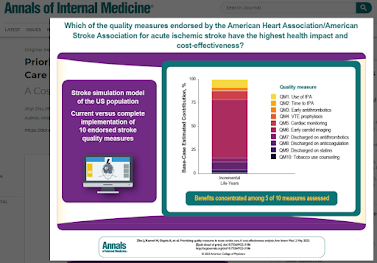
An excellent paper by Zhu et al. in Annals of Internal Medicine this month sheds a light on this.  If we have to choose, why not bang for the buck, or benefit for the resources, if you prefer.   Let's drop the $1000 quality measure that generates $100 of health value, and instead let's pick the $100 quality measure that generates $1000 of health value.   Sounds simple, until you realize the status quo is for Specialty X to want measure X, and Specialty Y to want Measure Y, and they argue-and-arm-wrestle to a decision.

In the field of stroke care, Zhu et al. assert that most of the benefit (impact) was expected to come from just 5 of 15 possible stroke quality measures.   Scarily, only 10 of 15 endorsed quality measures had enough outcomes data to allow a cost/benefit analysis.   2 of the 15 measues carried 70% of the value and 5 of the 15 measures carried 90% of the value.  

https://www.acpjournals.org/doi/10.7326/M22-3186

The article has an editor's Visual Abstract:

click to enlarge
The authors conclude:

Substantial variation exists in the potential net benefit of quality improvement across AIS quality measures. Benefits were highly concentrated among 5 of 10 measures assessed. Our results can help providers and payers set priorities for quality improvement efforts and value-based payments in AIS care.
_____

More of this kind of work is probably a good thing.   

On the same theme: A new Cass Sunstein article on algorithms in public policy - here.

See a USC article on a special sort of cost/benefit analysis called GRACE.


art, bing.com/create

Friday, May 12, 2023

AI Example: We Ask GPT4, "What is the MolDx Program??"

In a prior blog, I asked GPT4 to assess two press releases related to LBx coverage under the MolDx program.   Here, I ask GPT4 what it knows about MolDx, in general.

Note, this is not a human expert presentation on the MolDx program - MolDx or I could write that ourselves.  The aim here is only a "show and tell" of how GPT4 explains the MolDx program.  The answer is printed verbatim.

++++++

Please describe the Medicare MolDx program in as much detail as you can. You are writing for an expert in the diagnostics industry. 

GPT4 answers (verbatim):

The Medicare Molecular Diagnostic Services (MolDX) program, administered by Palmetto GBA, was initiated to manage and facilitate coverage and payment for molecular diagnostic tests (MDx). Molecular diagnostics represent a rapidly growing field that can provide critical information for diagnosing, treating, and monitoring diseases. 

However, the speed at which new tests and technologies emerge has led to challenges in ensuring that these tests are used appropriately and that they provide value to patient care. MolDX was developed in response to these challenges.

MolDX has a key role in assessing the clinical utility and validity of new molecular diagnostic technologies. It does this by evaluating the analytical and clinical validity of the tests, the clinical utility (how the use of the test can guide patient management), and the public health impact. The goal is to ensure that Medicare beneficiaries have access to molecular tests that are accurate, reliable, and clinically useful.

Key aspects of the MolDX program include:

1. Clinical Test Evaluation: MolDX reviews new MDx tests to determine if they meet Medicare's "reasonable and necessary" standard for coverage. It requires evidence that the test is clinically valid and useful. This typically involves reviewing data from clinical studies demonstrating that the test accurately detects or predicts the presence or absence of a condition and that the results of the test influence patient management and improve health outcomes.

2. Coding and Pricing: MolDX also plays a significant role in the coding and pricing of MDx tests. It has developed specific coding for many molecular tests to facilitate accurate tracking and reimbursement. Pricing is determined based on the resources required to perform the test and the clinical value it provides.

3. Program Integrity: MolDX works to maintain program integrity by ensuring that molecular tests are not misused or overused. It oversees the use of these tests and can deny payment for tests that are not reasonable and necessary.

4. Education and Outreach: MolDX provides education and outreach to providers and laboratories about covered tests, proper coding, and other relevant issues. This helps ensure that providers and labs understand the requirements and expectations of the MolDX program.

5. Research and Innovation: While not explicitly stated, the MolDX program appears to support research and innovation in the field of molecular diagnostics by providing a clear path to coverage for new and innovative tests.

From the press releases above [prior questions], we can infer that the MolDX process involves evaluating the analytical and clinical validity of a test, its clinical utility, and its relevance to the Medicare population. In both cases, the tests were granted coverage after demonstrating their effectiveness and utility in managing cancer, a condition of high relevance to the Medicare population.

AI Example: GPT4 Analyzes and Compares Two Moldx LBx Press Releases

One capability of GPT4 is to analyze and compare two different documents, such as press releases on related topics but from different companies.

Here, I asked GPT4 to read and compare two presses releases related to MolDx program coverage.  The first press release, 2023, explains Guardant coverage for MRD immunotherapy monitoring.  The second press release, 2022, explains Natera coverage for bladder cancer using MRD.   

I have not altered what GPT4 wrote, although I might have written different answers as a human expert.  This is just an exercise to see what GPT4 might do.   Note that GPT 4 has a random factor, so if the exact same questions were asked again, the results would vary.  My full prompt and press clippings are here.

______

Medicare “MOLDX” is a program that gives coverage for new molecular cancer tests.  One important area is minimal residual disease testing, which is looking for traces of cancer DNA in the patient’s blood.   MOLDX issues this coverage one test (and one cancer) at a time.  

Below, PART ONE is a press release from the company GUARDANT getting coverage for immunotherapy response.  The test is called “RESPONSE (TM)”.    PART TWO is a press release from the company NATERA getting coverage for its SIGNATERA (TM ) test in bladder cancer.

Please summarize each press release.  Please contrast and compare the two press releases for key similarities and differences.  


____
GPT4 Answers: (verbatim)


PART ONE SUMMARY: GUARDANT PRESS RELEASE

Guardant Health has received Medicare coverage for its Guardant360 Response test under the Molecular Diagnostics Services program (MolDX). This test is the first blood-only liquid biopsy that can monitor molecular response to immune checkpoint inhibitors in patients with metastatic or inoperable solid tumors. Following this decision, the test is now covered for Medicare patients in the U.S. who are on an immune checkpoint inhibitor therapy. The coverage includes a Guardant360 CDx or LDT test to establish a ctDNA baseline before therapy and a Guardant360 Response test 4 to 10 weeks after the start of the therapy to measure the change in ctDNA level. This adds to the existing Medicare coverage of Guardant Health tests for cancer patients.

PART TWO SUMMARY: NATERA PRESS RELEASE

Natera, a leader in cell-free DNA testing, has received coverage from the CMS Molecular Diagnostics Services Program (MolDX) for its Signatera molecular residual disease (MRD) test in patients with muscle invasive bladder cancer (MIBC). This decision is based on evidence from multiple validation studies showing that the Signatera test can provide early assessment of therapy effectiveness in both neoadjuvant and adjuvant settings. This represents the first coverage expansion under the foundational local coverage determination (LCD) for MRD testing in solid tumors (LCD L38779). This addition complements the existing Medicare coverage for Signatera in colorectal cancer and for pan-cancer immunotherapy monitoring.

COMPARISON OF THE TWO PRESS RELEASES

Both press releases announce the expansion of Medicare coverage for their respective molecular diagnostic tests, Guardant360 Response by Guardant and Signatera by Natera. Both companies operate under the Molecular Diagnostics Services program (MolDX) and both tests offer non-invasive, blood-based solutions for monitoring cancer progression and response to therapy.

The primary difference between the two is the specific application and function of the tests. Guardant's Guardant360 Response test is specifically designed to monitor the response of metastatic or inoperable solid tumors to immune checkpoint inhibitor therapy. It includes a baseline ctDNA test before therapy and another one 4 to 10 weeks after the start of therapy.

Natera's Signatera test, on the other hand, is focused on detecting minimal residual disease (MRD) in patients with muscle invasive bladder cancer. Its coverage expansion is based on the demonstrated ability of the test to provide an early assessment of therapy effectiveness in both neoadjuvant and adjuvant settings. This is the first expansion of coverage for MRD testing in solid tumors under a foundational local coverage determination (LCD).

In summary, while both tests are designed to monitor cancer progression and response to therapy, they target different types of cancer and have different specific uses.

_________

HUMAN:  Can you say anything or infer anything about how the MolDx program makes its decisions?

GPT4: (Verbatim)

The MolDx (Molecular Diagnostic Services) program is administered by Palmetto GBA, a Medicare Administrative Contractor. It was developed to identify and establish coverage and reimbursement for molecular diagnostic tests.

From the press releases you provided, we can infer several factors that MolDx considers when making decisions about coverage:

Clinical Validity: The MolDx program seems to require robust evidence of the test's clinical validity. Both Guardant and Natera presented data from multiple studies showing that their tests are reliable and effective for their intended uses.

Clinical Utility: In addition to proving a test's clinical validity, companies likely need to demonstrate its clinical utility. This means showing that the test can provide information that will help doctors make better decisions about patient care. For instance, the Guardant360 Response test can help doctors track a patient's response to immune checkpoint inhibitor therapy, and the Signatera test can provide an early assessment of therapy effectiveness in both neoadjuvant and adjuvant settings.

Unmet Medical Need: The MolDx program may also consider whether a test addresses an unmet medical need. The Guardant360 Response test is the first blood-only test that can monitor molecular response to immune checkpoint inhibitors, and the Signatera test addresses a high rate of recurrence in muscle invasive bladder cancer.

Quality and Quantity of Evidence: It appears that MolDx requires a substantial amount of high-quality evidence to grant coverage. Both Guardant and Natera cited multiple validation studies in their press releases.

Test's Relevance to Medicare Population: Given that MolDx is a Medicare program, the tests likely need to be relevant to diseases and conditions common in the Medicare population. Both cancer monitoring tests would fall into this category.

It's worth noting that while these inferences seem consistent with the press releases, the exact decision-making process of MolDx isn't specified in these documents. The actual process could be more complex and involve other factors not mentioned here.

Repeat - responses are GPT4 responses verbatim, with no human edits. A human expert might respond differently.

Labs Most Successfully Billing CMS for 81408, 87798 in 2021

This week, the Centers for Medicare & Medicaid Services (CMS) released billing data categorized by code and by laboratory (or physician) for the calendar year 2021 -  here

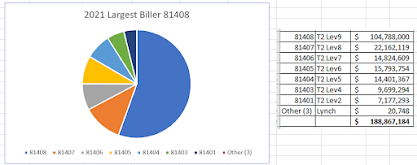
We closely examined the billing data for code 81408, Tier 2, Level 9, as it was the primary code used by numerous laboratories indicted by the Department of Justice (DOJ). A substantial number of these labs have either pled guilty or been convicted, with a significant concentration of the activity in Texas and Florida. For a detailed instance of a guilty plea involving 81408 billing in 2023, refer to this link.

Additionally, we scrutinized the billing data for code 87798, given that a large proportion of the billing occurred in Molecular Diagnostic (MolDx) states. Notably, these states transitioned from a notably lenient claims processing approach in 2021 to a tightly controlled methodology in 2022, as documented here.  We assessed potential Medicare savings under the new LCD, using 2021 data for MolDx states.

81408 / 2021

In 2021, the laboratory that achieved the greatest success in billing for code 81408 received a total of $188M from Medicare. This lab, located in Texas, billed almost exclusively with Tier 2 codes. Of this $188M sum, over half was paid under code 81408. Tier 2 codes were billed in multiples of two per patient, the only exception being 81407, which was billed in multiples of one.

The revenue this lab generated from 81408 in 2021 exceeded $100M, accounting for roughly a third of the national payments for this code in the same year, which totaled $280M. Interestingly, this lab exhibited a closely similar pattern of Medicare billing in the previous year, 2020, although the revenue generated then was significantly lower, at around $30M, 85% less. 

click to enlarge

87798 / 2021

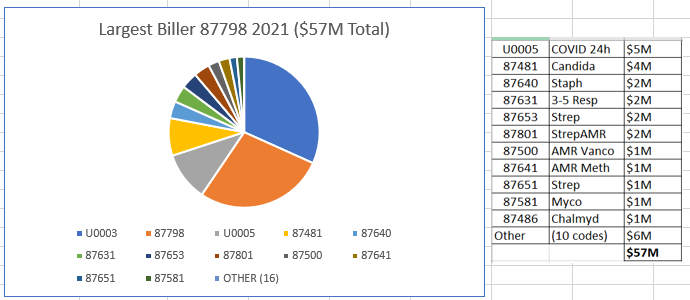
We looked at 87798, and especially in MolDx states, due to the new MolDx LCD restricting this billing.  In 2021, the laboratory that billed most successfully for code 87798 was located in the Carolinas, receiving approximately $57M in total from Medicare. About half of its revenue for that year was derived from COVID-19 testing (codes U0003 and U0005).

Code 87798, denoting an "amplified probe, other", with a value of $35, accounted for $14M of the lab's total revenue. A variety of smaller codes - including those for candida, staph, strep, and AMR - constituted the remainder of its billings.

If we exclude the COVID-19 codes, roughly 40% of the lab's revenue was generated by 87798. Of the nationwide $208M in payments for 87798, this lab's $14M represented approximately 7%. This indicates that the payments for 87798 were broadly distributed across various labs.

click to enlarge

__

Based on these examples, for 2021, if we extrapolate in a simple way that high-billing 87798 labs bill about 1/3 of their non-Covid molecular micro billing as 87798, then their total non-Covid molecular micro billing would be in the range of 3x$208M (87798) or $600M.    Similarly, if 81408 labs bill around 1/2 in 81408 and 1/2 in other Tier 2 codes, then Tier 2 billing would be circa 2x$280M (81408) or  $500M-$600M.   Smile: Actual Tier 2 payments in 2021 were $594,949,414 (based on October 2021 Excel sheets released by CMS), e.g. close to $600M, so the back-of-envelope math and the exact methods foot pretty closely.  


 art: bing.com/create


Thursday, May 11, 2023

Focus on Molecular Microbiology Code 87798: Impact of Palmetto 2022 LCDs

One of the major policy changes of 2022 in the MAC world has been the introduction of a broad-ranging molecular microbiology LCD by the MolDx states  Generally, only 3-5 concurrent molecular pathogen probes are allowed at once, althogh there are exceptions for unusual conditions like transplant patients.   (In addition, intense use, like in the ICU  sepsis patient, is part of a DRG and not controlled by the LCD).

I've been told that one impact is to control payments of code 87798, other amplified probe ($35).  This has a medical-unlikely edit of 13.   It's been said that past LCDs may have not paid for specific codes (such as "12-18 respiratory pathogens") but the LCDs didn't control use of 87798 x 13 in the same situation.

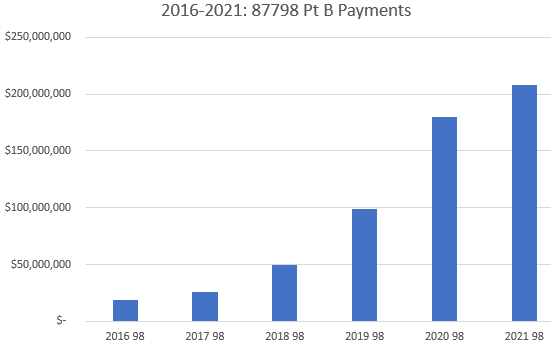
Here's the growth of 87798 from 2016 to 2021:

Note that the doubling-time began well ahead of the 2020 pandemic.

In other blogs, I've noted that Part B "Tier 2" CPT code payments for rare genes are almost entirely in Novitas/FCSO states (and ranging around $400M a year).   Where do the 87798 payments fall?

They fall mostly in MolDx states.

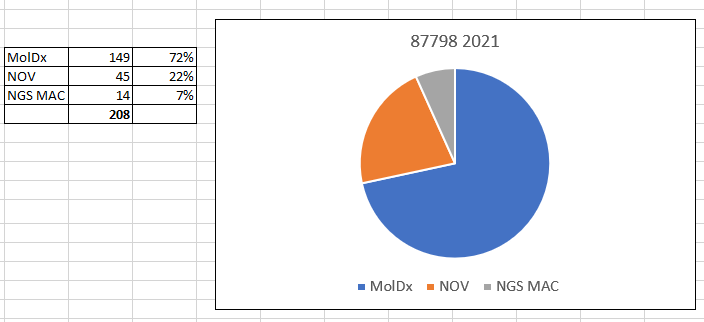
Using recently released 2021 data, 72% or $149M of the 87798 payments were in MolDx states.  

This left 22% for Novitas (FCSO) states and just 7% for NGS MAC states.


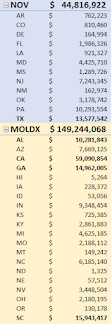
Within the MolDx MACs, payments are dominated by California, with $59M in 2021.  Other MolDx states in the $10-15M range for 87798 include Alabama, Georgia, South Carolina.  

Impact of LCD?

If the LCD drops payments by 90% in MolDx states, that would be about $130M.  The total impact could be higher; data shows that high-billing labs for 87798 bill about $2 in other molecular microbiology codes for every $1 billed as 87798.  (This is outside their Covid billing, which could be half of revenues in 2021).

More Data Views

A Google Sheets spreadsheet is here, with MAC and State level data.  I've clipped a partial table below as a JPEG.   

Interested readers can go to the CMS source for 2021 data here and filter for the code 87798 to see all providers and volumes.  

Average billings of top providers were 18 tests per patient (some in the high 20's or even 30's).  This is  interesting in that the MUE per claim is 13 (for a table of data by top billers, see at bottom).

Across all 87798 billing in 2021, about 75% was from clinical laboratories and about 15% from urologists or urology groups (about $30M).

partial table of MAC x states

click to enlarge


Wednesday, May 10, 2023

In the Cloud: Part B Genomics Payments, 2021, in Excel

This is a cloud Excel dataset of providers who, in CY2021, were paid for genetic/genomic test codes by Medicare Part B.

For a 16,000 line, 1 MB Excel data sheet, of Part B genomics payments, see the cloud here:

https://docs.google.com/spreadsheets/d/1higTTfO8GTu73byMv1zCZDU7KCWGJ8i-/edit?usp=sharing&ouid=110053226805181888143&rtpof=true&sd=true


For more about the data source, see my prior blog:

http://www.discoveriesinhealthpolicy.com/2023/05/big-news-cms-releases-physicianlab.html

###

###

About the Excel Data:

This data set was derived from all 2021 part B data by these filters:

INCLUDE:  (Starts with 811 812 813 814 815, Starts with U00, Ends with M, Ends with U).

This includes Category I genetic codes, PLA and "M" (MAAA) codes.   

While 16,000 lines may sound like a lot, the original cloud data files for all Part B 2021 services has 10M lines.

Somewhat inconsistently, in this cloud data, I have included Covid "U" codes, but not all of the Molecular Microbiology codes.   (All of the the micro codes make it a 30 MB dataset which is much harder to handle.)

I deleted physician names from this Excel, although those names are all public in the original CMS source website (above).   I did leave in all names of type, "Clinical Laboratory."

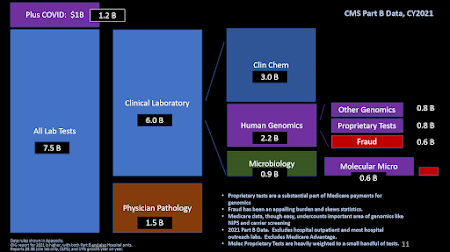
This is a CMS data summary for all lab tests in 2021, which I did based on the simple 2021 excel spreadsheets released by CMS last October for 2021. Click to enlarge.  


______

Exercise for the Reader

In order to search molecular microbiology codes in the original 10M line 3 GB data, the filter instructions you'd use would be:

INCLUDE: (Starts with 874, 875, 876, 877, 878, 879 or U00)

and then EXCLUDE:  Codes lower than 87468 and codes from 87802-87899.

This generates a 30MB Excel with about 100,000 lines.


Big News: CMS Releases Physician/Lab Database for CY2021; Boom in 81408 Ongoing

Each year since about 2016, CMS has realized a huge annual cloud database of all CPT & HCPCS codes paid to physicians and labs.   It comes out anytime between May and August, and this year, it's issued on May 10, 2023 for CY2021.

This data is titled, Medicare Physician & Other Practitioners - by Provider and Service.  Basically, you can search every CPT code (all the imaging codes; all the pathology codes; the BRCA code, etc) and see what any and all providers were paid for that code in Medicare Part B in CY2021.  

Find CY2021 data here:

https://data.cms.gov/provider-summary-by-type-of-service/medicare-physician-other-practitioners/medicare-physician-other-practitioners-by-provider-and-service/data

The full 2021 claim data set is 10M lines and 3GB.  However, you'll want to filter for subsets, like genetics.

Using the Data

It's a bit of a learning curve to learn to use this cloud database, but basically, the key commands are FILTER and then EXPORT.   

For example, if I filter on code 81162 - BRCA full sequencing - I get only 44 rows, which I can export in Excel and study.  

If I filter with the command "starts with 814" I get 1189 rows.  Which are all the codes and providers paid for 814nn, or CPT genomic sequencing procedures.  

When you have the filter you want, click on "Export."  Note, this gives you a csv file which you'll want to save as an Excel (or Google Sheets) file.

81408 Watch

For several full years, I've made watching the flow of payments under code 81408 and other Tier 2 codes.  

These codes, from 81400 to 81408, are issued by AMA CPT to track sequencing of clinically rare genes.   The amazing, amazing thing is that, most of the labs that bill 81408 at all ($2000, full sequencing, rare gene) bill it in multiples of 2 for every Medicare patient and ALSO bill the whole series of 81400-81408 on every patient.  This is, to borrow a CMS term, "medically unlikely."

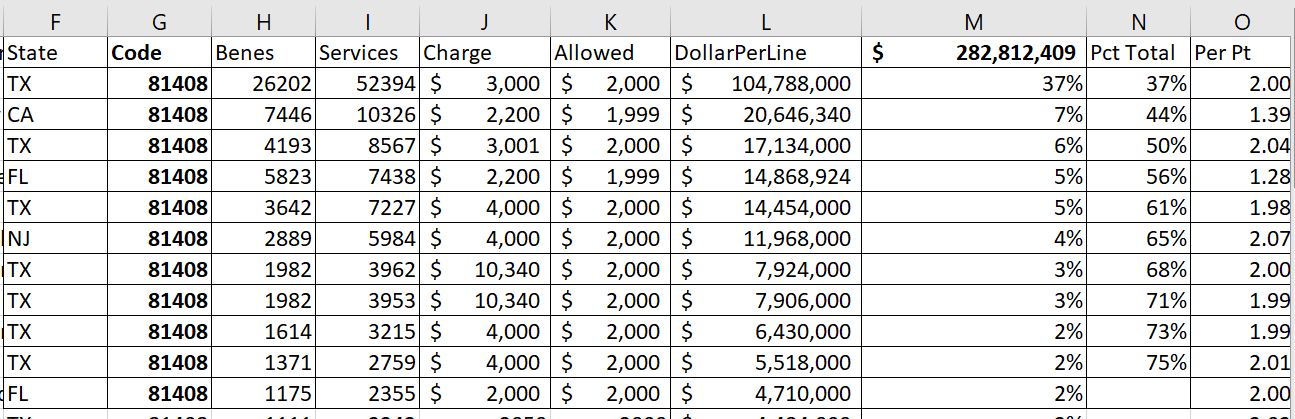
Medicare Part B ayments in 2021 for 81408 were $282M.  Payments, again as in a series of past years, are almost entirely in Florida and Texas.   (Based on past research, I and colleagues belive the one lab listed in "state of CA" has its NPI there but actually bills in another less-controlled state.  For example, MolDx edits would never allow payment of 81408).

One entity was paid $105M for 81408 or 37% of all 81408 uses nationwide.  The top five entities (of 80 entities) got over 60% of the 81408 payments.

Big busy genetics labs, like Ambry, Invitae, etc, were absent from the roster of 81408 recipients, as were Quest and Labcorp.  Click to enlarge.


In simple excel spreadsheets for CY2021, released by CMS around October 29, 2021, we already had seen that spending for 81408 was very high at $283M (the highest-paid code, somewhat above Cologuard 81528).    For my 10/2022 analysis of CMS data for CY2021, see here.

As I've reported over the several years, one can look up genetic labs reported in DOJ press releases as indicted or convicted for improper billing, and those genetic labs almost invariably have predominant billing of 814nn codes.   Of course, I can't make any assumptions about other labs with mostly 814nn billing patterns at Medicare.

bing.com/create

Why Tier 2 Code Fraud is Distinctive

For those labs who have been indicted or pled guilty or been convicted of lab fraud, in genetic testing, they usually are seen to mostly bill Tier 2 codes, all of them, and in multiples.  This is different than other kinds of common improper billing, such as electric wheelchairs.   If  a MAC gets 100 claims for 80 year olds around a state who need electric wheelchairs, well, it could be true.    But if a MAC gets 100 claims in a row, or 10,000, for 80 year olds, all of whom need $9000 worth of 16 different rare genetic tests, that's impossible, it's a different kind of detection issue.  

All billing for Tier 2 codes was $594M.   A bit of this is legitimate (occassional uses of 81401 or 81402 in uncommon patients.)  

###
See an adjacent blog to download, in Excel, my extract of CMS 2021 genomics data.


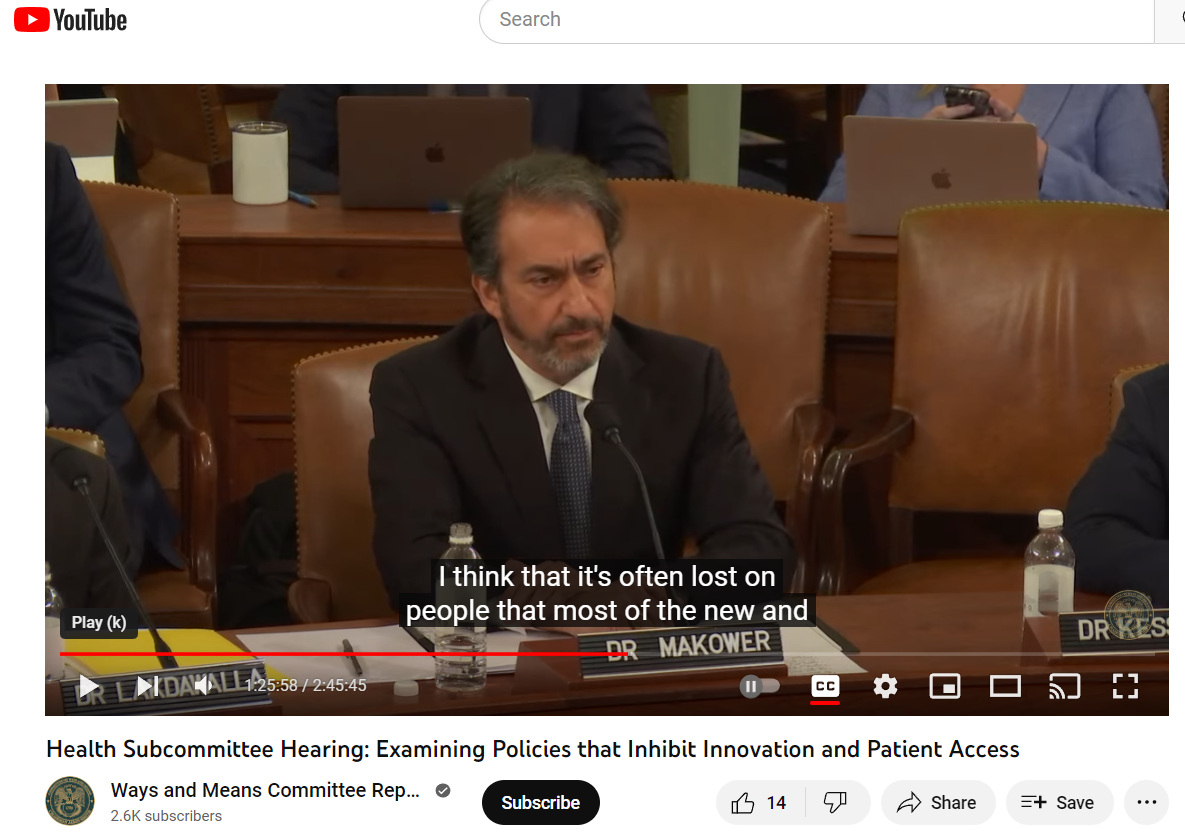
Rapid Video and Full Transcript: House Hearings on Health Innovation (May 10, 2023)

On May 10, 2023, the House Ways and Means committee, Health subcommittee, held a 3-hour hearing on policy barriers to health innovation.

Find the online video at YouTube here:

https://www.youtube.com/watch?v=_Evwt5DNbjo

And I've put a 40-page, 25000 word transcript in the cloud here:

https://docs.google.com/document/d/1j2-qksZN7qWCh6HIYD5gPo9nBvcml-un/edit?usp=sharing&ouid=110053226805181888143&rtpof=true&sd=true


I have also put the 5 witness testimony PDF documents in one zip file in the cloud here.

ADDED MAY 20:  Jason Shafrin publishes GPT summaries of those witness testimonies - here.

There were criticism of drug companies "gaming" the 340B and patent systems, but also much criticism of CMMI proposals to cut prices of accelerated approval drugs, and IRA for limiting reimbursement esp. for new indications.  

Numerous speakers bemoaned the loss of MCIT and want it brought back, or at least something comparable, by legislation if needed.   The need for legislation for prescription digital therapeutics was noted.   

Dr. Kesselheim of Harvard said there were too-many me-too drugs with no clinical advantage yet heavy advertising and high price points.  One of the congressmen, a doctor, noted that 50 different patients might respond differently to 50 drugs.  He criticized the German (AMNOG) system that sets prices of new drugs even as low as generic drugs if there is no advantage.  

Thanks to a colleague who provided this GPT4 summary in bullet points:

1. The government should foster an environment that promotes innovation and patient access to innovative care.
2. Recent examples of government getting in the way include CMS restrictive coverage mandates, CMMI considering changes to cover for Part B drugs [in-development ideas to cut price of accel. approval drugs], and USTR [US Trade Representative] waiver of critical IP protection for COVID vaccine.
3. Regulatory systems should work well to encourage innovation while balancing risk and reward.
4. The Independent Payment Advisory Board (IPAB) was a concern for many witnesses as it could limit access to innovative treatments.
5. The Innovation Center at CMS [CMMI] has the potential to promote value-based care but needs more transparency and accountability.
6. The FDA’s accelerated approval process is important for patients with serious or life-threatening conditions but needs better communication with payers and providers.
7. Intellectual property protections are crucial for incentivizing innovation in drug development.
8. Medicare reimbursement policies should be updated to reflect the value of new treatments and technologies.  [USC talked about a new value system called GRACE]. [*] 
9. Telehealth has great potential for improving patient access but requires regulatory changes to be fully realized.
10. Collaboration between stakeholders, including patients, providers, payers, and policymakers, is essential for promoting innovation and improving patient outcomes.


Monday, May 8, 2023

Company Founded to Lower Drug Prices, Abandons the Idea

EQRx, founded with much fanfare to create new drugs that were nonethless economically priced, gives up the idea.  Read the open access story in ENDPOINTS NEWS (email registration might be required.)

https://endpts.com/eqrx-lays-off-more-than-half-of-employees-abandons-drug-price-reform-mission/

In brief summary, EQRx, a start-up that aimed to provide lower-cost treatments and disrupt the US drug price system, has dropped its original mission and laid off more than half of its staff. The company has slashed its pipeline down to one drug, lerociclib, a cancer drug (CDK4/6 inhibitor).  The strategy was still off balance from a February 2022 FDA decision to reject a Lilly drug publicly on the principle its clinical testing had been in China only.  But lerociclib devellopment will ride on EQRx's ongoing billion-dollar cash position.

Writes Max Gelman, EQRx’s plan to upend the US drug price system with lower-cost treatments is over.   "We tried to change the system; maybe that was a stretch,” founder and EQRx executive chair Alexis Borisy told Gelman.


The topic was also covered at Genomeweb here.  See a discussion at "In the Pipeline" at Science here.

Congress Looks at Barriers to Health Innovation: Hearing Wednesday, May 10 This Week

Based on a May 3, 2023, Congress will hold a public hearing on "Policies that Inhibit Innovation and Patient Access," under the House Ways & Means committee.

See the press release here:

https://waysandmeans.house.gov/wp-content/uploads/2023/05/ADVISORY_Health-Subcommittee_May-10-2023.pdf

The hearing will be live-streamed and (normally) the video is archived as well.  Often, since this hearings arise suddenly, the  House committee may accept comments after the hearing as well.  This is open to May 24: WMSubmission@mail.house.gov   

The live stream will be a hearing page, with agenda and personnel, that will be created at the W&M committee.   https://waysandmeans.house.gov/  - keep checking:

https://waysandmeans.house.gov/event/health-subcommittee-on-examining-policies-that-inhibit-innovation-and-patient-access/

                                         Witness List

Mr. Tony Gonzales

National Early-Stage Advisor, Alzheimer’s Association

Mr. Ted Okon

Executive Director, Community Oncology Alliance

Dr. Darius Lakdawalla

Professor of Pharmaceutical Economics and Public Policy, USC Leonard D. Schaeffer Center for Health Policy & Economics

Dr. Joshua Makower, M.D.

Director, Stanford Byers Center for Biodesign, Stanford University

Dr. Aaron S. Kesselheim MD, JD, MPH

Professor of Medicine, Harvard Medical School

__

Recall that Congress had hearings on antibiotic resistance and on CMS policy, in the last ten days, my blog and link collections here.


Thursday, May 4, 2023

My Job Safe So Far: ChatGPT4 Totally Botches "30/70" Lab Referral Rule

I've seen some really incredible performance by AI like GPT4, being excellent at summarizing articles (up to 2000 words) and surprisingly good at suggesting PhD topics, PhD outlines, and even PhD first chapter of a PhD.   (See GPT4 suggest a Medicare lobbying strategy here and advise Hollywood studios on investments here.)

However, I've repeatedly seen it fail badly with even standard Medicare policy questions.  

For example, there is the lab referral billing 30/70 rule (based on SSA 1833(h)(5)(A); see here).  Below, GPT4 completely blows this, making up a nonexisting rule and then getting the 30/70 rule exactly backward initially.   

If you want to see the fiasco for yourself, below.

##

[Correct rule is shown in blue several screens down in the Q&A].

There is a special rule about labs billing medicare for send-away tests (referral tests).  I think they can bill Medicare if they bill themselves for no more than 30% of send-away tests, or that is, if they perform themselves 70 of every 100 tests they bill.   I think it's the 30/70 rule but it might be something else.

ChatGPT [all wrong]

The rule you are referring to is known as the "14/90 Rule," also called the "anti-markup rule" or "referral laboratory rule" in the context of Medicare billing. This rule was introduced by the Centers for Medicare & Medicaid Services (CMS) to regulate the billing practices of clinical laboratories.

According to the 14/90 Rule, a clinical laboratory can bill Medicare for referred tests (send-away tests) if it meets the following criteria:

  • The referring laboratory must perform at least 14 different tests for Medicare patients.
  • The number of referred tests must not exceed 90% of the total number of tests billed to Medicare.

In other words, the referring laboratory should perform at least 10% of the tests billed to Medicare to be eligible for reimbursement for referred tests. The 14/90 Rule aims to prevent overcharging and abusive billing practices by ensuring that laboratories have a significant portion of their testing services performed in-house.

Please note that this information is accurate as of my last knowledge update in September 2021. Rules and regulations may have changed since then. It is always a good idea to consult the latest CMS guidelines or a healthcare compliance professional to ensure compliance with the most current regulations.

User

I think you are in error.  I found documents on the 30/70 rule or 30% rule.  I found nothing on Google for any 14/90 rule anywhere.  SSA 1833(h)(5)(A).

ChatGPT [wrong again]

I apologize for the confusion, and I appreciate your diligence in seeking accurate information. It seems I made an error in my previous response.

You are correct; the rule you are referring to is called the "30/70 Rule" or "30% Rule." It is related to the billing of referred tests by clinical laboratories for Medicare patients. According to the rule, a laboratory can bill Medicare for referred tests if it meets the following criteria:

  • The referring laboratory must perform at least 30% of the tests it bills to Medicare in-house.
  • The number of referred tests must not exceed 70% of the total number of tests billed to Medicare.

This rule is designed to prevent overcharging and abusive billing practices by ensuring that laboratories have a significant portion of their testing services performed in-house.

Again, I apologize for the confusion in my earlier response, and I thank you for bringing it to my attention. As with any regulation, it is always a good idea to consult the latest CMS guidelines or a healthcare compliance professional to ensure compliance with the most current regulations.

User

No, you are closer but still wrong.  The lab must itself perform and bill at least 70% of tests.  It must not refer out more than 30% (if it bills them itself).

ChatGPT

I apologize once again for the confusion in my previous responses. You are correct, and I appreciate your patience in seeking accurate information.

The 30/70 Rule or 30% Rule you are referring to states that a laboratory can bill Medicare for referred tests (send-away tests) if:

  • The referring laboratory performs at least 70% of the tests it bills to Medicare in-house. [correct]
  • The number of referred tests (send-away tests) must not exceed 30% of the total number of tests billed to Medicare. [correct]

This rule is designed to prevent overcharging and abusive billing practices by ensuring that laboratories have a significant portion of their testing services performed in-house.

Please consult the latest CMS guidelines or a healthcare compliance professional to ensure compliance with the most current regulations, as rules and regulations may have changed since my last knowledge update in September 2021.


Very Brief Blog: Save the Links: House Hearings on (1) CMS and on (2) Antibiotic Resistance

Briefly - 

At the end of April, 2023, the House held two healthcare-related hearings. 

###  

The first was on CMS, and featured lengthy testimony and Q&A with CMS administrator Brooks-Lasure.

The April 26, 2023, hearing website (with links to YouTube video) is here.  The full title was, "Lowering Unaffordable Costs: Legislative Solutions to Increase Transparency and Competition in Health Care."  The full hearing ran 5 hours per the YouTube video.   The hearing page includes links to numerous pieces of early-draft or introduced legislation.

For this hearing I include a 90-page "auto transcript" in the cloud - here.  For example, while Brooks-Lasure testimony didn't mention "Alzheimer," that word occurs 41 times in the auto transcript (in connection with Medicare coverage for new Alzheimer drugs.)

###

The second hearing is, “Antimicrobial Resistance: Examining an Emerging Public Health Threat” and was held on April 28, 2023.   Find the Hill web page here.  The YouTube archive video is 2 hours long.  

Testimony included Kevin Outterson, executive director of CARB-X, and Amanda Jezek, SVP for public policy at Infectious Disease Society of America / IDSA.

See an auto transcript of the AMR session, in the cloud here.