Sunday, October 23, 2022

Side Note: New 2022 Review, History of Transgender Surgery; Medicare Notes

The new October issue of Annals of Internal Medicine has a long historical article, and an accompanying Op Ed, on the history of transgender surgery in the US.   See Magrath WJ, 2022, "The fall of the nation's first gender-affirming surgery clinic," here.   See also Keuroghlian AS & Radix AE, "A cautionary tale: The doomed gender identity clinic at Johns Hopkins Hospital," here.   They discuss the history of the transgender surgery center at Johns Hopkins, which closed in 1979.


____

Not mentioned are the Medicare policy tie-ins, which I'll just annotate briefly.   

1989

Medicare had no national policy on gender surgery until 1989, when it introduced a negative NCD, based on a extremely faulty "technology assessment" of the time (1980/1981).  (So this was a couple years after the Hopkins event and in Year 1 of the Reagan administration).  The negative NCD was published ;ater in 1989 as a few paragraphs in the Federal Register (August 1, 1989; Fed Reg 54:34555, at 34572.)  Here.  JPEG at bottom of this blog.

2013/2014

This 1989 NCD was thrown out by a panel of administrative law judges in 2013/2014, which I covered in a detailed blog in May 2014 here.  

(My 2014 blog notes that I had seen an optical character reading (OCR) version of the 1980/81 tech assessment, but the blog was edited by me to note that this had become a dead link in 2016. I don't seem to have a hard drive copy of that tech assessment, but in appears in bibliographies of academic articles on this Medicare history and in a discussion here.)   

2016

Since the NCD was active 1989-2014, when it was thrown out, CMS had no national statement on transgender surgery for a couple years.  

In 2016, CMS released a draft, and then final, NCD, that said that transgender surgery was a local MAC decision.  (Blog from June 2016 here).  NCD 140.9 homepage here.  

While the draft and final decisions in 2016 both left coverage to the MAC level, there were  substantial redlines between the draft and final.  Click to enlarge:

2016 (redline draft v final)

1989


Thursday, October 20, 2022

Peer Reviewed Study of Payor Coverage vs Guidelines (Wong et al 2022)

Earlier this month, I noted that California had vetoed a biomarker-access bill regulating insurance - here.  Bills of this type have been promoted by oncology community stakeholders like American Cancer Society Cancer Action Network (ACS CAN)

See a subscription deep dive article on the California veto at Genomeweb, here.

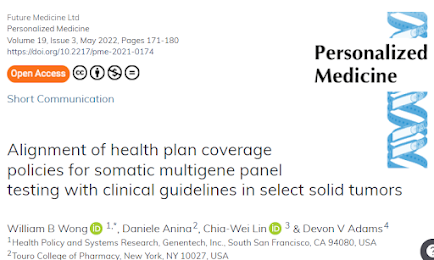
What I had not seen before, a May 2022 article by Wong et al., supported by ACS/CAN.  This article looks at payor coverage by state in comparison to guideline recommendations, and found that payor coverage often fell short of guidelines.

Find Wong et al. 2022 here:

https://www.futuremedicine.com/doi/epub/10.2217/pme-2021-0174


Aim: Commercial plan coverage policies for multigene panel tests may vary and could result in geographic variation in coverage due to the fragmented nature of the commercial insurance market. This study aimed to characterize the alignment of multigene panel tests coverage policies to that of clinical guidelines, overall and by state. 

Materials & methods: We reviewed NCCN Guidelines® for four tumors. Public coverage policies were identified via web search. Payer policies included those with the largest or second largest number of commercial lives in each state. Policies were classified as ‘more restrictive’ or ‘consistent’ with the guidelines. 

Results: Of 38 plans/policies reviewed, 71% were classified as ‘more restrictive’ than the guidelines, with variation in the number of commercial lives by state. Among these, 52% restricted on panel size and 63% restricted in all or select tumors. 

Conclusion: Most coverage policies were more restrictive. Clinical guideline clarity and state policies may improve alignment to guidelines and geographic variations.


Saturday, October 15, 2022

MolDx: More on the Draft Melanoma LCD; Timelines; A Model LCD Request Letter Format

One of the issues with the multi-MAC MolDx system is that all four of its participating MACs must post draft LCDs, before they can be reviewed and finalized.  

In June 2022, I wrote about a complex MolDx LCD for molecular melanoma diagnostics (here, DL39345, released June 23).  It looks like this draft LCD was not posted until October 6 in the CGS MAC jurisdiction (here, as DL39389).  Comment til November 19, while there public meetings separately in KY and OH on October 25 and 26.

My earlier June blog provided a full discussion (DL39345).  Since then, AMP has submitted public comments opposing the requirement the test be ordered by a dermatopathologist only (here).  

Here, some additional observations.

Timeline

I don't believe I noticed earlier, this draft LCD has a Request Letter provided.  

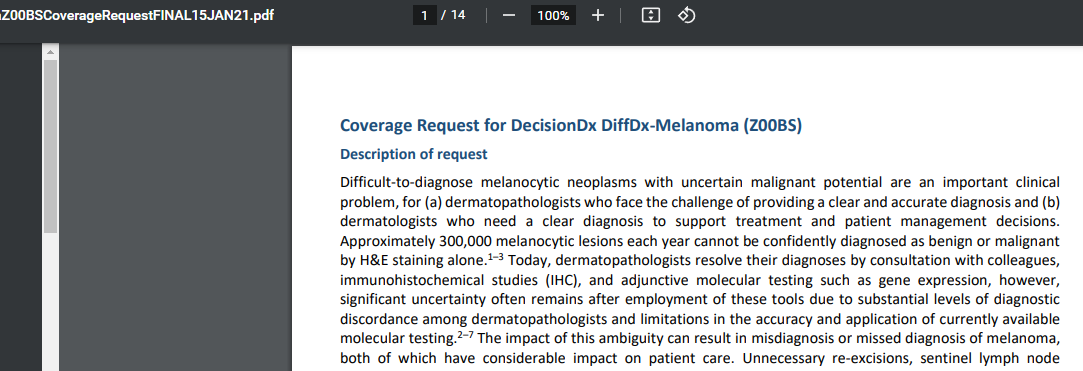
While the 14 page PDF has no date (or date redacted), I noticed the final title of the PDF was "Final 15 Jan 21" suggesting a review time of about 18 months between the request submission and the draft LCD's first posting in June (and 21 months, til the posting in the CGS MAC.)  

Generally, MolDx MACs post final LCDs 11, 12, or 13 months after the draft LCD.  

This suggests about 30 months (2.5 years, or longer, depending on the CGS timeline) between the submission letter and the final LCD (and, add 45 days for the final LCD to become effective.)

According to the 14 page request, Castle met with MolDx in October 2020 to help plan its January 2021 LCD submission and rationale.

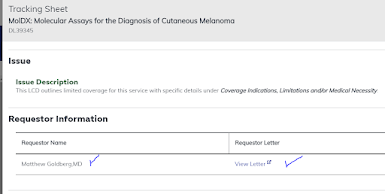
Although there's no name or date on the letter, the splash screen for the issue description and requestor information says it's from Matthew Goldberg MD.  


"Read How a MOLDX LCD Request Letter is Written"

Find the 14 page request here:

https://www.cms.gov/medicare-coverage-database/attachments/lcd/39344_6/DecisionDxDiffDxMelanomaZ00BSCoverageRequestFINAL15JAN21.pdf

Note the request letter is posted at CMS, not at a MAC.   A duplicate cloud copy here.

Foundational LCD and the Paradox of "Comparable to Covered Tests"

The LCD is a "foundational" or umbrella LCD that will cover future tests on a rolling basis if MolDx determines that they have "equivalent or superior performance to covered tests."

  • "Tests that demonstrate similar indicated uses and equivalent or superior performance to covered tests may similarly be covered under this policy."

However, this is trickier than it sounds.  

Many tests might be listed in the associated billing article only under the generic code 81479 (other molecular test), therefore, it would be hard for the reader to know what covered tests to look up, to compare their performance. 

This particular LCD article DA59163 covers unknown tests under 81479, plus 2 named tests 0090U, 0314U.  

These 0090U Myriad Mypath (now acquired by Castle) and  Castle DiffDx.  

0090U MyPath is an ADLT test at $1950.    

0314U is being priced.  A majority of CMS advisory panelists last summer recommended to crosswalk 0314U to 81529, which DecisionDx Melanoma, an ADLT test at $7193, one of the highest price tests on the whole lab fee schedule.   4 panelists recommended a crosswalk to 0090U, which CMS preferred.  This MyPath test is $1950, the crosswalk price being offered by CMS and far lower than $7193.


Nerd Note 00

The 14-page request letter attached to this LCD is a useful model.  A prior LCD had a request letter attached, but it was redacted to little more than a table of contents (here). 

Nerd Note 01

ADLT rules require that the test be made by the original developer, not simply licensed in, and not sold (unless a lab is acquired by a successor owner).  However MyPath 0090U appears to have been "acquired" by Castle.  And it's still listed as an ADLT.   This suggests that CMS applies the "not bought or sold" rule at the original time of deeming a test to be an ADLT, and CMS does not apply the rule again if circumstances change.  

(While in some places the rules are vague about whether a "lab" or possibly "a test" is being sold, others define this as "a successor owner of the laboratory" and not "of the test.")

Nerd Note 02

Why is 0314U Diff Dx being priced by CMS, why isn't Castle requesting it be an ADLT?  

According to the MolDx DEX Test Registry as of 10/2022, DiffDx is "not covered" so it can't apply to be an ADLT yet.  


Screen  shot: 14 page PDF LCD request letter


Friday, October 14, 2022

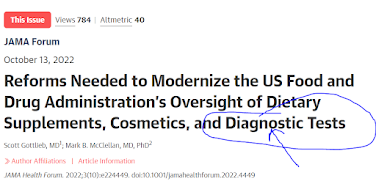
Very Brief Blog: in JAMA, Gottlieb & McClellan Promote VALID (FDA Diagnostics Regulation)

As numerous trade journals have reported over several months, the VALID ACT (FDA control of LDT diagnostic tests) has been rising and falling regarding its odds of becoming legislation.

In a new twist, Scott Gottlieb and Mark McClellan, both former heads of the FDA, strongly encourage Congress to pass the VALID ACT and as soon as possible.   (McClellan is a former head of both FDA and CMS).

Find it here:

https://jamanetwork.com/journals/jama-health-forum/fullarticle/2797520


Among others, AdvaMed is also urging Congress to push ahead with VALID (here).

___
The Regulatory Affairs Professionals Society, RAPS, hosts a two day course on the new European IVD regulations, October 18-19 in Amsterdam, full agenda here.

New Article: Tunis et al, Improving Medicare's Coverage of Innovative Technologies

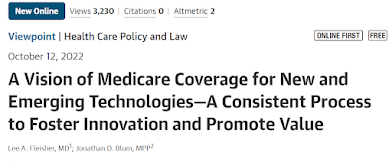
Just yesterday, I wrote about a new article in JAMA by CMS leadership on improving Medicare coverage of new technologies.   Here.

Today, new news.  An article by Tunis and colleagues in Health Affairs, "Improving Medicare Coverage of Innovative Technologies."  Find the article here:

https://www.healthaffairs.org/content/forefront/improving-medicare-coverage-innovative-technologies

Note that the Health Affairs blog article links through to a longer, 33-page white paper online at Tufts, here.

The article opens,

After advances and setbacks, policy makers have revived efforts to improve the Medicare coverage process for new medical devices. Industry groups and others have long argued that the existing process is inefficient and unpredictable, and that a streamlined pathway for coverage decision making is needed for novel technologies that address serious and life-threatening illness. However, more rapid coverage processes, with shorter review periods and greater reliance on intermediate or surrogate endpoints, often mean more uncertainty about a technology’s risks and benefits at the time of coverage. 

The enduring challenge is how to expedite the process to ensure that Medicare beneficiaries have appropriate, timely access to novel medical technologies, while providing robust and efficient mechanisms for evidence generation in the pre- and post-coverage period.


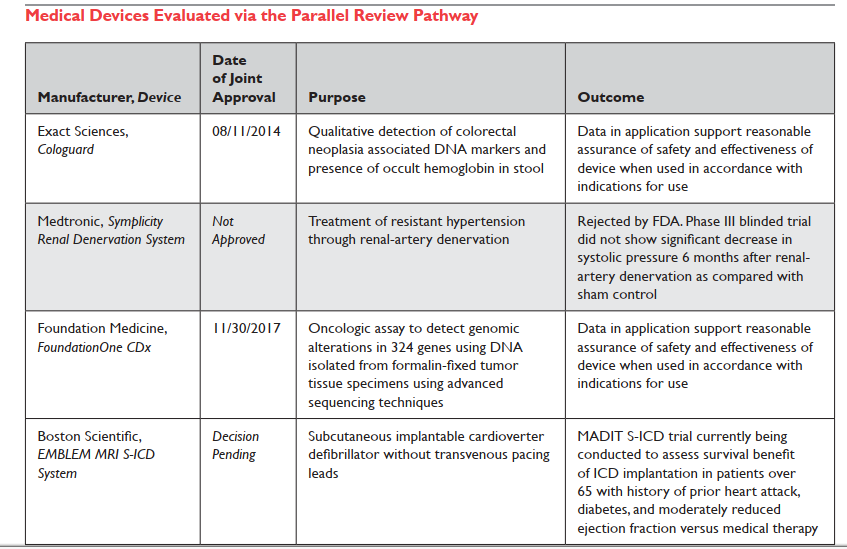
Tunis et al. cite to Holtzman 2018, a review of parallel review.  They cite four products in the P.R. pathway; I was only aware of Cologuard 2014 and Foundation Medicine 2017.   Both Cologuard and Foundation Medicine reflected complex or specialized policy circumstances.  (That is, one-offs from which generalizations would be dicey.)   The Cologuard test, as a preventive benefit, was flatly non covered w/o a CMS NCD, and for CMS, it was a chance to show it could use P.R. at least once, the first use.  And Cologuard clearly performed a good bit better than FIT, so the chance that FDA would not approve it or CMS would not cover it was, I would think, infinitesimal.  (As an original scientific achievement, it's a big deal; as a regulatory achievement for CMS, it was a six-inch putt, once the data was in.)  And the Foundation Medicine NCD was originally, in its first draft, as much about cancelling all coverage of LDTs, as of allowing coverage of the Foundation FDA test.

However, P.R. was also used for a Medtronic renal denervation system that got stuck without FDA approval, and the Boston Scientific cardioverter w/o transvenous pacing leads (EMBLEM).(*)   
Holtzman 2018 Table 2

In their white paper, Tunis et al. cite three possible reasons for little uptake of P.R.: (1) Company concern it will delay market entry or trigger a premature negative NCD which wouldn't occur otherwise; (2) CMS will request too many changes to the FDA plan; or (3) NCD will trigger "CED" which otherwise wouldn't come to attention.   I would add a different and 4th reason: I'm aware of several companies that tried to get into the P.R. process and were turned away at the door (declined even a pilot meeting; the initial P.R. request is routed through FDA staff and got canceled there with a quick "Dear John" email reply.)

As an aside, when CED is discussed (as in Tunis et al.) it's not usually mentioned that some examples of CED, I believe, simply match up to FDA-required post registrational clinical studies (thus, not requiring or reflecting any additional expertise at CMS).  

___

(*) If I'm reading the 2017 decision on "leadless pacemakers" correctly, it requires CED but it doesn't mention parallel review, so even if I'd read it, I wouldn't have added it to my parallel review list.  I didn't see this on Google either; only in Holztman Table 2 line 4, above.


Thursday, October 13, 2022

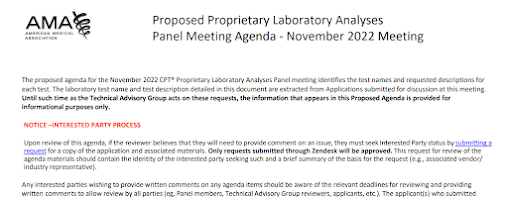
Brief Blog: AMA Releases Bonanza of 35 PLA Applications

The AMA CPT has released for comment some 35 code actions for the October or Fourth Quarter PLA cycle.  A few of the applications are withdrawals or revisions, but most are for new PLA codes.

Find the AMA PLA home page here:

https://www.ama-assn.org/practice-management/cpt/cpt-pla-codes

Find the AMA PLA PDF of the new action items here:

https://www.ama-assn.org/system/files/nov-2022-pla-public-agenda.pdf

Dates:
Comments on the PLA applications are offered only for a few days; see the PLA PDF for "Zendesk" instructions but do this right now if you want to comment on a code.

The PLA committee will meet and vote around November 7.   The AMA CPT committee will convene (quite briefly) by teleconference on November 21 to endorse the codes, so they can be released January 1.

Codes - A Few Highlights

It looks like the first agenda item is a PLA code for the Adaptive Biotechnologies FDA-approved CLONOSEQ test.

Two codes that just became active in July (0324U, 0325U) for cell culture drug response in oncology, are poised for deletion.  CMS had proposed to crosswalk these to the (I believe) off market Predictive Therapeutics cell culture codes from around 2014 (81535, 81536x3, $1100) whereas a near-identical test 0248U is in current gapfill at about $2600.

There is a code triplet for Oncuria (bladder cancer detection) and one for OVAWatch (ovarian cancer detection).   

There is a 17-pathogen bladder pathogen test (Qlear Urine), and a reflex version including antibiotic resistance genes.  There is a different test for "20 or more" pathogens in urine.  There is a 55-pathogen respiratory test. A separate wound infection test has 34 pathogens and 21 antibiotic resistance genes.  There are two complex kidney function tests (NaviDKD and PromarkerD).

There is the ArteraAI 128-image prostate image test with AI.

There is a somewhat complex (15 gene) cfDNA test for colorectal cancer.

Genesys has a 143-gene carrier panel.


Brief Blog: JAMA Article by CMS on CED/TCET. CMS Opens Registration for MedCAC on CED.

In the past month, Medicare calendared a December 7, 2022, MEDCAC (advisory meeting) on its Coverage with Evidence Development Paradigm, and AHRQ issued a report on CED to date.  

Now, CMS has published a JAMA article on coverage for early technologies, AND, opened registration for the December 7 webinar event.

Find the JAMA article here:

https://jamanetwork.com/journals/jamainternalmedicine/fullarticle/2797447

See trade journal coverage of the JAMA article here:

https://www.fiercehealthcare.com/payers/cms-hints-new-pathway-quickly-review-medical-devices-medicare-coverage

Find the Fed Reg announcement of the December 7 event here:

https://www.cms.gov/Regulations-and-Guidance/Guidance/FACA/downloads/id79.pdf

Find the registration for December 7 here (scroll down for reg)

https://www.cms.gov/medicare-coverage-database/view/medcac-meeting.aspx?medcacid=79&year=all&sortBy=meetingdate&bc=15

AHRQ's draft report, which will be the core discussion document on December 7, is here:

https://effectivehealthcare.ahrq.gov/products/coverage-evidence-development/draft-comment


From a separate workstream, at Tufts University, see a new paper on "Improving Medicare Coverage" by Tunis et al. 

https://www.healthaffairs.org/content/forefront/improving-medicare-coverage-innovative-technologies


Regarding the JAMA Fleisher article, see comments below; I think there may be more content or at least as much value and material in a slightly later article by Dhruva et al in NEJM - here.

##


According to the new JAMA article, CMS is working on a regulation that would allow it to review data before FDA approval and determine a coverage pathway (such as "local coverage vs national coverage" and "coverage with or without CED").   Honestly, this description makes it sound awfully close to "Parallel Review" ahead of FDA approval, something that has barely, ever, been used in its 10 years of existence.   But we'll see what develops.  

Here are the four bullets of the proposed plan, as per JAMA:

The CMS rule that is being developed will meet the following principles:

  1. Manufacturers may enter the process on a voluntary basis. This process will be limited to medical devices that fall within the Medicare statute and are relevant to the Medicare population.1
  2. The CMS may conduct an early evidence review (before the device secures FDA marketing authorization) and discuss with the manufacturer the best Medicare coverage pathway, depending on the strength of the evidence collected.
  3. At the manufacturer’s request, CMS may initiate the coverage review process before FDA market authorization, which could require developing an additional evidence development plan and confirming that there are appropriate safeguards and protections for Medicare beneficiaries.
  4. If CMS determines that further evidence development is the best coverage pathway, the agency would explore how to reduce the burden on manufacturers, clinicians, and patients while maintaining rigorous evidence requirements.
The boldface red text both captures the key points of the JAMA plan, and, indicate areas that overlap with existing Parallel Review either explicitly or by common sense (obviously, CMS already would want to reduce, not raise, "unnecessary burdens," even if that phrase isn't explicit in parallel review).  


TCET

This events are the rolling out of a general program for technology coverage, which goes under the umbrella term "Transitional Coverage for Emerging Technologies" TCET.   CMS began holding town halls soliciting ideas on improving coverage last spring.   AdvaMed has a detailed white paper on the topic.    

I made a mid-September five minute video guide to what's happening -

http://www.discoveriesinhealthpolicy.com/2022/09/new-video-keeping-up-with-busy-tcet.html


Monday, October 10, 2022

Nerd Note: Statute that CMS Can't Apply Changes Retroactively

Updates 2023/03

Wolverton at AKIN law firm discusses.

https://www.mondaq.com/unitedstates/healthcare/1033896/going-retro-retroactive-rulemaking-under-the-medicare-statute-and-when-is-a-rule-really-retroactive

Section 102 of H.R.3391 - Medicare Regulatory and Contracting Reform Act of 2001

https://www.congress.gov/bill/107th-congress/house-bill/3391/text?s=1&r=33

I am not sure there is any matching regulation so 1871(e)(1) may be viewed as self implementing and may have no explicit regulatory discussing in the CMS CFR.

An example of CMS going to some detail and claiming retroactivity due to statutory instruction, under proper use of 1871 is found at:  3 FR 29699-711, Long term care hospitals, 5/22/2008.

https://www.govinfo.gov/content/pkg/FR-2008-05-22/html/08-1285.htm


From time to time a company has grounds to protest that an adverse change from CMS is being applied retroactively.  But generally, CMS's hands are tied from retroactive changes.

Here's the regulation.   

https://www.ssa.gov/OP_Home/ssact/title18/1871.htm

Rules and Policy Statements Aren't Retroactive:

(e)(1)(A) A substantive change in regulations, manual instructions, interpretative rules, statements of policy, or guidelines of general applicability under this title shall not be applied (by extrapolation or otherwise) retroactively to items and services furnished before the effective date of the change, unless the Secretary determines that—

(i) such retroactive application is necessary to comply with statutory requirements; or

(ii) failure to apply the change retroactively would be contrary to the public interest.

##

This law 1871 also contains a clause, 1871(a)(4), that a final regulation must be a "logical outgrowth" of a proposed regulation, or else it triggers a new public comment period.  For example, CMS could propose a timeline be 12 or 24 months, and finalize at 18 (a logical outgrowth).   But CMS can't propose "Policy A" and finalize as "Policy Z" when Z is wholly different policy that is not a natural outgrowth.  

##

For a Supreme Court case hinging on the details of CMS regulatory processses like the quote above, see Alina 2019:

https://www.supremecourt.gov/opinions/18pdf/17-1484_4f57.pdf

Readers might enjoy reading SSA 1871 as a whole. 

#####

From Fed reg 2008, re a retroactive rule claimed by CMS with detail:

Section 1871(e)(1)(A) of the Act provides that a substantive change 

in regulations, manual instructions, interpretative rules, statements 

of policy, or guidelines of general applicability under this title 

shall not be applied (by extrapolation or otherwise) retroactively to 

items and services furnished before the effective date of the change 

unless the Secretary determines that (i) such retroactive application 

is necessary to comply with statutory requirements; or (ii) failure to 

apply the change retroactively would be contrary to the public 

interest. As explained in the paragraph above, the MMSEA requires the 

Secretary to implement various policy changes either contemporaneously 

with the enactment of the MMSEA on December 29, 2007 or beginning with 

cost reporting periods beginning on or after December 29, 2007 as 

applicable. Therefore, under the authority of section 1871(e)(1)(A)(i) 

of


[[Page 29708]]


the Act, we are making the provisions of this interim final rule with 

comment period that implement sections 114(d) of MMSEA retroactive to 

December 29, 2007. The statute also requires that section 114(c)(1) and 

(2) be implemented beginning with cost reporting periods beginning on 

or after December 29, 2007. Therefore, under the authority of section 

1871(e)(1)(A)(i) of the Act, we are making the provisions of this 

interim final rule with comment period that implement section 114(c)(1) 

and (2) effective for cost reporting periods beginning on or after 

December 29, 2007. Additionally, as explained previously, the Secretary 

also finds that it would be contrary to the public interest if these 

provisions were not made effective on December 29, 2007 or for cost 

reporting periods beginning on or after December 29, 2007, as indicated 

above. Therefore, under the authority of section 1871(e)(1)(A)(ii) of 

the Act, we are making these changes effective under the timeframe 

noted above.

    For the same reasons noted above, we find good cause under section 

553(d)(3) of the APA to waive the 30-day delay in effective date.

tagssa

tagretroactive

Thursday, October 6, 2022

California Vetoes Bill that (Would Have) Required Biomarker Coverage

Several states, including Illinois and Louisiana, have passed bills that mandate guideline-recommended or FDA-approved biomarker coverage.   The bills vary; some are specific to cancer and some are not.

One of the most recent proposals has been vetoed by the Governor of California, after having been passed by the legislature at the end of August.

The open access news story is available at Genomeweb.

https://www.genomeweb.com/policy-legislation/california-governor-vetoes-biomarker-test-coverage-bill#.Yz76LXbMKM8

The governor's online rationale is here.

https://www.gov.ca.gov/wp-content/uploads/2022/09/SB-912-VETO.pdf?emrc=49097a


Press release from American Cancer Society here.  Univ Calif had supported the bill.

See a related study from ACS in May 2022 regarding patients' access to biomarkers and insurance coverage, here.

See the ACS Cancer Action Network home page of press releases related to access to cancer care here.

See also:  https://www.fightcancer.org/state-policy-principles-support-access-biomarker-testing and https://www.fightcancer.org/policy-resources/improving-access-biomarker-testing

Tuesday, October 4, 2022

Very Brief Blog: Two Interesting Articles in JACR

 I ran across Journal of the American College of Radiology around 2010, working on CMS PET scan policy, and I've been a fan ever since.   While lab and pathology journals (e.g. AMP's Journal of Molecular Diagnostics) have important policy articles from time to time, JACR is mostly policy and business articles, some of them really intriguing.  I've always assumed that there's crossover between imaging and lab diagnostics, both being, diagnostics.  I mused on this in March 2022 here.

Here are two interesting articles from the September issue, and if I read correctly, both are flagged as open access.

In a really unique eight-page article, Stefan Tigges MD presents diagnostic test metrics (NPV, etc) in a sophisticated way yet using a cartoon format.  Find it here.


On a wholly different topic, Brandser & Kothari talk about the pressure of unpredictable work volume and reading queues in day to day radiology, and how their group practice came up with some novel work plans to improve effectiveness.  (Some of the fastest readers in the group, were happy to get paid extra to do "bunker shifts" reading a fixed aliquot of images in queue.  And during that time - say, on a Saturday - having no other duties, and just working from home.  Sounds simple, but someone had to think of it.)  Sort of like an attorney going into the home office on Sunday and knocking out 1.5 billable hours. 

One thing I noted - while CMS doesn't have a fixed time for physician RVUs, they are often around 3 per hour.   E.g. a 45-60 minute office visit, gets 2.6 work RVUs.   This radiology practice has a standard metric of an output of 10 work-RVUs per hour.   (For an internist, that would be 4, "45 minute" office visits per hour to log 10 w-RVU per hour).  (It's like the joke about a procedure that gets on the books 37 or 42 CMS minutes, but is scheduled every 20 minutes at all clinics in the real world).   


It's a Tough World for Tests: NGS MAC LCD on Ovarian Biomarkers (Nothing Covered)

There are a number of biomarkers for detecting ovarian cancer or working up adnexal masses.

If you'd like to be prepared for a tough review picking apart your new diagnostic test, get hardened up by reading the NGS MAC article about ovarian cancer tests (A58112) and the LCD (L38371).  I just ran across these documents; they're from 2020.

My only point here, is when you enthusiastically bring your shiny new test and your one first publication in 40 patients to Medicare or another payer, you may get some pretty rough handling.  (Many startup labs don't foresee this.)

Summarizing the NGS MAC author:

  • "This is a non-coverage policy for all multi marker serum tests related to ovarian cancer testing."

Read the LCD and data review here:

https://www.cms.gov/medicare-coverage-database/view/lcd.aspx?lcdId=38371&ver=12

Read the public comment article and the NGS rebuttals, here:

https://www.cms.gov/medicare-coverage-database/view/article.aspx?articleId=58112&ver=6

##

While not the only tests reviewed, two of them, Ova1 and OVERA come from Aspira Women's Health.  Both have been FDA cleared.

https://aspirawh.com/

Nasdaq AWH

https://finance.yahoo.com/quote/AWH/financials?p=AWH


##

The same MAC has a more liberal policy for several biomarker tests, like 4KScore, which are used to guide management of an intermediate PSA like "4".  It was just updated to add EPI, MyProstateScore, and isoPSA.


The summary coverage for prostate is below.  "Coverage" decisions are obviously longer than non-coverage decisions; the latter are basically one word, "no."

Coverage Indications, Limitations, and/or Medical Necessity

One biomarker test, ordered by a physician or other qualified health care professional (i.e., NP, CNS, PA) is covered ONCE per year. For men >/ 45 years old receiving testing prior to potential biopsy, covered testing includes %fPSA, PHI, Select MDx, 4K Score or MyProstate score, in men >/ 50 covered testing additionally includes EPI and isoPSA in those men >/ 50 with a PSA > than 4ng/ml. Those men, who need a repeat biopsy in the setting of patients thought to be at higher risk despite a prior negative biopsy, covered testing includes %fPSA, PHI, 4K Score, PCA 3, Confirm Dx, MyProstate Score and isoPSA with confirmed * moderately elevated PSA (>3ng/ml and <10ng/ml; or PSA >/4ng/ml and < 10ng/ml in men > 75 years of age) with BOTH of the following... [high risk indication of cancer, or contraindication to biopsy anyway]

Brief Blog: Genomeweb Deep Dive on BCBS Requesting More Proof of NGS Validation

Interesting (subscription based) 5000 word article at Genomeweb, by Turna Ray.  She describes a major BCBS plan, Highmark, wanting additional  third-party validation on NGS tests for both somatic and germline variants.   Highmark wants this done by March 2023.   

It's not clear what the range of validating authorities is, but it's clear, right now they exclude CLIA and CAP.   (However, potentially CAP could add what they require, over time).  In the article, Highmark's Matt Fickie MD is quoted as: "CLIA and CAP are a joke, and they all know that."

Much of the article focuses on validation certified by the Center for Genomic Interpretation, led by Julie Eggington (the CGI).  (MolDx isn't mentioned, but there is a long discussion of New York State validation.)

The article is described as first of two.

  • Genomeweb article here.  (Part 2 here.)
  • One of the first links is a 2021 review on the "art and science" of variant interpretation, authors Giles to Eggington, here.
  • Find the CGI here.

###
The article quotes the familiar numbers that there are 167,000 genetic tests, that 22,000 new tests per year are marketed, etc.  But if you look at Medicare data, 90% or more of the payments are under just 10-15 codes, not leaving much room for the other 166,000 tests.  

Monday, October 3, 2022

AMA Releases Nine New Final PLA Codes (Effective Jan. 1, 2023)

Each quarter, AMA releases a new batch of PLA codes.   These were submitted about 90 days before the release date, and, will be "effective" 90 days later.   

Heads up, applications for new PLA codes are due October 4, and new regular CPT codes due November 2.  The former will be posted for comments in about a week, the latter will be posted for comments around November 14.  

Find the just-released October 1 PLA codes here:

https://www.ama-assn.org/system/files/cpt-pla-codes-long.pdf

Note that AMA issues a running tally of all PLA codes too recent to be in the current year's book.   The 2022 book went up to 0284U, and this code list funs from 0285U down to 0363U.   It also includes numerous codes with smaller or larger editorial changes in the past year.  

Quest AD Detect, 0346U, is now effective (October 1) and is being priced by CMS (at a very low price).  Myriad Genesight 0345U is also now effective October 1, and is being priced by CMS (currently at a crosswalk of $1336).   Read about the current CMS pricing on these effective-October-1 codes here.

Newly released codes for use January 1, 2023, begin at 0355U (QUEST ApoL1 risk variants.)  See full code names at the AMA PDF link above, but I'll give very short informal summaries to help orient you to the new codes.

  • 0355U, Quest APO-L
  • 0356U, Naveris, oral cancer, 17 risk score markers
  • 0357U, InterVenn, DAWN AI & Mass Spec test of 142 analytes for melanoma immuno oncology benefit
    • (See Genomeweb this week for an RNA SEQ test that may outperform PDL1 here.)
  • 0358U, FujiReBio, FDA cleared 2-biomarker CSF test for Alzheimer's
    • Note that Quest LDT plasma Alzheimer amyloid test 0346U made this summer's pricing cycle, while 0358U FujiReBio FDA CSF Alzheimer test will be in next summer's pricing cycle.
  • 0359U, Cleveland Dx, IsoPSA, PSA isoforms
  • 0360U, Biodesix Nodify CDT, 7 autoantibodies for lung cancer diagnosis
    • Biodesix frequently applies for ADLT status, so we'll watch for that on this code.
  • 0361U, Mayo NFL (neurofilament light) for neurology, digital immunoassay, quantitative
    • Next summer, we'll watch how pricing compares to Quest's 0355U.  
    • Digital assays for proteomics are a rising platform.
  • 0362U, Protean, Thyroid GuidePX, 82 genes for thyroid cancer subtypes
  • 0363U, Pacific Edge, CXBLADDER Triage, 0363U, 5 gene bladder cancer risk
    • This test was in the news over the summer.  June here.  July here.
    • Note that Pacific Edge also has codes 0012M, 0013M, the first for risk of urothelial carcinoma, the second for risk of recurrence, both are 5 gene MAAAs.  CMS Pt B use CY2020 was 1,353 for the '12M and 640 for '13M ($760).  


____


__
As I noted in a recent blog, there are some weird things in how CMS assigns hospital outpatient status indicators.  For example, 0342U (Immunovia IMMRAY Pancreatic cancer diagnostic, "E1" not payable by statute) and 0343U (MIR Scientific MIR Sentinel, prostate sncRNA test, "E1" not payable by statute).  Here.  Almost no lab codes get OPPS APC status of E1 = banned by law.   Odd.  

Tufts Policy Center Releases White Paper on Medicare & Emerging Technologies

 A major new white paper has been released by the Tufts CEVR - the Center for the Evaluation of Value and Risk in Health.   It's titled "Medicare Coverage of Emerging Technologies: Challenges and Opportunities."  Authors are Sean Tunis, Peter Neumann, James Chambers, and Nola Jenkins.

Download the paper from here:

https://cevr.tuftsmedicalcenter.org/publications/medicare-coverage-of-emerging-technologies-challenges-and-opportunities


See also a March 2022 paper by Stanford Biodesign, Ruggles et al., on the need for Medicare coverage for innovative technologies, here, here.  And CMS is updating its rules and requirements for Coverage with Evidence Developments, here and here.  I posted a five minute video update of the CMS events in mid-September, on YouTube, here with some links to sources like an AdvaMed white paper on the topic.

Back to the CEVR 33-page whitepaper released today, they highlight seven recommendations.

  1. Assess existing programs thoroughly.
  2. CMS CMS-specific processes for innovative technologies.
  3. Balance the interest of multiple stakeholders [with conflicting interests].
  4. Expand the expertise and bandwidth in CMS personnel for this topic.
  5. Clarify what "evidence for Medicare population" means.
  6. Expand the use of real world evidence.
  7. Consider a "CMS opt out option for FDA approved devices that requires limited CMS engagement."


Sunday, October 2, 2022

Very Brief Blog: Strange CMS PGX Pricing as Entertaining Video

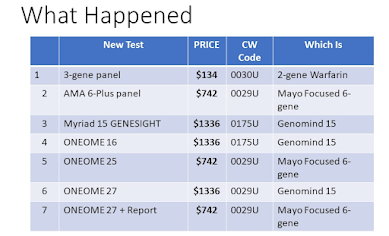
I have joked that I thought I could use September's Medicare pricing of 7 pharmacogenetic tests as a simple teaching lesson in how the crosswalk process works for new tests.

Unfortunately, the prices half and double in unpredictable ways, and I'm unable to give a clear teaching lesson.  Maybe that is the point!  (I actually held the video for several days to see if CMS would issue an updated plan with corrections, but it didn't happen.)

I discuss the pricing of new PGX tests in both a video and a blog.

PGX VIDEO

https://www.youtube.com/watch?v=w9vfr1ZkT3M

Note this has a "humor section" the first 20 seconds. You can jump to the PGX codes at 1:37 below.

0:01 Humorous Intro and Background 1:37 The New Pharmacogenetics Codes Explained 2:39 The Odd Pricing Levels CMS Published

PGX BLOG

http://www.discoveriesinhealthpolicy.com/2022/09/the-quirky-world-of-cms.html