Monday, July 20, 2015

Bruce Quinn Joins FaegreBD Consulting as Senior Director

Health Markets & Reimbursement Policy Expert Bruce Quinn, M.D., Ph.D. Joins FaegreBD Consulting


Washington, D.C. (20-July-2015) - Bruce Quinn, M.D., Ph.D., has joined FaegreBD Consulting as a senior director with the firm’s health and biosciences team in Washington, D.C., where he leads the firm’s health markets and reimbursement strategy consulting practice. He has offices in Washington, D.C. and Palo Alto, California.
Quinn is a national leader on Medicare policy, the impact of health reform on innovation and the crafting of successful business strategies within the U.S. health care reimbursement system. In addition to his work in the health and biosciences sector, Quinn also provides significant synergies with the firm’s intellectual property, compliance, and corporate transactions groups.
Prior to joining FaegreBD Consulting, Quinn was a senior health policy advisor with Foley Hoag after serving as the medical director for the Medicare Administrative Contractor in California.  Earlier in his career, Quinn was a physician executive in the health and life sciences division of Accenture, working with the pharma, biotech and genomics industries.
“Bruce has unparalleled experience advising companies of all sizes through the enormous change occuring across the health policy landscape, particularly in bringing new technologies into a reimbursed market,” said Dave Zook, FaegreBDC chair. “We are pleased to add Bruce’s deep expertise to our regulatory and legislative capabilities as the shift from volume to value unfolds in our public and private health plans.”
“Bruce brings invaluable expertise to our expanding health and biosciences practice,” said group leader and principal Debra Lappin. “Bruce joins shortly after we’ve welcomed former CMS senior offical Mike Adelberg. Bruce brings yet another new perspective that we’re thrilled to offer our clients.”
Quinn is a board-certified pathologist with a subspecialty in neuropathology. As a physician-scientist on the faculty of Northwestern University School of Medicine, he led pathology research for Northwestern’s NIH-funded Alzheimer Research Center. Quinn has also held academic positions at New York University School of Medicine and the UCLA Center for Health Sciences — and is the author or co-author on over 30 scientific publications.
Quinn holds an M.D. and Ph.D. from Stanford University School of Medicine and an M.B.A. in health, finance and strategy from Northwestern University’s Kellogg School of Management.
LInks:
http://www.faegrebdc.com/
http://www.faegrebdc.com/bruce-quinn

Press release:
http://www.faegrebdc.com/19454
Media Contact: Meg McCormick, +1 612 766 8127, megan.mccormick@FaegreBD.com

Sunday, July 19, 2015

CMS Holds July 16 Public CLFS Meeting - Drugs of Abuse Codes and Genomic Procedure Codes

On July 16, 2015, CMS held its annual public meeting to discuss new codes for the Clinical Laboratory Fee Schedule.  This summer's meeting was attended by one of the largest audiences ever.

Topics included:

  • Implementing the PAMA authority to reprice the CLFS based on market prices of commercial insurers; 
  • How to price the Exact Sciences Cologuard test; 
  • How to price new genomic procedures such as exome sequencing; and 
  • How to code and price drug screening tests.
CMS has posted the entire workshop online at Youtube, and I have detailed speaker by speaker meeting notes on this blog.

Note that the most important topics discussed at the July 16 public meeting will be revisited by CMS's new expert advisory panel on lab test crosswalking and policy, on August 26 (here).

More after the break.


Friday, July 10, 2015

Medicare and End of Life Planning – What Actually Happened?

In early July, within a couple days of a very dry and deeply buried CMS policy change, the media produced hundreds of stories about Medicare newly offering an “Advance Planning Option” – which means "paying for doctors to talk to patients about end-of-life decisions."

What happened?  What does it mean?  See a full history and discussion after the break.


Wednesday, July 8, 2015

Links to the CY2016 Proposed Rules (IPPS, OPPS, PFS, ESRD)!

Each year from April to July, CMS  issues annual rulemaking and policymaking proposals for inpatient, outpatient, physician office, renal, and other policy domains.

Links to all are found here, after the break.

Monday, July 6, 2015

April's Diagnostics Reform Plan Moves to Draft Legislation in June

In April, a coalition of stakeholders called the Diagnostic Test Working Group released a substantial plan for FDA reform (my short mid-April note here, including several key links to more information).

In June, the House Energy & Commerce workgroup, 21st Century Cures, worked to convert the essay-style proposal into draft legislation.  For example, actual legislation includes many conforming amendments that reconcile new parts of the FDA statue (if enacted) with older parts.  

Turna Ray at Genomeweb has published the second of two very detailed articles on the plan, the newer article dated June 17, 2015.  Available here (subscription only.)

Since the legislative draft language exists now, it is likely getting comments from some stakeholders but to my knowledge it has not been publicly posted yet.  

Thursday, June 4, 2015

Light news: Word maps

For several years, I've seen word maps based on the frequency of words on the web or in a document.  It turns out these can be generated for free at Wordle.net .

Here is a word map of a project I wrote in January on PAMA and Point of Care tests:


Monday, June 1, 2015

Medicare Again Releases One Year's Worth of Provider-Level Data (June, 2015)

In Spring of 2014, Medicare received a year's worth of extremely detailed Part B data, by procedure code AND billing physician or laboratory.   The data dump (some 10 gigabytes' worth) prompted a series of investigative articles and reports from many journalists.  CMS' webpage and press release at the bottom of this article.


Wednesday, May 27, 2015

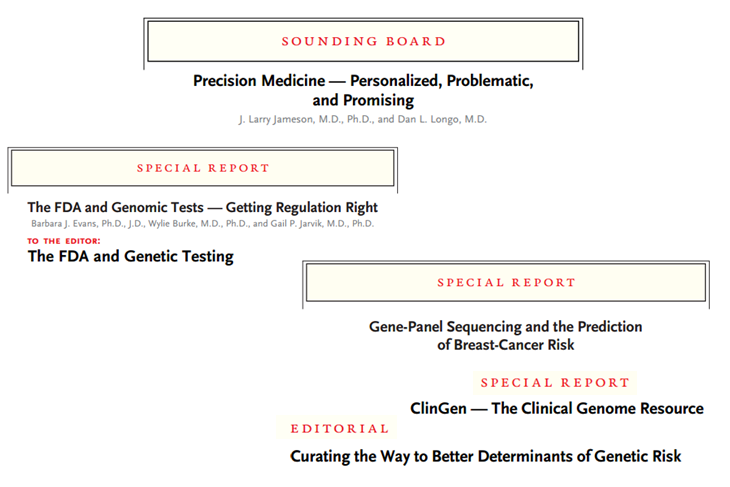
NEJM Publishes Six Papers on Genomic Testing (May 27, 2015)

On May 25, 2015, the New England Journal of Medicine published six policy papers on genomic sequencing applications, policy, and challenges.

Links after the break.

Tuesday, May 26, 2015

FDA Continues Down-Classifying Genomic Tests

Would FDA Overrun LDTs?
In 2014, the FDA announced an extensive plan by which it would regulate laboratory-developed tests.   Concerns were quickly raised that the agency's regulation process would be far to cumbersome.

The FDA has issued several guidances that so its flexibility in approaching the classification of genomic tests.  More after the break.

CMS Releases Draft Gapfill Pricing for 2015 Molecular CPT Codes


Addendum, September 2015: 
May 2015 draft gapfill prices discussed in this blog entry.  
Final September 2015 prices discussed here.
------------------------------------------------------
What is going on?
  1. CMS put 29 brand new molecular CPT codes into its contractor-based gapfill process on 1/1/2015.  This included high-profile new codes like "exome sequencing" and "tumor gene panel, >51 genes."
  2. By May, CMS contractors had come up with proposed prices for 10 of the 29 codes.  CMS has published those prices on a state-by-state basis (published May 26, 2015).
  3. CMS is accepting public comment on the proposed test prices until July 20, 2015.
  4. In July and August, Medicare contractors may review incoming public comments.  The contractors may hold, raise, or lower their proposed prices in August.  
  5. In September, CMS will publish the median price for each priced test.  This will become a national fee schedule price on 1/1/2016 and forward.   
What do we know so far?
  1. Contractors only priced 10 of the 29 molecular CPT codes.  19 were left blank.
  2. The more advanced test codes - for genomes, exomes, mitochondrial genomes, and sets of 51+ tumor genes - show no proposed prices at this point.
  3. The Genomic Health Oncotype DX test received a range of prices, between $2000 and $3400, with about half of the MAC regions reporting.

More after the break.

Growing Awareness that Pathology Policy is Crucial for Precision Oncology

Over the past several days I noticed a flurry of interesting, potentially connectable policy articles in precision medicine for oncology.   I'll list them and draw some lines among them in this blog.

If you work on the laboratory side of precision oncology, you've been familiar with challenges created by the outdated CPT/RVU/CLFS payment and pricing system.  You've either never heard of the Medicare "14 day rule" -- or it makes you tear your hair out.

Clinicians are paying attention now, too. And so is biopharma.

Two interesting entry points, from different associations, are ASCO's position on next-generation sequencing reimbursement and a CAP TODAY feature article on pharmas that are paying a lot of attention to the delivery side of combination diagnostics.

Friday, May 22, 2015

CCLA Federal Lawsuit Against LCDs: Dismissed for Lack of Standing.

Over the past year, this blog has carried several entries about the California Clinical Lab Association effort to overturn Medicare LCDs as being inconsistent with federal authority to defer policymaking to private entities (e.g. Medicare contractors.)  July 2014 blog, here.  April 2014, here.  The case got further than many attempts to sue HHS, because it reached oral argument a few months ago rather than just being dismissed on the paper record.

On May 20, 2015, a federal court ruled that the case participants lacked standing to sue HHS in federal court.

  • A patient (Jane Doe) had not suffered injury justifying standing, and 
  • the laboratory association had not exhausted its administrative appeals within the agency, before proceeding to federal court.   


The decision is in the cloud, here.  Detailed analysis at Pathology Blawg, here.

MolDX Finalizes Coverage for Lung Cancer Comprehensive Genomic Profiling (CGP)

In January 2015, the Medicare MolDX program published a draft coverage determination for comprehensive genomic profiling (CGP) in lung cancer patients if initial genetic tests had failed to find mutations for EGFR or ALK.   See earlier coverage, here.  The policy covered first-line CGP testing but only in non- and light-smokers.

MoLDX has finalized the LCD with minimal changes, with a 45-day effective date of July 6, 2015.  The final (future effective) version is here.


Some details and a redline comparison after the break.

Thursday, May 21, 2015

CMS issues draft coverage for Genomic Health Oncotype DX Prostate Test

On May 21, 2015, the Medicare contractor Palmetto GBA released draft coverage for the Oncotype DX Prostate prognostic gene panel test, as part of Palmetto's MolDX program.

The draft LCD is on line here or here; Genomic Health's press release is here and coverage at Genomeweb (subscription), here.

Coverage conditions are similar to those proposed and finalized for the Myriad Genetics Prolaris test.

Wednesday, May 20, 2015

Medicare's 0.0023% Budget for Telemedicine - What Does New Legislation Do?

According to an article in the May 14, 2015 "Inside CMS" trade journal, Medicare spending for telemedicine is currently at $14M - which is 0.0023% of Medicare's $615B budget.

The article is based on a new industry report from the Waters Center for Telehealth and eHealth Law (here).  Medicare's thin coverage for telemedicine opened with a short section of the Balanced Budget Act of 1997, providing limited benefits for live video interviews between centrally located physicians and patients located in remote areas (here).  Although this limited benefit has been expanded in baby steps, it contrasts sharply with a recent forecast for telemedicine becoming a $17 billion dollar global industry in the 2015-2020 range (here).  Mid-2015 investments in dhealth are running in the $2B range (for 3 estimates, see here).  Outside of Medicare, barriers are falling.  United Healthcare recently began providing some coverage for virtual visits (here) and Walgreens is setting up to provide telemedicine visits as well (here).