Tuesday, April 5, 2022

Very Brief Blog; Duke/Stanford Release 78-page Deck, Meeting Summary, Video on TCET

Medicare's new logo for future programs for innovative technology is TCET, Transitional Coverage for Emerging Technology.  This is intended to replace MCIT, Medicare Coverage for Innovative Technology, a Trump program for breakthrough devices that was canceled by the new administration.  Note that while MCIT was a defined program and regulation that was complete, the TCET is just an "idea" or a "brand" for an unknown basket of things CMS may do in the future.  

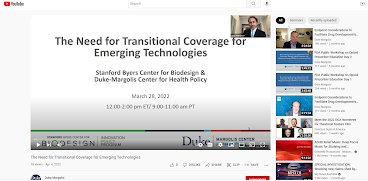
The Duke Margolis Center and the Stanford Center for Biodesign held a workshop on the topic on March 29, preceding a CMS call on the topic on March 31.  Duke/Stanford have now release:

  • A 78-page deck used in the meeting
  • A 2-page meeting summary.
  • A 2-hour YouTube meeting video.

Find it all here:

 https://healthpolicy.duke.edu/events/need-transitional-coverage-emerging-technologies

Tidbit: This links to the Duke Margolis health policy center channel at YouTube, which may have other videos you'll find of interest.


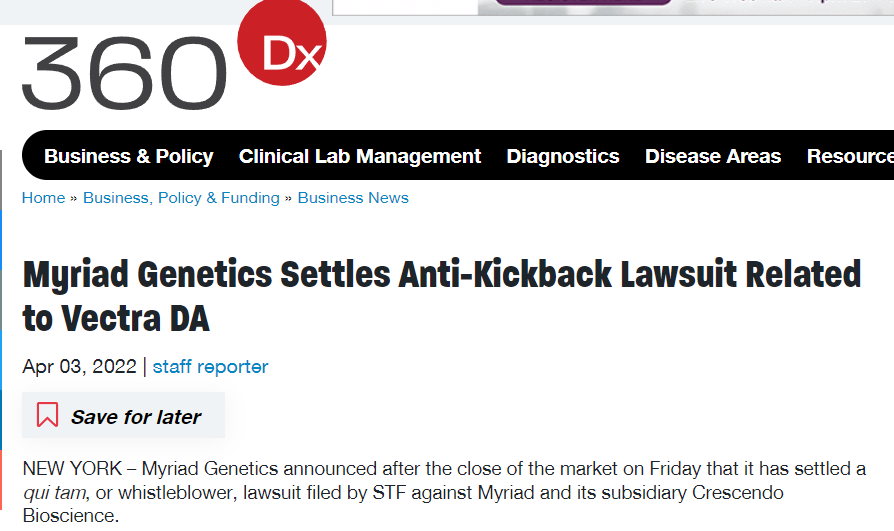
Myriad Settles Anti-Kickback Lawsuit, per 360DX

360DX runs an open-access article re a lab industry legal settlement, and it's worth skimming.

First, Myriad Genetics settled this with no admission of error.  

According to 360Dx, the case, which dates back to at least 2020, had to do with fair market value payments to providers for services and other financial agreements.   360Dx states Myriad settled for about $45M.  It had to do with the Crescendo business unit.  

Second, one thing to track is that disputes about payments, kickbacks, fair value, etc, can get complicated and expensive even when DOJ is not involved.

Third, the lawsuit is a whistleblower (qui tam) lawsuit, where a private party can bring a case in the name of the government and share in future settlements or repayments.  One might think, "Who would know about this and complain about it?" and cases like this show that well, it's anybody in the room.  

See a 2019 case where Myriad settled (per article, for $9M) with "a non traditional relator" who was a Medicare contractor employee.  This article concludes, "At a minimum, organizations should remain cognizant that the universe of potential FCA relators is not limited to their own employees, but may instead include the very officials and contractors with whom they interact when submitting claims for payment to the government."  Add staff in physician's offices, hospital billing or compliance staff, etc.


___

Myriad bought Crescendo for $270M in 2014 and resold it in 2021 to LabCorp for $150M.


Very Brief Blog: Navigating the AMA CPT Calendar

Although I know the AMA puts a lot of work into designing and redesigning its website, I still feel that finding things can be a bit of an adventure.  Here are some current entry points.


"Editorial Panel Meetings & RUC Calendar"

This is a master webpage for CPT Editorial meetings and the RUC (valuation) meetings.  It lists the next couple CPT or RUC meetings by date and provides a fairly elaborate 9-column PDF calendar for both CPT and RUC key deadlines.  This is the only place I see a notice that the September 15-17 CPT will be in Seattle.  

Webpage: https://www.ama-assn.org/about/cpt-editorial-panel/cpt-editorial-panel-ruc-meetings-calendar

Big PDFhttps://www.ama-assn.org/system/files/cpt-ruc-calendar.pdf


"Summary of Panel Actions"

This gives you brief summaries of all CPT codes and how they were disposed at the prior (and all prior) CPT meetings.

https://www.ama-assn.org/about/cpt-editorial-panel/summary-panel-actions


"Editorial Process Calendar"

This page gives you a range of key CPT information, such as code application deadlines and special early dates relevant to pathology code applications (due to the multiple working groups that meet early).

The next CPT application deadline is June 15 (for September meeting) then November 2 (for February 2023 meeting).

https://www.ama-assn.org/about/cpt-editorial-panel/cpt-editorial-panel-meeting-process-calendar


CPT Editorial - Rolling Announcements

This page seems to hold a range  of rolling announcements about CPT Editorial.  Notably, this is where they announce the website for the upcoming meeting's registration.   That web page - the registration web page for the next meeting - can be hard to find.

https://www.ama-assn.org/about/cpt-editorial-panel


Registration and Agenda for the Upcoming May 2022 Meeting (Chicago)

May 12-14, find it here:  https://www.ama-assn.org/practice-management/cpt/cpt-may-2022-editorial-panel-meeting

The May 2022 meeting is listed as "virtual or in person" but on the registration link the In Person meeting is listed as "closed."   Getting to the meeting webpage may require (free) AMA email registration.   The webpage includes a full agenda of all codes in play for the next meeting and how to comment in advance on them.

___
Bonus.  The early release schedule, and online PDF descriptions, for Category III codes are here. Codes passed in Feb and May are released July, active January.   For October codes, release January, active July.  While CMS doesn't assign RVUs to Cat III codes, it does always assign them an APC category in the hospital outpatient system.

https://www.ama-assn.org/practice-management/cpt/category-iii-codes


Monday, April 4, 2022

Very Brief Blog; MOLDX Posts Technical Assessment Spreadsheet for Infectious Disease

In a major event for Medicare policy, in mid-March MolDx published a new overarching policy for molecular infections disease testing, covering a range of differently defined use cases (GI, pulmonary, urologic, etc).
  • See the original blog and access to the LCD here.  
  • A week later they also published a very detailed response-to-comments on the numerous comments received - here.
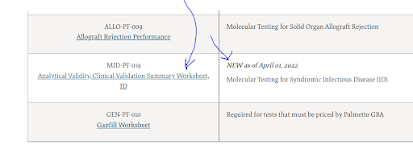
Now on April 1, 2022, we have the last major part of this policy event.  MolDx has published a detailed template, in Excel format, for infectious disease panel testing, with performance and quality criteria that must be meet.   Find it on the link, look under the section "MID-PF-019, Analytical & Clinical Validation Summary Worksheet for ID."    


For me the Excel link is here, but that could change over time.

Per email, MolDx confirmed to me the panel TA is required for 2 or more pathogens.  It is *not* required for strains of 1 pathogen (e.g. HSV-1 and HSV2- does not trigger the "panel" TA).  

Not that MolDx defines panel as 2 or more, including 2-5, but AMA CPT has several panel codes for the terminology "3-5 targets, 6-11 targets, 11-25 targets," so the MolDx species terminology and the AMA CPT wording might not line up.  I'll leave the details to MolDx and ID experts.


The format seems clear and shows MolDx's continual efforts to improve the clarity of its information 
requests, which also speeds the review time at MolDx itself.

Sections include:
  • General Test Information
  • Accuracy EP-9A2
    • I believe EP9A2 is a reference to a CLSI lab guideline document
  • Analytical Sensitivity EP17A2
  • Precision (Qualitative, Quantitative)  EP05A2, EP12A2
  • Minimum Input Quality MM09A2
  • Quality Controls and Management
  • Five extra questions, e.g. "Is antimicrobial sensitivity testing performed (AST?)"
  • List CPT/PLA code (or suggest crosswalk if N.A.)


Friday, April 1, 2022

Very Brief Blog: AMA Issues April 1 Newly Created PLA Codes

 AMA releases Proprietary Laboratory Analysis (PLA) codes quarterly, and the April 1 codes are out on time.

Find the PLA home page here.  Find the April new codes here.

There are 9 new codes released April 1.  (For comparison, 17 were released on December 30.)

Basically, AMA reports PLA codes in two places.  The first is in the annual codebook, for each calendar year.   Second, AMA keeps a rolling tally of NEW PLA codes, too new to be in the current printed book.  This appear in a PDF file that grows quarter by quarter, until it is cut down when a new annual codebook appears.

Next - AMA takes PLA applications due April 5, and will post them by mid-April for public comment, and finalize them at the May 2022 AMA CPT meeting.  Generally, those codes have always appeared in the June CMS crosswalk/gapfill meetings for pricing.


Wednesday, March 30, 2022

PMC Publishes Research Article on Pharmacogenetics Inventories; Notes on Medicare Coverage

What's Up?

There has been a boom in pharmacogenetics interest in the last several years.   The Personalized Medicine Coalition (PMC) has just published a deep dive into how two catalogs of useful pharmacogenetics genes, and gene-drug pairs, compare and differ.  

Concurrently, a UK report recommends wider use of PGx in the NHS health system (here).

________

Background

Shortly after the creation of gene-specific CPT codes in 2014, there was a huge boom in CYP gene testing in Medicare payments - the new codes generally had no controls or edits - followed by a huge fall in CYP payments as stringent LCDs appeared.  (The CMS data for CYP spending around 2013-2016 looks almost like a COVID wave and plummet).

In 2020, MolDx adopted a PGx LCD which covered gene-drug pairs endorsed by either of two authorities external to Medicare, being FDA or CPIC.  

My MolDx PGx blogs here, here.  In late 2021, the Novitas-FCSO MACs followed with a closely similar LCD, blog here.

PMC Publishes Paper, March 2022

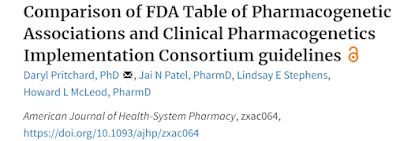
PMC has published a deep-dive paper comparing the two inventories references as gold standards by the LCDs, the FDA webpage for PGx genes and the CPIC website for consensus-driven PGx gene reviews. 

The paper is called, Comparison of FDA Table of Pharmacogenetic Associations and Clinical Pharmacogenetics Implementation Consortium guidelines, and appears in Amer J Health System Pharm this week.   

Find the new paper, open-access here.

PMC writes:

Study Finds Incongruities Between Drug-Gene Associations Listed in FDA’s Table of Pharmacogenetic Associations and Guidelines Published by Clinical Pharmacogenetics Implementation Consortium (CPIC)

Bridging Inconsistencies May Encourage More Widespread Utilization of Hallmark Personalized Medicine Tests

WASHINGTON (March 30, 2022) — A comparative analysis conducted by the Personalized Medicine Coalition and published today in the American Journal of Health-System Pharmacy reveals incongruities between the drug-gene interactions that appear in the U.S. Food and Drug Administration’s Table of Pharmacogenetic Associations and those that are referenced in widely consulted clinical guidelines published by the Clinical Pharmacogenetics Implementation Consortium (CPIC). The findings underline differing perspectives regarding the classification of certain gene-drug interactions that may deter clinicians from ordering pharmacogenetic (PGx) tests whose results would be difficult to interpret.

In comparing the drug-gene associations listed in FDA’s table with the guidelines published by CPIC, a team of authors including PMC Senior Vice President for Science Policy Daryl Pritchard, Ph.D., Atrium Health Cancer Pharmacology and Pharmacogenomics Chair Jai N. Patel, Pharm.D., PMC Program Manager Lindsay E. Stephens, and Intermountain Healthcare Executive Clinical Director of Precision Health Howard L. McLeod, Pharm.D., found that the same drug-gene associations and dosing implications were reported for only five of the 126 drugs that were listed by one or both sources. An additional 34 drugs were listed by both sources but with differing gene associations and dosing implications. The remaining 87 drugs were listed by only one of the two sources.

“This study reveals conflicting information regarding potential drug-gene interactions that undoubtedly cause confusion among health care providers, thereby slowing the integration of pharmacogenomics, one of the pillars of personalized medicine, into clinical care,” said PMC President Edward Abrahams.


British Recommendation: More PGx

See an open access article at Genomeweb about a British report 951pp) recommending more PGx in the UK.

https://www.genomeweb.com/policy-legislation/uk-report-urges-widespread-nhs-uptake-pharmacogenomics

Report online - 

https://www.bps.ac.uk/getmedia/b43a3dca-1bbf-4bff-9379-20bef9349a8c/Personalised-prescribing-full-report.pdf.aspx

Tuesday, March 29, 2022

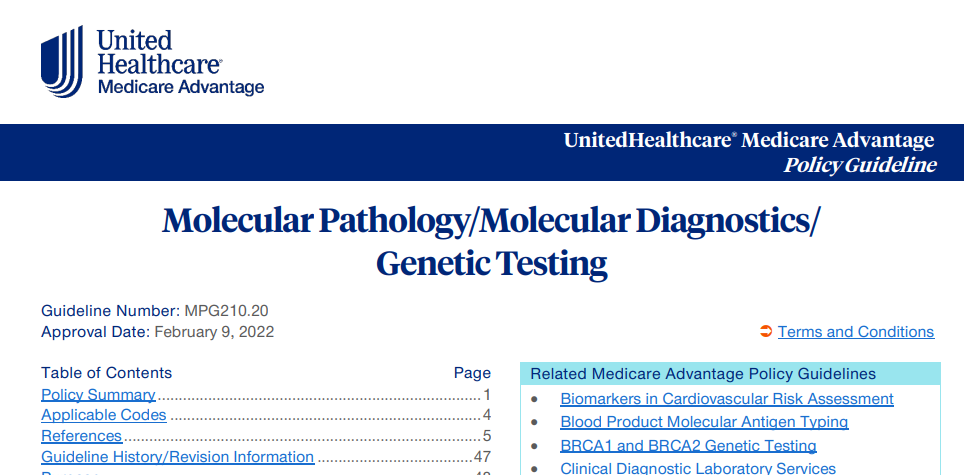
United Healthcare's 40-Page Guide to Medicare Molecular Policies; MolDx Definition of Algorithm

Worth knowing about.  For its Medicare Advantage plans, United Healthcare needs to follow Medicare policies, and for genomics, that's mostly local or LCD policies.

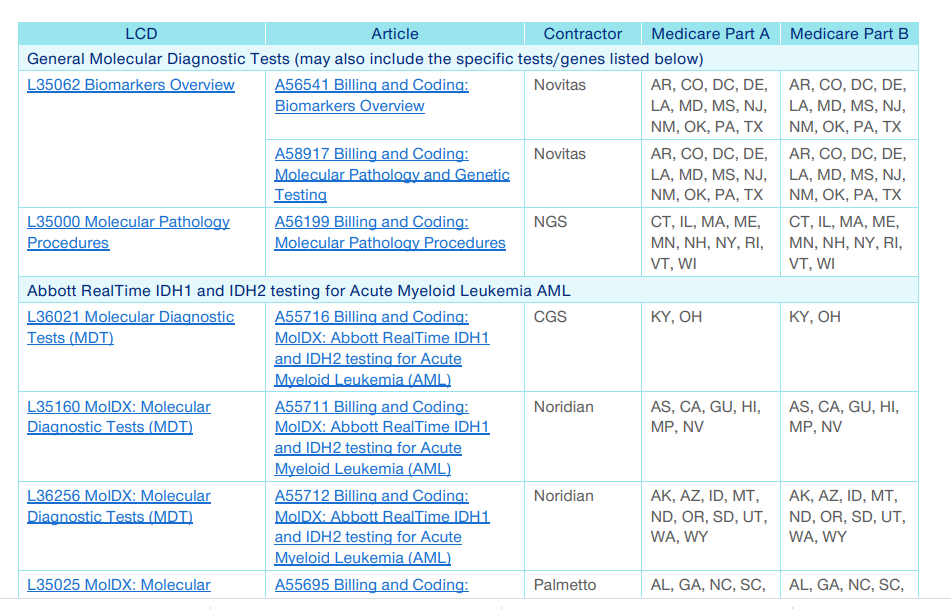
United Healthcare publishes a 49 page guide, updated regularly, of which pages 5-49 are an index to the numerous local LCDs and billing articles.   Handy to know about.

https://www.uhcprovider.com/content/dam/provider/docs/public/policies/medadv-guidelines/m/molecular-pathology-diagnostics-genetic-testing.pdf


MolDx Defines an Algorithm

One thing I've heard about but not sure I've seen directly, the MolDx definition of an "algorithm" in a lab test.  Find it for example at Article A58677.  From March 2021.

An algorithm being defined as....
_______

An algorithm may be considered a meaningful and independent component of a laboratory process when ALL the following conditions are met:

  • It is an unambiguous problem-solving operation that includes deploying a set of rules or calculations requiring computer processing;
  • The test result (or a component of the result) is the calculated output of this process, and not an intermediary process;
  • The same or similar test result could not be obtained without the use of this process;
  • The input for the computation is derived from biological samples using analytical processes, and must include data from the sample submitted for the test;
  • The process must:
    • Either be required for the analytical result, OR
    • If adjunct to the analytical result as a post-analytical process, the calculation itself must be independently found to be reasonable and necessary apart from the other components of the test.

Examples:

  • A gene expression profile test wherein sequencing data must be compared in a calculation to an existing and validated set of profiles to bin it in one of several possible risk stratification groups would require the use of an algorithm as defined above.
  • A next generation sequencing (NGS) test that uses computation to identify variants in a sample is not considered as using an algorithm in this context. The calculation in this scenario is seen as an intermediary process.
Calculations using only clinical information not derived from analytical services on biological samples are not considered algorithms in this context. 

Examples would include using the clinical information from the patient in a calculation to assess their risk stratification or using a similar process to identify relevant clinical annotations derived from literature as associations with sequencing variants.

A test that inputs resultant analytical processes that are reasonable and necessary (such as gene variants or protein markers) that are post processed by computation, but wherein that subsequent computation is not independently established as reasonable and necessary above and beyond the other lab components, shall not be considered an algorithm as a valid component of a laboratory test.

Brief Blog: OIG Issues Advisory Opinions on Clinical Trial Copays, Digital App Payments

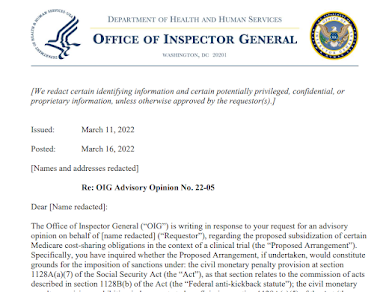
The HHS Office of the Inspector General regularly responds to request for Advisory Opinions (most frequently on endless scenarios for anti kickback regulations).   Sometimes, companies submit for an opinion on behavior of their competitor, hoping to get a negative opinion.   Some opinions are deadly dull; others treat odd topics in a surprising way.

HHS has a homepage for Advisory Opinions, or AO's, here.  There were 20 in 2021, and already 4 in 2022.  (There were only 9 in the 2020 election year and even less, 6, in 2019.)

AO-22-05 Cost Sharing in Trials

AO-22-05 is about a manufacturer subsidizing cost-sharing obligations in a clinical trial.  The context is Category B Investigational Device trials, which are paid by CMS (see webpage here.)   

Note that when Medicare itself does Coverage with Evidence Development, a little widget of statute allows CMS to vary the cost-sharing rules to ensure masking (treatment vs control, don't get different payments).  See my comment about SSA 1833(w) in an earlier blog here Text at footnote.

This AO, in contrast, is about the manufacturer and copays, not CMS itself and copays.  

In the case, the OIG found the scenario allowable, for example, because the trial enrollment was fixed, not open-ended (there would be exactly 260 patients with or without the copays), and the trial was a one-time surgical device (so there was no ongoing inducement to a patient.)

AO-22-04 Digital Apps, Payments to Patients

AO-22-04 handles "contingency management" rewards software used as part of addiction treatment software.   The patient using the software completes modules and may get a reward (e.g. Starbucks card).  Is this a kickback or inducement?  

The OIG ruled no, for several reasons, one of which was that the app provider did not itself directly bill the federal government.  

See also a recently introduced bill for FDA-approved digital medicine software, S 3791, HR 7051, here.


___

Text of 1833(w) re: patient copays in CMS-supported trials.

(w) Methods of payment.—The Secretary may develop alternative methods of payment for items and services provided under clinical trials and comparative effectiveness studies sponsored or supported by an agency of the Department of Health and Human Services, as determined by the Secretary, to those that would otherwise apply under this section, to the extent such alternative methods are necessary to preserve the scientific validity of such trials or studies, such as in the case where masking the identity of interventions from patients and investigators is necessary to comply with the particular trial or study design.

Monday, March 28, 2022

CMS Announcement for March 31 Webinar on Transitional Coverage for Emerging Devices

 CMS held a webinar on the theme, "Transitional Coverage for Emerging Devices," on February 17.   CMS will hold a second webinar on the same theme on Thursday,  March 31, at 3 pm ET (12 noon PT).

A February 17 transcript is here.

Note that CMS is consistently using "Transitional Coverage for Emerging Devices" or TCET as a brand name, or programmatic name, but it doesn't have any specific rules or content yet.   

For the next, March 31 webinar, here's the email invitation as I received it:

____________

CMS is hosting the second in a series of public meetings to obtain feedback to help inform CMS’ development of an alternative coverage pathway to provide transitional coverage for emerging technologies.  


These meetings are part of several steps CMS is taking to help better achieve the goals of timely and predictable Medicare coverage of devices while ensuring that Medicare covers items and services on the basis of scientifically sound clinical evidence and with appropriate safeguards.  


We appreciate all of the helpful stakeholder feedback we received during the first listening session on February 17. The transcript and recording for the February 17 meeting can be found here. The framework for the second listening session on March 31 at 3:00 PM ET  builds upon information gathered in the first session.  


During the March 31 listening session, we would appreciate receiving feedback on the following questions: 

  • Do stakeholders find CMS guidance on acceptable outcomes and durations of follow-up useful within specific therapeutic areas?
  • Engagement with CMS should occur after the results of pivotal clinical trials are available, but early enough to expedite coverage after FDA market authorization.  As we streamline the coverage review process, what is the appropriate timing of stakeholder engagement with CMS?
  • As we work to provide a more collaborative evidence development process, what are stakeholders thoughts on:
  • Should CMS provide early feedback on strengths and weaknesses of the available evidence based upon a preliminary systematic literature review?
  • Should manufacturers propose a fit-for-purpose evidence development plan to resolve any evidence gaps identified during the preliminary systematic literature review as part of the national coverage determination process? 
  • How should CMS approach evidence development requirements for similar devices that are FDA market authorized after a Coverage with Evidence Development decision is finalized? 


You can register for the March 31 listening session by following the link below. If you previously registered for the February 17 session, you do not need to register again to attend the second session on March 31. 


What: CMS Listening Sessions on Transitional Coverage for Emerging Technologies


When: March 31, 2022 3:00 - 4:30 PM ET.


Who should attend: This listening session series is designed for all Medicare and Healthcare Partners.


RSVP: https://cms.zoomgov.com/webinar/register/WN_gfZYH-txQu2kP4MZVbMSJw

Sunday, March 27, 2022

MedCityNews: IBM Dumps IBM WATSON, Gets "Salvage Value"

I wrote two blogs on AI in radiology and pathology so far in 2022, focused on very specific achievements (here, here).

Here's a story that didn't get the headlines it might have.  MedCity reports that "IBM is dumping" IBM WATSON, its much-touted, formerly much-hyped program, and "for salvage value," here.   See also a story at Quartz, "What Went Wrong?" here.   Similarly, NYT last summer here.  On the sale, some additional quotes and links here.

AI has to be approached carefully; see a current JAMA article discussing problems with the historical roll-out in the past decade of computer assisted detection in mammography - here.   

On the Other Hand

On the other hand - in focused domains, there are really interesting things going on.  

See an article on an AI-based improvement in measuring PDL1 and tumor infiltrating lymphocytes, here.  And see a MedCity article on digital pathology companies collaborating with major health centers toward focused goals, here.

___

Memory Lane

In 2010, GE bought Clarient, a specialty pathology lab, here.   One area of major investments by GE was "MultiOmyx" multi antigen slide staining (restaining) technology (here).  I don't think it ever went very far commercially, but, NeoGenomics does have a webpage about MultiOmyx here, and reported a number of 2021 abstracts.  WSJ labeled Clarient a $587M acquisition in 2010 (here).  The 2015 sale to NeoGenomics was reported at $275M.   However, it was also reported at the time that GE was retaining 32% of Clarient, suggesting the sale represented 68% of the market value.    As I was writing this, Neogenomics abruptly sank 30% on March 29, 2022 (here).

Friday, March 25, 2022

Cancer Cells in Culture: The Next Frontier in Clinical Diagnostics?

The idea of using cancer cells in culture to predict chemoresponse has been around for decades, literally back to the 1970s.   However, it's never thrived, and both Medicare and commercial insurers tend to have non coverage policies (see CMS NCD here, see ASCO here).  For Medicare nerds, there's even some colorful legal history online.

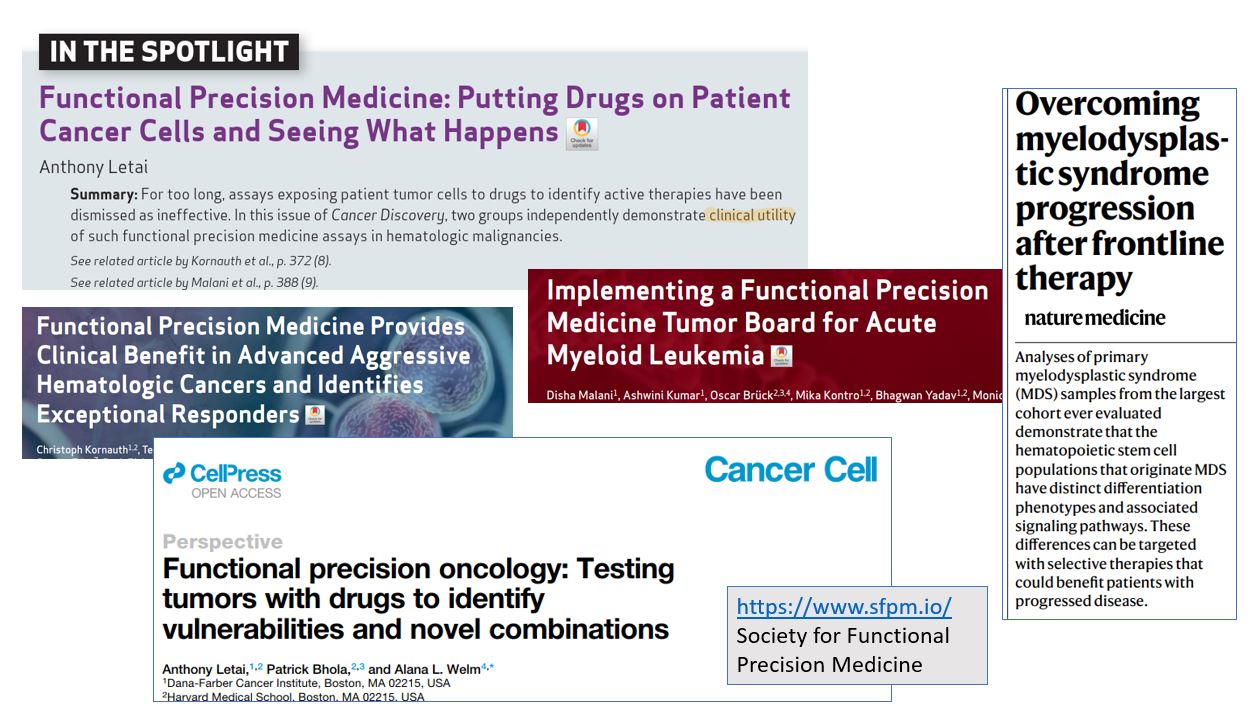
But this may change soon.   There's a groundswell of activity in functional cancer cell assays - of the patient's own cancer cells - to predict chemoresponse.  Publications are appearing rapidly and funding of new companies is active.

Here are some entry points:

  • For a thorough 2022 review and entry point, see Letai et al., "Functional precision oncology: Testing tumors with drugs to identify vulnerabilities and novel combinations."
    • At Cancer Cell here, and open access.
  • See two articles in the February 2022 issue of the AACR journal, Cancer Discovery:
    • Kornauth, "Functional precision medicine provides clinical benefit in advanced aggressive hematologic cancers and identifies exceptional responders."  Here.
    • Malani, "Implementing a functional precision medicine tumor board for AML."  Here.
      • See an Op Ed by Letai on the two articles here.
  • See a March 2022 article in Nature Medicine by Ganan-Gomez et al:
    • Galan-Gomez, "Stem cell architecture drives myelodysplastic syndrome progression and predicts response to venetoclax-based therapy."  Here.
    • This is paired with a news article here.
    • See also coverage of this report, in Precision Oncology News here.
There's also an active "Society for Functional Precision Medicine" now, here.  It's meeting in New Orleans in April.


Context: Conventional Genomic Medicine is Important, But Results Don't Always Help

Both the Cancer Cell review by Letai, and the Kornauth article (with detailed tables) discuss that broad studies of the population impact of conventional genomic panels often show fairly small results in the whole population, although big results for certain patients (e.g. for the 2% who are ALK fusion positive).  

This same point was made by Adashek et al. last year in Nature Cancer, "Missing the target in cancer therapy," 2:369, 2021.   These comprehensive tests are critically important to run, to find the positives, yet, 10% of patients may have Gene A, 5% have Gene B, 2% have Gene C, and it tails off from there.   

In the same vein, see a December 2021 article in Precision Oncology News, with San Antonio breast conference data, that in a clinical report, the lower-ranked genes or unranked genes (in a 300- or 400-gene panel) do not often contribute to improved survival.    

Potentially, functional assays can step in and fill the gap in finding the best therapy choices for the 50-70% of patients who don't have a clear cut gene-targeted drug, or in whom, their ideal gene-targeted drug just didn't work.  

____

Tidbit.  For those who missed it, see Turna Ray's 2021 year-in-review for precision oncology - January 2022, here.

Wednesday, March 23, 2022

Duke Margolis Center, Stanford Biodesign Co-Host Workshop on Medicare Coverage for Innovation

In 2020/2021, CMS proposed and finalized "Medicare Coverage for Innovative Technologies," MCIT, then canceled it.  Now in 2022, CMS is hosting "listening sessions" about programs for innovation under the title "Transitional Coverage for Innovative Technology," TCET.   

MCIT would have been based on FDA breakthrough device status.  "TCET" is just a title without specific rules or content yet.  

On March 28, 2022, Duke and Stanford will co-host a two-hour program, "The Need for Transitional Coverage for Emerging Technologies" from 9-11 pacific, 12-2 eastern.  This program brings together the Duke Margolis Health Policy Center and the Stanford Byers Center for Design.

Find the website here.   Find the agenda here.  Find the Zoom registration here.  Find the 9-page white paper "Discussion Guide" here.  In a nice collaborative touch, I noticed the agenda PDF is hosted at Duke.edu, while the Zoom link is hosted at Stanford.


More about MCIT/TCET:

  • CMS hosted a "listening session" on the yet-undefined idea of TCET in mid-February; I summarize it in a short video here.   
  • More recently, I tried to dollarize the value of MCIT, as it was proposed in 2021, and found that with simple assumptions it was highly value-creating, whereas with similar assumptions, Coverage with Evidence Development (CED) was value-destroying - blog and data here.
  • I just turned in galleys for an article covering my views on ways Medicare promotes or blocks innovation, which will appear in the journal Inside Precision Medicine (formerly Clinical Omics) in early April.
CMS March 31

The Duke webinar on March 28 precedes a second CMS-based listening session on TCET on March 31.

Sunday, March 20, 2022

Very Brief Blog: Is VALID Back with Momentum?

Update: March 25, 360DX runs an article on how laboratory and genetic experts are viewing the chance for a revived VALID bill: here.

March 20 Blog:

Usually I go further than just pointing to subscription articles, but here, there's one that is worth just pointing to.

On March 16, 2022,  360DX ran a detailed subscription article, by Adam Bonislawski, with the headline:


Recall that the VALID act has been kicking around for a number of years, and has been introduced in multiple versions - the "Verifying Accurate Leading-edge IVCT Development" Act.  For the most current legalese, see the House HR4128 version for 2021-2022 here.   The bill heavily edits existing FDA law, inserting or deleting clauses, which makes it particularly hard to read as a stand-alone document.

The new attention is that DC insiders seem to see momentum for attaching VALID Act to MDUFA, the five-year FDA funding authorization bill which must be past in 2022.    Proponents are happy; opponents like AACC say this is a very bad idea; and ACLA is quoted as saying it is taking this very seriously and looking at it very closely, and if it passes, hopes to input some key edits and improvements.   Most parties seem to agree that part of the political momentum is a January 2022 NYT lead article on NIPT testing, which is an LDT field, including parties that felt that article was an awful article.
____

See a 2021 paper on the cost of VALID Act for cancer labs (here; I'm a middle coauthor) and an article asking whether FDA lessons from the EUA rapid review experience might not benefit efforts like the VALID Act (here).  

As noted in the "update" top section, see also a March 25, 2022, article in 360DX on how ACMG and other genomics experts are viewing a revived VALID.

Bizarre Article: Medicare MACS Seek Repayment for "Stem Cell" Injections

This is one of the oddest stories I've seen in a year.  Since it likely involves a lot of litigation, I'll focus on what MedPageToday has reported.

In a March 16, 2022, open access article (registration might be required) MedPageToday writes, 

The article links to a WPS MAC recoupment articles, which announce retroactive claim denials and recoupments for certain HCPCS codes for injections of "manipulated and/or placental tissue biologics for injections."   Find the WPS MAC article here.

The MAC doesn't seem to list the HCPCS codes that are involved, which surprised me a little.  The MAC does cite a Medicare manual passage stating, "The A/B MAC (A), (B), or (HHH), or DME MAC will deny coverage for drugs and biologicals, which have not received final marketing approval by the FDA unless it receives instructions from CMS to the contrary."

The FDA periodically has published alerts to the public about "regenerative medicine products" such as "stem cells."  Here from 2020.

While the MAC doesn't cite HCPCS codes, the in depth MedPage article refers to at least one code, Q4206.  The approval of the HCPCS code is summarized at the CMS HCPCS meeting of May 13, 2019, which is in an online CMS PDF at page 11 (here).   Historically, Q codes were issued for specific Medicare program needs (such as to implement an NCD rapidly) and Q codes were issued quarterly at a time when other HCPCS codes were normally only issued annually.   

Coverage?

Possibly, the coverage could be related to the 21st Century Cures Act, which made it harder for MACs to create and revise LCDs.   Possibly, CMS told MACs to pay claims with legal codes unless (1) they had bandwidth to stop the claim for manual review by clinical staff, or (2) they had an LCD on it.  Lacking either, the codes may have autopaid at the time of submission.  Autopay is common, for example, codes for office visits, or appendectomies, generally autopay.  It sounds like these were "buy and bill" products, so the first line of recoupment is the doctor or clinic that billed Medicare, not the manufacturer.

I found an article A54117 describing coverage of Q4206 at Novitas MAC here.

Payments for the one code mentioned by MedPageToday, Q4206, were $19M in CY2020.  (Here.)  Around Summer 2022, CMS will release 2020 files of which doctors were paid for the code (and all other HCPCS and CPT codes).

Pricing?

I'm not sure how codes for stem cells etc would have been priced.  

CMS has a lot of Q codes in DME pricing files (e.g. here) and a lot of Q codes in ASP drug pricing files (e.g. here).   In the time available, using those 2 sources, I didn't find a published reference price schedule at CMS which would allow autopay of (for example) Q4206.

___

And the lesson is...

For startups that are working they tuckus off to get Breakthrough Approvals and other validations, and finding it dead-hard to get a single dollar from a MAC, they'll be mystified at how tens of millions of dollars allegedly flowed out this way, again, taking the MedPageToday article as the source.
 
____
Cloud copy of WPS article here
A54117 here.  A54117 linked to Novitas LCD L35041.


Friday, March 18, 2022

Nerd Note: March 9, 2022: CMS Updates ADUHELM Pricing

There has been extensive news pro and con the Alzheimer drug ADUHELM.  I noted an unexpected reference to ADUHELM pricing when I was looking up ASP pricing on other products.   I'll quote CMS in full; I don't claim to fully understand the inner details of ASP pricing rules.  This points up the complexity of the longstanding ASP pricing rules for injectable Part B drugs.

"WAMP" is "Widely Available Market Prices," see an OIG report here from 2012.

See a February 2022 notification from OIG to CMS, here.

Relatively complicated WAMP rules are online here, with a key section at (d)(3):

(3) Widely available market price and average manufacturer price. If the Inspector General finds that the average sales price exceeds the widely available market price or the average manufacturer price by the applicable threshold percentage specified in paragraph (d)(3)(iii) or (iv) of this section, the Inspector General is responsible for informing the Secretary (at such times as specified by the Secretary) and the payment amount for the drug or biological will be substituted subject to the following adjustments...[continues]


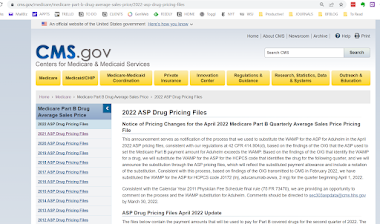
https://www.cms.gov/medicare/medicare-part-b-drug-average-sales-price/2022-asp-drug-pricing-files

2022 ASP Drug Pricing Files

Notice of Pricing Changes for the April 2022 Medicare Part B Quarterly Average Sales Price Pricing File

This announcement serves as notification of the process that we used to substitute the WAMP for the ASP for Aduhelm in the April 2022 ASP pricing files, consistent with our regulations at 42 CFR 414.904(d), based on the findings of the OIG that the ASP used to set the Medicare Part B payment amount for Aduhelm exceeds the WAMP.

 Based on the findings of the OIG that identify the WAMP for a drug, we will substitute the WAMP for the ASP for the HCPCS code that identifies the drug for the following quarter, and we will announce the substitution through the ASP pricing files, which will reflect the substituted payment allowance and include a notation of the substitution.

Consistent with this process, based on findings of the OIG transmitted to CMS in February 2022, we have substituted the WAMP for the ASP for HCPCS code J0172 (Inj, aducanumab-avwa, 2 mg) for the quarter beginning April 1, 2022.

Consistent with the Calendar Year 2011 Physician Fee Schedule final rule (75 FR 73470), we are providing an opportunity to comment on the process and the WAMP substitution for Aduhelm. Comments should be directed to sec303aspdata@cms.hhs.gov by March 30, 2022.


Jeopardy question - Answer, WAMP.   Question, "Alex, what is Medicare Widely Available Market Price?"